


In December 2025, two articles published in the Journal of the American Medical Association reinforced, from complementary angles, an already sobering finding: transgender and gender-diverse (TGD) youth bear a disproportionate burden of psychological distress. The first, by McArthur and colleagues in JAMA Pediatrics, is a systematic review with meta-analysis focusing on suicidality (ideation and attempts) and non-suicidal self-injury (NSSI). The second, by Bista and colleagues in JAMA Network Open, is an Australian cross-sectional study examining depression and anxiety at the very beginning of adolescence, based on a large school-based cohort. Taken together, they outline a plausible chain: environments that expose trans youth more frequently to stigma, bullying, and insecurity increase the risk of depressive and anxiety disorders, which in turn constitute a major breeding ground for suicidal ideation, self-harming behaviors, and suicide attempts.
McArthur and colleagues’ meta-analysis is striking first for its scope: 137 studies, 262 distinct samples, and 131,429 TGD youth (mean age 17 years, up to age 25). By aggregating available global data, the authors estimate pooled prevalences of 48.8% for suicidal ideation, 26.2% for suicide attempts, and 46.6% for NSSI. In other words, across the compiled studies, nearly one in two TGD youth report suicidal thoughts or non-suicidal self-injury, and about one in four report at least one suicide attempt. The review also highlights substantial variability depending on methodology (anonymous surveys tend to yield higher figures than interviews or medical records), indicating that these behaviors remain partially invisible in certain care contexts.
The article then details how these risks vary by age. For suicidal ideation, estimates increase with age: 37% among children (7-12 years), 47% among adolescents (13-17 years), and 58% among young adults (18-23 years). Suicide attempts follow a similar gradient: 16% among children, 26% among adolescents, and 29% among young adults. Non-suicidal self-injury is already very high in childhood within the included studies (47%), remains substantial in adolescence (45%), and reaches 51% among young adults. These figures do not point to an individual fragility that suddenly emerges at 15 or 17 years of age; rather, they describe a cumulative process over time – growing awareness of stigma, repeated experiences of rejection, barriers to care, and the broader social climate – that can transform initial distress into a chronic trajectory.
McArthur and colleagues also offer a very explicit comparison with cisgender youth. In their discussion, they recall benchmark figures for cisgender peers: 20.5% for suicidal ideation, 7.1% for suicide attempts, and 17.7% for NSSI, and conclude that the levels observed among TGD youth are 2 to 3.5 times higher. If this comparison is translated into risk ratios based on the figures cited in the article, it yields approximately 2.4 times higher rates of suicidal ideation (48.8% vs 20.5%), about 3.7 times higher rates of suicide attempts (26.2% vs 7.1%), and about 2.6 times higher rates of NSSI (46.6% vs 17.7%). In other words, the risk difference is not marginal: it is measured in multiples, not in isolated percentage points.
This is where the study by Bista and colleagues helps clarify the likely mechanism. Their work focuses on 6,388 Australian students aged around 13-14 years, recruited through 134 schools as part of the Future Proofing Study, with data collection waves between 2019 and 2022. This very early snapshot of adolescence already reveals a massive differential in internalizing disorders. In the overall sample, 15.1% report depressive symptoms at a clinical level and 14.6% report anxiety symptoms at a clinical level; among TGD adolescents, however, these proportions rise to 59.3% (clinical depression) and 48.8% (clinical anxiety), compared with 13.3% and 13.1% among cisgender adolescents. Even after adjustment for numerous factors (demographics, psychosocial variables, family, school), TGD status remains associated with high odds ratios: 5.68 for clinical-level depression and 3.49 for clinical-level anxiety (compared with cisgender peers). This signal is consistent with the idea that the excess suicidality described by McArthur and colleagues likely stems, at least in part, from an elevated risk of depression and anxiety – disorders that, in the general population, are among the most robust predictors of suicidal and self-harming behaviors.
Finally, the two articles converge on a point of action: prevention cannot be limited to crisis detection; it must transform contexts. McArthur and colleagues emphasize the value of regular screening in primary care, but above all the need to train healthcare providers in affirmative practices and to support inclusive policies. For their part, Bista and colleagues describe protective factors – family and peer support, a positive school climate, access to affirmative care and support – and conclude that strategies must address identity-specific stressors and contextual risks (bullying prevention, improving school climate, access to services). They stress the need for interventions “from the very beginning of adolescence” to reduce mental health inequalities. Overall, the message is clear: reducing depression, anxiety, and suicidality among trans youth is not a matter of issuing individual injunctions to “get better,” but of building affirmative environments – at home, at school, in healthcare, and in law – that reduce exposure to stigma and increase access to protective resources.
Within the affirmative environments recommended by the authors, what role should gender-affirming care play? While these two studies cannot assess the mental health impact of such care, other recent studies have examined the issue. This is the case, for example, with a recent study – summarized here by Trans Youth Trajectories – by Luke Allen and colleagues, which observed a decrease in suicidality after two years of hormone therapy in a sample of 432 trans adolescents. More broadly, the most recent literature review to date, published in October 2025 by Prokop and colleagues, concluded that hormone therapy may improve the mental health of trans adolescents. Regarding puberty blockers, the latest known literature review is that of the SIEDP, which recommends their use for trans adolescents who need them, on the grounds of their beneficial effects on mental health. These two bodies of findings align with very recent consensus clinical recommendations from the AWMF, the SFEDP, and the ESPE.
As for chest surgery (top surgery) in transmasculine minors, the practice is more debated. A recent study from the University of San Diego by Junye Ma and colleagues found that medically necessary surgical interventions and hormone therapy for trans youth were associated with lower depression and better gender congruence than hormone therapy alone or no medical care. However, a literature review by Anna Miroshnychenko and colleagues, funded by the SEGM – and widely cited in the U.S. HHS report – questions the quality of studies documenting the mental health benefits of these surgeries. It has prompted strong methodological criticisms, notably from Schechter and colleagues, Armstrong and colleagues, and Lane and colleagues. The central point of these critiques concerns the application of study appraisal tools to a field – plastic and reconstructive surgery – where randomized trials, strict control groups, or “intervention vs non-intervention” comparisons are rarely feasible, often unethical, and, importantly, not required for comparable surgeries performed in cisgender youth.
The excess suicidality observed among trans youth cannot be understood independently of the social, institutional, and medical conditions in which these young people live. Improving trans youth mental health above all requires making their environments safer and ensuring access to affirmative care grounded in the available evidence, but also in clinician consensus closest to real-world practice, and in the preferences and values of the people directly concerned.
Note: TYT’s scientific news articles are now written with the assistance of AI. Their content nonetheless relies on a systematic, full human reading of the studies reported, ensuring factual accuracy and allowing for independent editorial framing of the scientific news.
More news

The Netherlands strengthens its gender-affirming care model for trans minors
The evidence supports gender-affirming care
Read more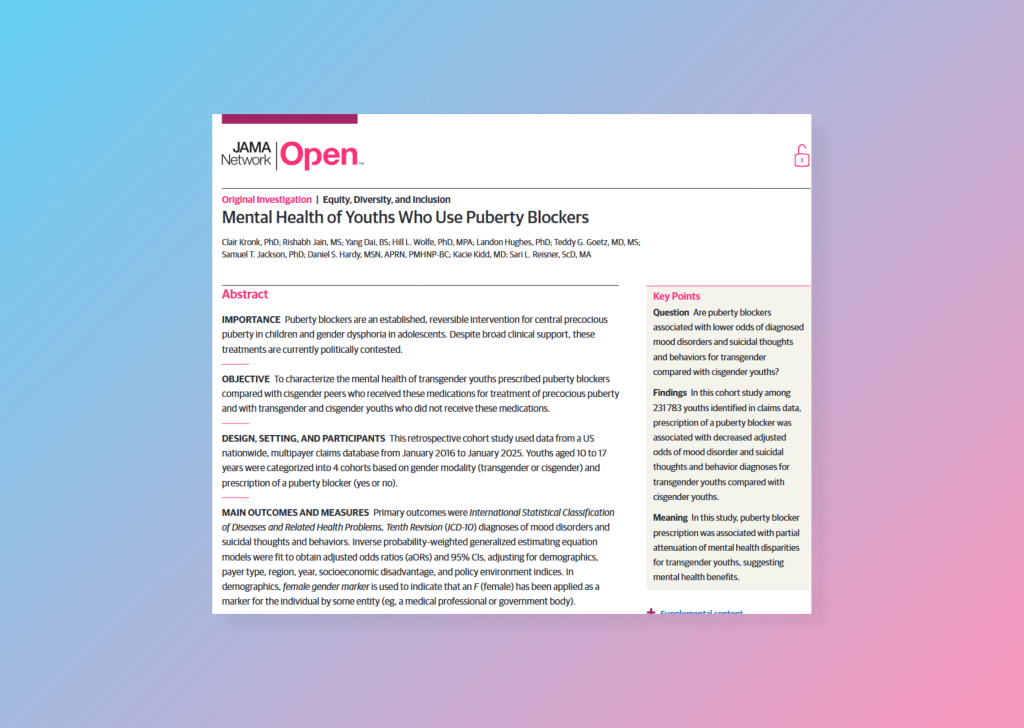
Puberty Blockers and Suicidality: New Study of 230,000 Youths
Lower Suicidality Among Transgender Youths
Read more
Without consent: the scientific misconduct scandal at Norway’s national centre for trans youth
Illegitimate research on trans minors
Read more
It Is False to Say That Medical Transitions Worsen Young People’s Mental Health
On the pseudoscientific exploitation of a study
Read more
Webinar “A Trans-Skeptical Parenthood” on July 2 at 6:30 p.m.
Trans Youth Trajectories webinar
Read more
2.2% of young people in France are trans or non-binary
Findings from a nationally representative survey
Read more