


A working group of the French Society of Pediatric Endocrinology and Diabetology has developed a consensus of experts made up of about 20 pediatric endocrinologists from 14 specialized teams in France and Switzerland.
The recommendations address ethical considerations related to gender-affirming care (puberty blockers and sex hormones) for trans adolescents. The experts emphasize the need to balance the young person’s best interests and their autonomy, while taking into account the complexity of hormonal treatments and their long-term effects, which remain poorly documented. Recent studies show that trans adolescents often reflect extensively on these treatments, understand their effects and risks, and are competent to make an informed decision. Moreover, rates of detransition remain low, around 1 % to 6 % depending on the studies.
According to specialists, even if no severe risks are known, evaluation of medical and psychological effects should continue in the long term. In any new treatment, especially in pediatrics, long-term knowledge is lacking — but this does not mean that treatment should be withheld. Indeed, a wait-and-see approach has been shown to be ineffective in reducing psychological distress, and is associated with increased suicide attempts and altered psycho-affective and cognitive development.
Practitioners are advised to provide clear, appropriate and comprehensive information on the proposed treatments, including how they work, expected effects, potential risks, and whether effects are reversible or not. This information should be communicated before prescribing to allow sufficient reflection time, with adapted supports to facilitate understanding. The young person and their legal representatives must be informed of their freedom to stop treatment at any time without affecting their medical follow-up. Healthcare professionals ensure that consent is free and informed, consulting other professionals if necessary. Written and understandable consent is required for each hormonal treatment discussed in multidisciplinary collegial discussion.
The care approach is affirmative, as recommended by the World Health Organization and major health societies, recognising and supporting the young person’s gender identity and addressing psychological, social, and medical aspects of wellbeing in an integrated way. This approach aims to respond respectfully and holistically to young people’s needs, enabling them to affirm their gender identity. A multiprofessional support structure is recommended, involving specialists in mental health, pediatric endocrinology, fertility, and other professionals such as peer-support workers, legal experts, and social workers. This care network should collaborate with local resources to provide adapted support close to where the young person lives.
Experts recommend that every therapeutic decision (puberty blockers, hormones) should always be preceded by a collegial discussion within a multidisciplinary team, particularly when it concerns young people under the age of 16. The experts specify: “The minimal quorum for these meetings consists of at least one pediatrician specialized in endocrinology and one child psychiatrist who both will not necessarily be in charge of all the cases presented, but whose role will be to provide a specialized opinion when necessary. The case will be presented by at least one of the professionals accompanying the adolescent. Depending on local possibilities and the needs of the situations presented, other members of the team or care network may also participate, respecting medical confidentiality, as well as any person whose expertise can enlighten the discussions, including peer support groups. In light of local logistical capabilities, particularly in terms of medical confidentiality, we advise offering the young person concerned the opportunity to be present or represented during discussions about their situation.”
With regard to puberty blockers, they are indicated from the onset of puberty for young people who have a persistent gender incongruence associated with expressed distress related to the development of secondary sex characteristics. Suppressing puberty provides an opportunity to continue exploring gender identity while alleviating the distress that pubertal progression would cause. It also makes it possible to avoid certain potential future surgeries or to make them less invasive. Regarding long-term adverse effects, data accumulated over 40 years from their use in cases of precocious puberty are reassuring. Effects on mental health are beneficial or non-detrimental, depending on the studies. Puberty blockers do not impair academic performance or executive functioning. Fertility develops normally after discontinuation of blockers. Bone mineralization requires particular monitoring because of the treatment’s effect on it (which is reversible later with pubertal induction), especially since bone density in transgender youth is already low even without treatment, possibly due to dysphoria (low physical activity, eating disorders, etc.). Calcium and vitamin D supplementation is recommended, as is regular physical activity.
Sex hormones, for their part, are indicated in the presence of a confirmed gender incongruence and for young people who demonstrate a sufficient level of emotional and cognitive maturity to provide informed consent to treatment. The experts specify: “The duration of gender incongruence, medical follow-up history, persistence of transition requests, psychological distress, and the individual’s maturity level should be considered when determining the optimal timing for introducing gender-affirming hormone therapy.” The experts note a lack of knowledge regarding the long-term impact of gender-affirming hormones on fertility, despite numerous cases of pregnancy among trans men who have discontinued testosterone. The use of estrogens appears to be less favorable for future fertility prospects than the use of testosterone. In all cases, gaps or partial knowledge justify recommending a fertility preservation consultation.
The publication of these first French recommendations on supporting trans adolescents comes as two other sets of recommendations are being developed: the European pediatric endocrinology recommendations and the French Haute Autorité de Santé guidelines for those aged 16 and up.
For access to the French version of the SFEDP recommendations, click here.
For access to the English version, click here.
More news

The Netherlands strengthens its gender-affirming care model for trans minors
The evidence supports gender-affirming care
Read more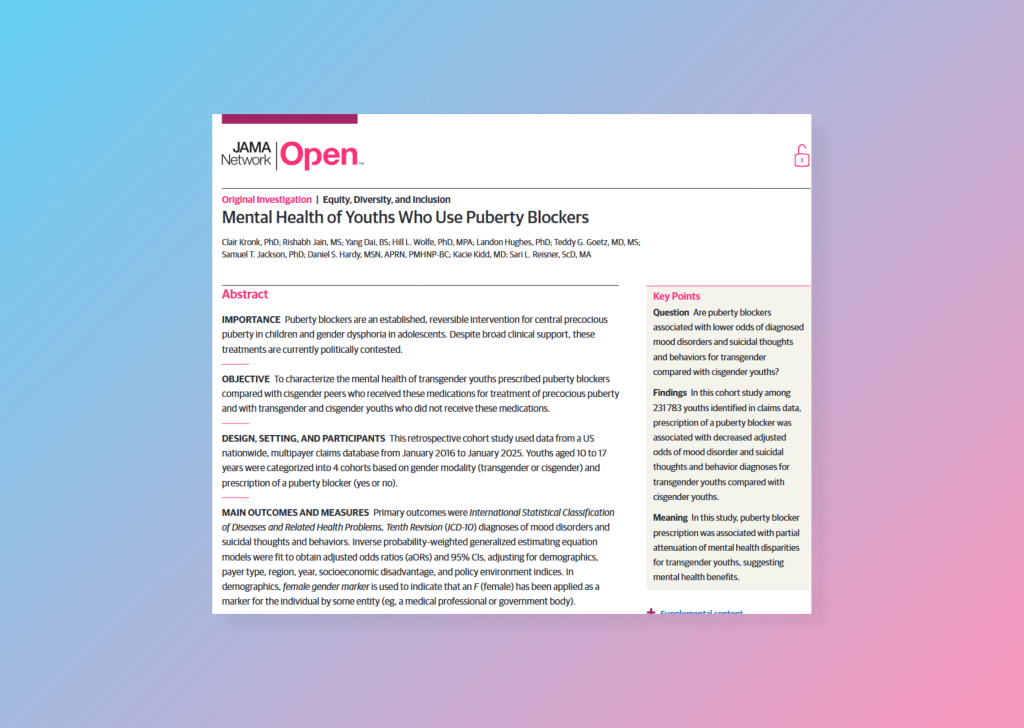
Puberty Blockers and Suicidality: New Study of 230,000 Youths
Lower Suicidality Among Transgender Youths
Read more
Without consent: the scientific misconduct scandal at Norway’s national centre for trans youth
Illegitimate research on trans minors
Read more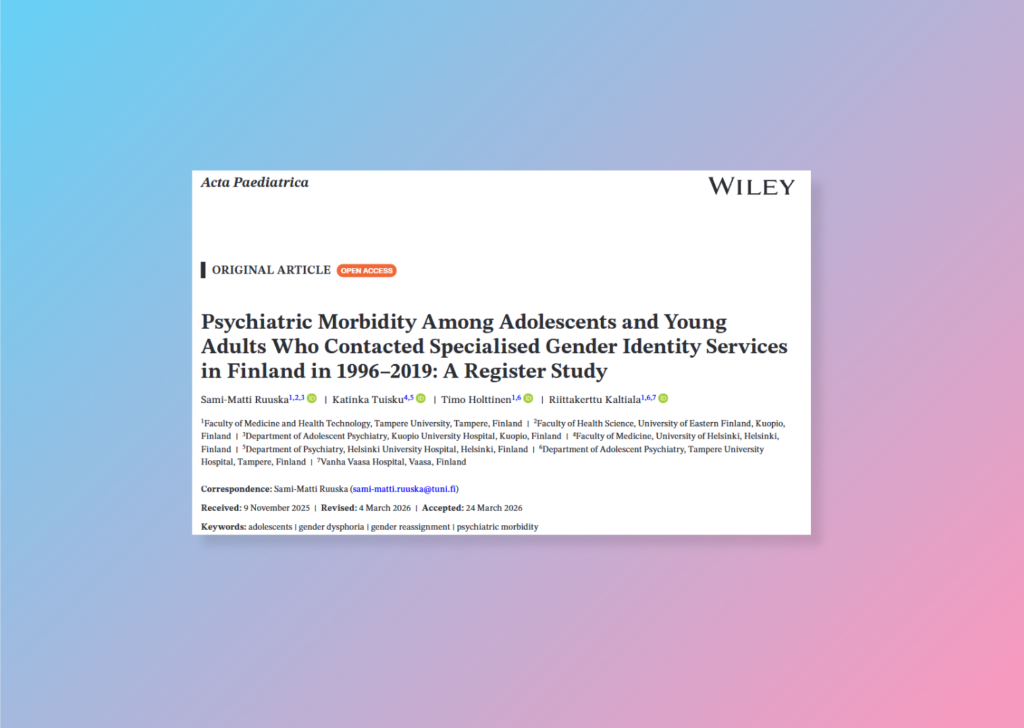
It Is False to Say That Medical Transitions Worsen Young People’s Mental Health
On the pseudoscientific exploitation of a study
Read more
Webinar “A Trans-Skeptical Parenthood” on July 2 at 6:30 p.m.
Trans Youth Trajectories webinar
Read more
2.2% of young people in France are trans or non-binary
Findings from a nationally representative survey
Read more