



In Norway, five university researchers have been found responsible for scientific misconduct committed through gross negligence in research involving trans minors whose consent had not been obtained. Among those implicated are Anne Wæhre and Trond H. Diseth, senior clinicians in the national paediatric gender incongruence service. Norway’s leading trans patient organisation has accused the service of exercising monopolistic and transphobic control over access to care.
The case
The case originated in the examination of four publications based on the medical records of trans patients treated by Norway’s national service. What had initially been presented as a routine internal quality-assurance exercise gradually emerged as a body of research conducted without consent, without prior ethical approval, and with anonymisation safeguards deemed insufficient. The matter therefore moved beyond a methodological controversy to become a major research-integrity case, attracting extensive coverage in the national press.
In June 2026, the joint research integrity committee of the University of Oslo, Oslo University Hospital and Akershus University Hospital issued a unanimous opinion on four publications produced by Norway’s National Treatment Service for Gender Incongruence (NBTK). Its review also concerned five co-authors employed by Oslo University Hospital: Anne Wæhre and Trond H. Diseth, senior physicians in the NBTK’s paediatric unit; Kjersti Gulbrandsen, head of its adult unit; and Cecilie Bjertness Nyquist and Linda W. David, both PhD candidates.
The decisive point in the 146-page report, which we were able to consult, concerns the classification of this work. The researchers presented it as an internal “quality assurance” exercise intended to assess the service’s performance. The committee concluded instead that it constituted research.
This conclusion is essential because it makes the ordinary safeguards governing medical research applicable. The use of health data should have been subject to prior ethical approval, patient consent or a formal exemption from the duty of confidentiality, together with sufficiently robust anonymisation safeguards. Their absence was therefore not merely an administrative irregularity. For two of the publications, the committee found that it amounted to a serious breach of research standards, committed through gross negligence, and therefore to scientific misconduct.
Two publications recommended for retraction, two others under scrutiny
The two articles recommended for retraction concern children and adolescents referred to the national centre. The first, published in European Child & Adolescent Psychiatry, examines trends in referrals to the NBTK over two decades, the demographic characteristics of the young people concerned, and their mental health. The second, published in Acta Paediatrica, describes their treatment pathways.
The committee did not find, on the evidence then available, that the other two articles under review, by Sundhagen et al. (2023, 2024), involved scientific misconduct, although it also identified significant shortcomings in both. It recommended that Oslo University Hospital consult the Regional Committees for Medical and Health Research Ethics (REK) for a formal assessment of whether the articles constituted health research. Depending on that assessment, the question of scientific misconduct and possible retraction could also be considered.
A complaint brought by PKI and David R. Banos
The case began with a complaint submitted to the committee by representatives of PKI, the Norwegian Patient Organisation for Gender Incongruence, together with David R. Banos, a professor of statistics at the University of Oslo. The complaint concerned four publications on gender incongruence among children, adolescents and adults.
The complainants alleged that the research teams had used information from medical records and registries without prior approval from REK, without patient consent, without an exemption from the duty of confidentiality, and with insufficient anonymisation, in some cases creating a risk of re-identification. These allegations formed the core of the committee’s review.
David R. Banos’s involvement initially concerned the statistical methods used to describe trends in referrals to the NBTK. Scrutiny of those analyses then led the complainants to question the project’s status and the ethical approvals on which the publications relied. A methodological controversy thus developed into a research integrity case.
The “quality assurance” defence rejected
The researchers concerned argued that the data had been used for hospital quality assurance, intended to assess and improve care within the service, rather than as part of a research project. The committee concluded instead that the publications produced new and generalisable knowledge, appeared in international scientific journals, and formed part of doctoral projects. It therefore rejected the researchers’ defence.
NEM, the Norwegian National Committee for Medical and Health Research Ethics, subsequently confirmed this analysis for the two paediatric articles. It found that the project fell within the scope of Norway’s Health Research Act because it used scientific methods to produce new knowledge from sensitive data concerning minors.
What consequences have the five researchers faced?
For the five researchers employed by Oslo University Hospital, particularly Anne Wæhre, the senior author of the two publications recommended for retraction, the publicly established consequences are, at this stage, primarily scientific and reputational. The committee attributed collective responsibility to them for scientific misconduct committed through gross negligence in connection with the two articles concerning minors. In addition, the joint research integrity committee of the Norwegian Institute of Public Health (NIPH) is investigating the roles of the other three co-authors employed by NIPH. Its findings could ultimately increase the number of researchers found responsible for scientific misconduct from five to eight.
Following NEM’s decision, Oslo University Hospital acknowledged that the “quality assurance” classification had been incorrect, apologised to patients and the organisations concerned, and announced that the two articles would be retracted. The decisions, however, imposed neither dismissal nor suspension from clinical duties, nor did they prohibit the researchers from conducting further research. To date, no individual professional sanction of this kind has been made public.
Beyond these articles, a crisis of trust
The report does not settle all the criticisms directed at the NBTK. For several years, PKI has accused the service of exercising monopolistic, discriminatory and transphobic control over trans people’s access to care, particularly that of minors, and has directly implicated the centre in the practice of conversion therapy.
The committee’s conclusion gives new weight to this crisis of trust. It shows that data entrusted to the service in the course of care were turned into research material without the required safeguards, within the very service that occupies a central position in Norway’s care system. The case now raises broader questions: how did the initial statistical analyses lead to the discovery of these breaches? To what extent do the committee’s findings support PKI’s criticisms? What consequences should the NBTK, Oslo University Hospital and the journals concerned draw from them?
Our interview with David R. Banos
Trans Youth Trajectories explores these questions in an interview with David R. Banos, one of the authors of the complaint. We ask him about the statistical anomalies that first raised suspicions and about how a methodological controversy became a research integrity investigation. The interview also considers what further steps he believes are needed regarding the publications, the data used, the individuals implicated, and the future organisation of care and research concerning trans minors in Norway.
Trans Youth Trajectories: Could you explain the analyses described in the publications at issue, and what you saw as their fundamental weaknesses?
David Banos: The first thing that caught our attention was a graph projecting further increases in referrals. It extended an observed trend into the future without identifying a convincing mechanism that would make that trend continue. This is an unjustified extrapolation fallacy in statistics: the fact that a curve has risen does not mean that it will keep rising. When later figures became available, referrals had in fact fallen substantially.
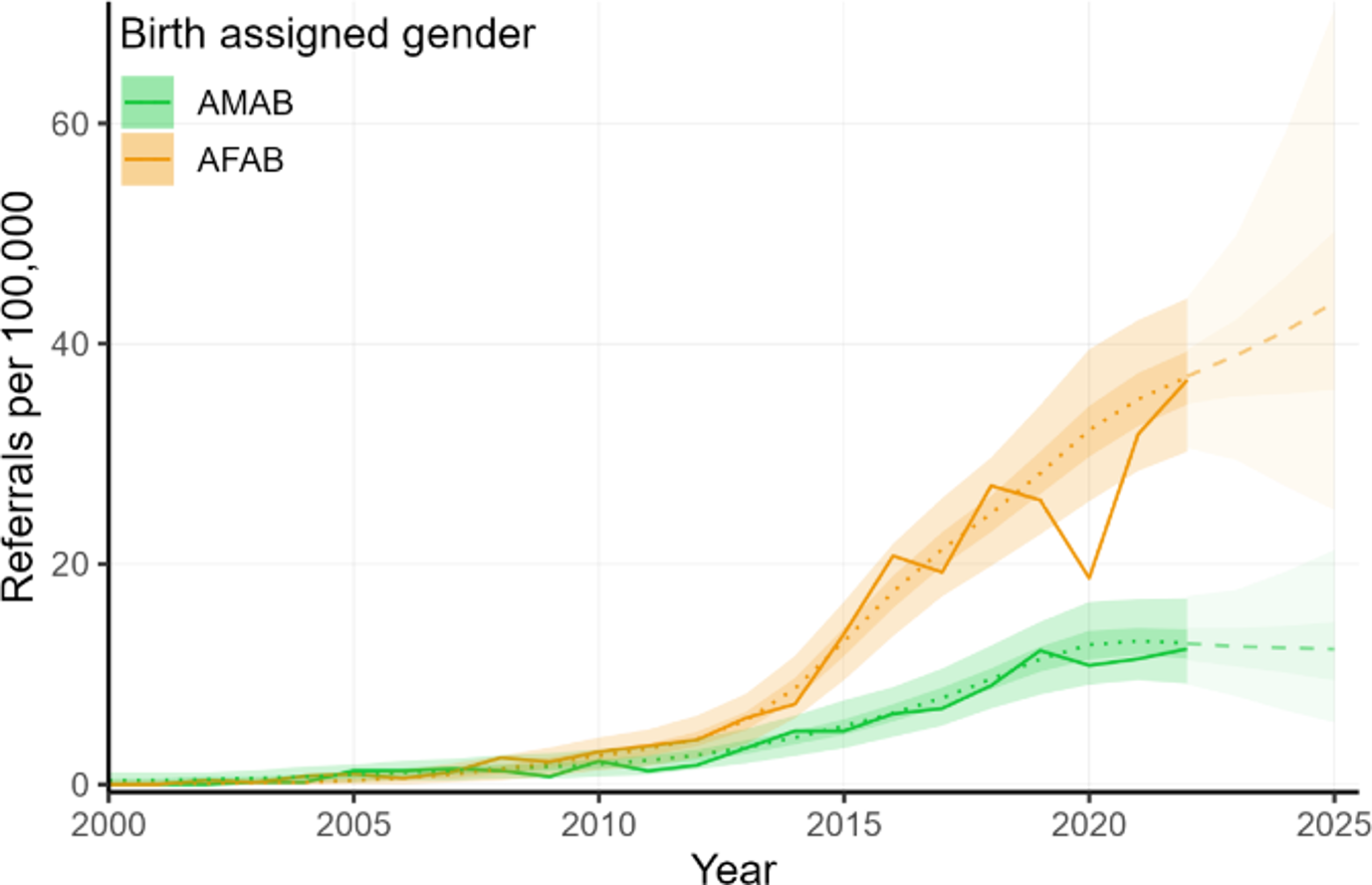
Figure 2 from Nyquist et al. Population-adjusted numbers, demographics and mental health among children and adolescents referred to the Norwegian National Center for Gender Incongruence over two decades. Eur Child Adolesc Psychiatry 34, 647–657 (2025)
The model also treated the lower numbers during the pandemic as an artificial dip and then projected forwards from the subsequent rebound. That risked interpreting a one-off post-pandemic catch-up effect as a lasting increase. There were several other statistical concerns, including overdispersion in the binomial modelling and very considerable uncertainty in the forecasts.
A separate concern involved the analyses of psychiatric diagnoses. Referral patterns are shaped not only by individual characteristics, but also by referral practices, access to services, clinical capacity and social conditions. Moreover, this sample came from a psychiatry-led referral system, which creates substantial selection and confounding effects. Unless those limitations and the purpose of the analysis are made explicit, psychiatric diagnoses, when used as covariates, can be interpreted as explaining gender incongruence itself.
That is both a statistical and an ethical problem. ICD-11 [of the World Health Organization] deliberately places gender incongruence outside the chapter on mental disorders. Mental-health difficulties among trans young people must be studied, but they should not be used to imply that being trans is a symptom of psychiatric illness.
These are only examples. It was while examining these methodological problems that we began asking how such sensitive data had been obtained and discovered that the required ethical safeguards were also missing.
TYT: How was the circumvention of consent and ethical approval underlying these publications uncovered?
DB: The basic rule is not obscure: health research in Norway requires an appropriate legal and ethical basis. We read the relevant legislation carefully. We could not reconcile those rules with the use of these sensitive patient data without consent or ethical approval, and we therefore submitted a formal complaint to the Research Integrity Committee. At the same time, the patient organization (PKI) told us that several members had discovered that hospital staff and PhD students had accessed their medical records under the label “research” around 2022 and that the hospital replied it was “internal quality assurance”. In Norway, patients can see who has accessed their records, even on their phones. That was when we realized we were witnessing a serious breach of research ethics.
In its initial assessment, the committee found that the researchers had acted negligently and had breached fundamental rules they should have known. It nevertheless stopped short of finding scientific misconduct, partly because the researchers had consulted the hospital’s Data Protection Officer, which the committee treated as a mitigating factor and because it assumed that the researchers had acted ‘through lack of knowledge’.
After that decision, we found three additional publications and, more importantly, documents showing that attempts to obtain permission for non-consensual use of the records had repeatedly been refused, culminating in a final decision by NEM, Norway’s highest medical research ethics body. On 26 April 2020, NEM stated:
“NEM has nevertheless concluded that protecting the individual’s personal integrity and right to self-determination is of such importance for this patient group that no exemption from the consent requirement can be granted. The application seeks access to medical records containing highly sensitive information. The information was provided at a time when the patient was particularly vulnerable, in the firm belief that it was protected by a duty of confidentiality. NEM therefore finds that using this sensitive information for research without obtaining consent would violate the individual’s personal integrity and right to self-determination.”
Excerpt from NEM decision 2020/61, dated 26 April 2020 (our translation).
NEM concluded that using these sensitive records for research without consent would violate the patients’ integrity and right to self-determination.
What we discovered next was difficult to comprehend. On 14 May 2020 – only eighteen days after that decision – the researchers established what they described as an “internal registry”, GIRCA, and began retrospectively extracting information from patient records under the label of quality assurance.
Through FOI [Freedom of Information] requests, we obtained documents from the project rejected by NEM. They showed that a substantial part of it corresponded to what was later published by Nyquist and colleagues in the European Child & Adolescent Psychiatry article. The record reviews were also performed by PhD researchers without treatment responsibility, while the work was described elsewhere as research and presented in EPATH 2025.
Calling an activity “quality assurance” does not create an unrestricted right to access patient records. There must still be a lawful, necessary and service-related reason for accessing each patient’s information – particularly when the people concerned left the service many years earlier.
With this additional evidence and, among other factual reasons, the committee unanimously concluded that the conduct had been grossly negligent and constituted scientific misconduct. It also found that data from an older, consent-based research registry approved by the Norwegian Data Protection Authority had been incorporated into the non-consent-based GIRCA registry.
We also uncovered further serious matters about the authenticity of the permits and protocols to create GIRCA that were outside the committee’s assessment. In our repertoire of several FOI requests, we obtained up to five different versions of the permit from the Data Protection Officer to create GIRCA. To date, we still do not know which one is supposed to be the original. Their content varied in length, expiry date, number of variables collected and purpose. The case is now being considered by the Norwegian Health Authorities.
Finally, the other two publications among the four examined were not cleared unconditionally. The committee considered them research but requested a formal ethical assessment from the relevant body. Its conclusion applied, in its own words, “as the case stands now”. Depending on that assessment, those publications may also require correction or retraction.
TYT: Does the conclusion confirm all the criticisms of the NBTK?
DB: Partly. The committee examined specific publications and specific breaches of research ethics; it did not investigate every criticism that trans organisations have made of the NBTK, naturally.
In my opinion, the committee worked professionally. It did not take a position in the wider political or clinical debate about trans healthcare, as it should be. That is important, because its conclusion cannot simply be dismissed as one side of a contested debate: this was purely and entirely a research ethics scandal on a vulnerable group.
At the same time, I do not believe these breaches arose in isolation. In my view, they reflect a deeper institutional problem: decades of monopolistic power, insufficient independent scrutiny and repeated patient complaints that have not produced any change at all.
Hundreds of complaints over the last years. Patient-experience hospital polls were exceptionally poor; on one measure on patient trust, the result was around twenty times worse than the hospital average. Overall NBTK scores the worst by far among the 51 departments at the National Hospital (Rikshospitalet). The leader of the adult Gender Identity ward who had faced years of serious criticism nevertheless remained in charge and has now been found responsible for scientific misconduct. It is reasonable to ask how such warning signs could be disregarded for so long.
When an institution repeatedly receives serious complaints without visible consequences, a culture of impunity can develop. People may begin to act as though ordinary rules do not apply to them. In my view, that is connected to the service’s longstanding paternalistic and monopolistic approach – an approach in which trans identities have too often been viewed through the language of pathology rather than through the experiences and needs of trans people themselves.
TYT: How can institutions repair the breach of trust with patients from a vulnerable population whose medical data were used without their consent?
DB: Repairing trust is conceptually simple, although it requires genuine will and action: acknowledge what happened, accept responsibility, listen to those who were harmed and make structural changes. An apology without accountability will not be enough.
Unfortunately, the hospital’s response during the investigation deepened the breach of trust. The former research director and the head of the clinic declined to meet with the patient organisation, investigate the case, including concerns about possible document falsification, or notify the relevant bodies or temporarily suspend the research. The Joint Committee criticised the hospital’s handling. The current acting research director has, after the committees and NEM’s conclusion, acknowledged the failures and apologised, which is a welcome and important first step.
However, Rikshospitalet, when it comes to trans health, has a history that must be confronted honestly. Patients have described degrading assessments connected with the SOBER European collaboration. Until 2016, Norwegian state practice also made castration a condition for changing legal gender which the hospital enforced as part of the medical assessment. Many of those affected have said that they experienced this as coercion and have repeatedly asked for an apology.
Now some of those same patients have discovered that people within the same institution accessed their most intimate medical information and used it for research without their consent – research interpreted through a psychiatric and potentially pathologising lens. It is difficult to express what that must feel like.
The integrity committee did not examine this wider historical context, but the hospital’s management should. I would ask its leaders to demonstrate empathy and accountability and ask themselves: would they have let it go so far, had it been a different vulnerable group?
In my view, NBTK should close down and be replaced by a genuinely decentralized and depathologized model. Both its history and its current conduct speak for themselves. When several members of a service’s leadership are implicated and trust has deteriorated over decades, retaining the same structure, people and monopoly cannot credibly represent change.
Norway already has regional centres with relevant competence. They should assume responsibility for care. Decentralization was already planned in 2016 by an expert committee in connection with the elaboration of the new Gender Recognition Act in Norway. Ten years later, we see no change. Gender incongruence should not be governed by old-fashioned monopolistic psychiatric assumptions about how people ought to understand or express their gender.
For the sake of decency and justice, trans people must have a real alternative to Rikshospitalet: care based on their needs, self-determination, the principles of Standards of Care Version 8 [of the WPATH] and a fully depathologised approach. Healthcare exists to help people live healthier and more fulfilling lives – not to make them conform to the expectations of a conservative part of society. At least, they should be given the chance to choose a real alternative based on these values.
More news

The Netherlands strengthens its gender-affirming care model for trans minors
The evidence supports gender-affirming care
Read more
Puberty Blockers and Suicidality: New Study of 230,000 Youths
Lower Suicidality Among Transgender Youths
Read moreWithout consent: the scientific misconduct scandal at Norway’s national centre for trans youth
Illegitimate research on trans minors
Read more
It Is False to Say That Medical Transitions Worsen Young People’s Mental Health
On the pseudoscientific exploitation of a study
Read more
Webinar “A Trans-Skeptical Parenthood” on July 2 at 6:30 p.m.
Trans Youth Trajectories webinar
Read more
2.2% of young people in France are trans or non-binary
Findings from a nationally representative survey
Read more