


Following the publication of a study on the origins of TYT, summarized on our website, Nicolas Sallée, a sociologist, turns in a very recent article published, with Florence Giguère-Diaz, in Actes de la recherche en sciences sociales to the parents described as “trans-sceptical” of trans children, whether those children are minors or young adults.
The article is situated in a context of intense political and clinical controversy surrounding the gender transition of minors, which has intensified since the early 2010s with the rise in the number of adolescents and young adults followed in transition-related care pathways, particularly among people assigned female at birth. In a previous news article, we discussed the likely cause of this predominance of transmasculine adolescents, namely transmisogyny, which prevents transfeminine adolescents from coming out and transitioning in proportions comparable to those of transmasculine adolescents.
The authors of the present study examine how some parents, far from adopting an outright or conservative rejection, construct an opposition to their child’s transition in the name of an imperative of protection. This “trans-sceptical parenting” is analyzed as a specific form of parental paternalism, rooted in relations of age and filiation, which brings together clinical knowledge, feminist references, and everyday experiences of parenting.
The investigation is based on qualitative material collected in France from nine families who are members of a parents’ collective opposed to the gender transition of minors, referred to as “collective B.” The interviews mainly involve mothers from the middle and upper classes, with high levels of cultural capital, who often claim a progressive or feminist background. The authors show that these parents are not external to contemporary norms of “concerted education,” but that they come to suspend some of its principles when the trans question emerges, perceived as a threat to family equilibrium and to the child themself.
The first stage of these trans-sceptical trajectories lies in a re-reading of the child’s coming out. When the child is an adolescent, the announcement of a trans identity is frequently described as brutal, unexpected, and emotionally destabilizing. Cynthia, the mother of Sam, aged 16, thus recounts the moment of the disclosure: “And then she says to me: ‘I need to tell you something, I don’t feel good in my body, I’d like you to do like the Scouts do, to call me like a boy and to call me by my new name’” (Cynthia, p. 98). She then describes her own shock and the way she regains control of the situation by immediately redirecting her child’s words toward the existing therapeutic follow-up.
These parental accounts tend to disqualify the desire to transition by framing it within a developmental interpretation of adolescent distress. Cynthia thus explains that Sam would have a gap between chronological age and psychological maturity: “she’s going to be 17, but she has the mental age of a 12-year-old” (Cynthia, p. 98). This insistence on “immaturity” allows parents to morally justify their opposition by claiming to act in the child’s future best interest, assuming that the child will later come to recognize “the wisdom of the restrictions” imposed.
The presumed suddenness of the desire to transition constitutes another central element of this re-reading. Christine recalls the coming out of Noé, who was 15 at the time, during what she considered a trivial moment, and concludes with a phrase that is both affectionate and infantilizing: “We’ll talk about it again, kiddo” (Christine, p. 98). Estelle, for her part, contrasts Charlie’s coming out with recent memories of gender conformity, stating: “a year before her coming out, she was in a bikini on the beach flirting with guys” (Estelle, p. 98). These accounts produce a coherent narrative in which trans identity appears as an inexplicable rupture, and therefore a suspicious one.
The parents interviewed also appropriate contested clinical knowledge to support their position. Several explicitly mobilize the hypothesis of “rapid-onset gender dysphoria,” popularized by Lisa Littman, and associate their child’s trans identity with the influence of social media. Mara thus describes what she perceives as online endangerment: “She was subscribed to channels where trans people were cutting off their breasts, staging themselves after surgery” (Mara, p. 99), before concluding with “the online recruitment of children who are a bit, a bit lost, because they are adolescents” (Mara, p. 99). These statements convey a vision of the child as vulnerable, malleable, and exposed to influences deemed harmful.
Another pillar of trans-sceptical parenting lies in an essentialist conception of sex, often articulated through what is described as “radical” feminism. Christine expresses her refusal to recognize her child’s claimed gender without equivocation: “At some point, biology! That’s the foundation… She can dress up like a guy all she wants, she’s a woman. End of story” (Christine, p. 99). This type of discourse opposes the fixity of biological sex to what is presented as an ideological confusion between sex and gender, attributed to a form of “transactivism” perceived as dangerous.
The feminism mobilized by some mothers is presented as distinct from religious or reactionary conservatism. It is grounded in a revalorization of women’s condition and in the denunciation of the structural oppression of women. Estelle thus explains that her child’s desire to transition would be rooted in a rejection of the female condition: “We haven’t valued being a woman enough… I have breasts, I breastfed, and those were wonderful moments. It creates career inequalities and that’s awful, but breastfeeding my children were magical moments… I didn’t say that enough to my daughters” (Estelle, p. 100). From this perspective, opposing transition means protecting not only the child, but also the social category “women,” conceived as being under threat of dilution.
When children reach legal adulthood, parental authority – which until then had constituted a central lever of trans-sceptical parenting – becomes legally null. This loss of power profoundly transforms family relationships, particularly when children nevertheless embark on transition-related steps. Parents then describe an acute sense of dispossession, compounded by the collapse of the hope they had placed in their child’s eventual renunciation. Whereas during minority opposition could still be framed within a temporality of waiting – that of a future return to reason – entry into adulthood brings this possibility to a close. The authors show that this shift is accompanied by an intense emotional experience, marked by anger, sadness, and resentment, as well as by a hardening of representations of trans identity.
This hardening is expressed in particular through discourses marked by disgust and the monstrification of trans trajectories. Mara, referring to the content her daughter viewed online, thus speaks of “just horrible stuff, to the point that I watched two or three things and then I… I didn’t want to watch anymore, because it was unbearable. Unbearable!” (Mara, p. 99). The lexical choices, the emphasis on horror and unbearable excess, convey a visceral reaction of rejection, in which trans bodies are perceived as reaching a threshold of moral and sensory tolerability. Far from being anecdotal, this register of disgust contributes to the retrospective justification of parental opposition: what provokes disgust cannot be recognized as legitimate, let alone as desirable for one’s child.
In conclusion, the article sheds light on a form of trans-sceptical parenting that is socially situated, intellectually resourced, and emotionally invested, and that cannot be reduced to ignorance of the issue. By analyzing these trajectories as “parental careers,” Sallée and Giguère-Diaz show how parents learn to oppose their child’s transition by combining protection, authority, and the production of knowledge, albeit at the cost of enduring conflicts and sometimes irreversible ruptures in family ties.
Click here to access the study.
Note: TYT’s science news articles are now written and translated with the assistance of AI. Their content nevertheless relies on a systematic, full human reading of the studies discussed, ensuring the accuracy of the information and allowing the TYT team to freely contextualize and editorialize current research.
More news

The Netherlands strengthens its gender-affirming care model for trans minors
The evidence supports gender-affirming care
Read more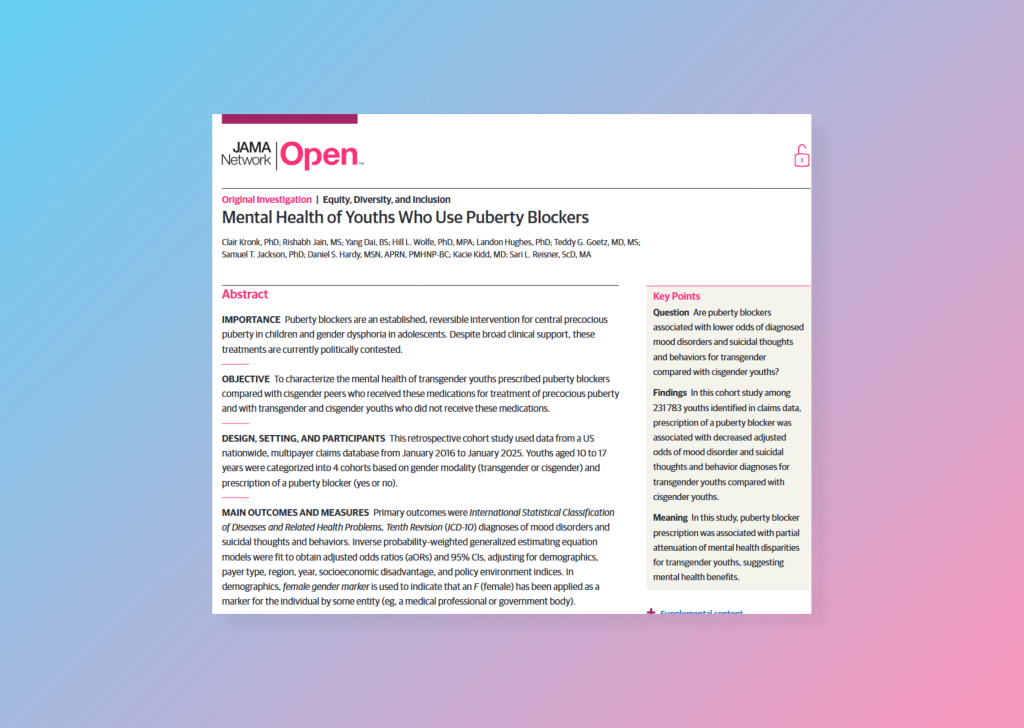
Puberty Blockers and Suicidality: New Study of 230,000 Youths
Lower Suicidality Among Transgender Youths
Read more
Without consent: the scientific misconduct scandal at Norway’s national centre for trans youth
Illegitimate research on trans minors
Read more
It Is False to Say That Medical Transitions Worsen Young People’s Mental Health
On the pseudoscientific exploitation of a study
Read more
Webinar “A Trans-Skeptical Parenthood” on July 2 at 6:30 p.m.
Trans Youth Trajectories webinar
Read more
2.2% of young people in France are trans or non-binary
Findings from a nationally representative survey
Read more