


A report by the United States Department of Health and Human Services (HHS), published on 1 May 2025, presents itself as a scientific review of the “effectiveness and safety” of gender-affirming care for trans minors. Commissioned by the White House under Presidential Executive Order No. 14187, it claims to provide an evidence base to guide public health policy. In reality, as shown by two independent analyses published recently (Rider et al., 2025; Dowshen et al., 2025), it is less a scientific exercise than a political document aimed at delegitimising an established medical practice.
A political, not scientific, mandate
The report falls within the framework of Presidential Executive Order No. 14187, signed on 28 January 2025 by Donald J. Trump and entitled “Protecting Children from Chemical and Surgical Mutilation.” This text, available on the official White House website, states:
“Across the country today, medical professionals are maiming and sterilizing a growing number of impressionable children under the radical and false claim that adults can change a child’s sex through a series of irreversible medical interventions.”
The order further states that “it is the policy of the United States that it will not fund, sponsor, promote, assist, or support the so-called ‘transition’ of a child from one sex to another.” It therefore instructs the HHS: “The Secretary of HHS shall, consistent with applicable law, take all appropriate actions to end the chemical and surgical mutilation of children.”
These passages show that the mission entrusted to the HHS was not aimed at a neutral evaluation of the scientific literature, but at constructing an argument to justify the withdrawal of federal funding for gender-affirming care for people under the age of 19 (all categorised as “children”). The order moreover uses morally charged terms (“mutilation,” “sterilisation,” “false claim”) rather than language drawn from the scientific literature, thereby placing the discussion on an ideological rather than a medical footing.
Budgetary instrumentalisation
Since September 2025, this orientation has extended into budget negotiations surrounding the House HHS Appropriations Bill. As revealed by journalist Erin Reed, the Republican draft bill funding the Department of Health includes a clause prohibiting any federal funding for “social, psychological, behavioral, or medical intervention to treat gender dysphoria.”
This clause – described as a poison pill – is intended to make the budget bill unacceptable to Democrats, to the point of triggering a shutdown (budgetary paralysis), by tying the continuation of health programme funding to a ban on gender-affirming care.
An official statement published on the White House website illustrates this rhetorical framing, accusing Democratic lawmakers of being “the party of open borders, violent crime, and transgender for everybody.” This combination of budgetary threats and stigmatising language places the issue of trans health within a financial and moral power struggle, in which access to care becomes a variable of political negotiation.
Critiques by Rider et al. (2025): methodological shortcomings and political bias
Rider and co-authors argue that the HHS report “was not peer-reviewed, and its authors were not identified.” These shortcomings run counter to the minimum standards of a systematic review. The authors also emphasise that “most paediatric care relies on evidence of a quality and robustness comparable to that supporting gender-affirming medical care.” The HHS’s demand for randomised controlled trials is, more broadly, methodologically unrealistic in paediatrics. This double standard therefore reflects an intention to selectively discredit the literature favourable to gender-affirming care, in order to pursue the policy initiated by Presidential Executive Order No. 14187.
Critiques by Dowshen et al. (2025): lack of rigour and misinterpretation
Dowshen and colleagues note that “more than 20 % of the references in the HHS report come from mainstream news articles, blogs, or social media posts,” and conclude that “such citations fall well below the minimum level of evidentiary credibility generally expected of a scientific review.” The authors highlight several interpretive distortions: the report foregrounds “two deaths by suicide” in a cohort of 315 treated trans youth, while omitting that the same study documents a significant improvement in depression, anxiety, and overall well-being after two years of hormone therapy. They further add that the HHS “lists hypothetical risks without providing any evidence,” even though “gender-affirming treatments have been used safely and effectively for decades to treat cisgender youth with precocious puberty.”
A biased use of “quality of evidence”
Both commentaries converge on a central point: the HHS misused the concept of quality of evidence to legitimise an ideological rejection. Dowshen and colleagues note that “the HHS report uses the technical concept of ‘quality of evidence’ to justify rejecting gender-affirming care, while at the same time acknowledging that no data support the alternative it promotes – psychotherapy alone.”
Safety, benefits, and clinical ethics
Both articles challenge the alarmist presentation of risks: the HHS report “provides no evidence that puberty-blocking medications and hormone therapy are harmful.” On the contrary, they recall that these treatments have been used for decades with low rates of adverse effects and well-established clinical effectiveness. Rider and colleagues also point out that longitudinal studies show reductions in depressive and suicidal symptoms, as well as improvements in quality of life – elements absent from the report. From an ethical standpoint, both teams invoke the principle of non-maleficence: refusing or interrupting treatments that have been validated exposes the young people concerned to an increased risk of distress and suicide.
A political instrument under the guise of science
In conclusion, Dowshen and colleagues denounce “a dangerous intrusion of politics into medicine.” The HHS report follows in practical continuity with the stance of its Secretary, Robert F. Kennedy Jr., who has stated that he intends to “make the proof” in order to retroactively justify a political decision. Written in just 90 days, this anonymous report contains conclusions that appear to have been drafted in advance. These elements indicate that the HHS report is neither a neutral review nor a methodological contribution to research on gender-affirming care. Rather, it more closely resembles a tool designed to legitimise a policy of exclusion, developed in a climate of budgetary and ideological tension. Its content—widely discredited by the scientific community—forms part of a strategy aimed at dislodging trans-affirming medicine from the domain of clinical science and relegating it to that of moral and partisan debate. For researchers and clinicians, this case should serve as a major warning: it demonstrates how governmental institutions can instrumentalise the rhetoric of scientific rigour to justify normative rollbacks. For trans youth and their families, it concretely signifies an increased risk of denial of care and institutional stigmatisation.
And for the scientific community, a fundamental question arises: how far can we allow science to become the alibi of a political power that uses it to restrict human rights rather than to improve public health?
This article was translated from French into English using artificial intelligence tools.
More news

The Netherlands strengthens its gender-affirming care model for trans minors
The evidence supports gender-affirming care
Read more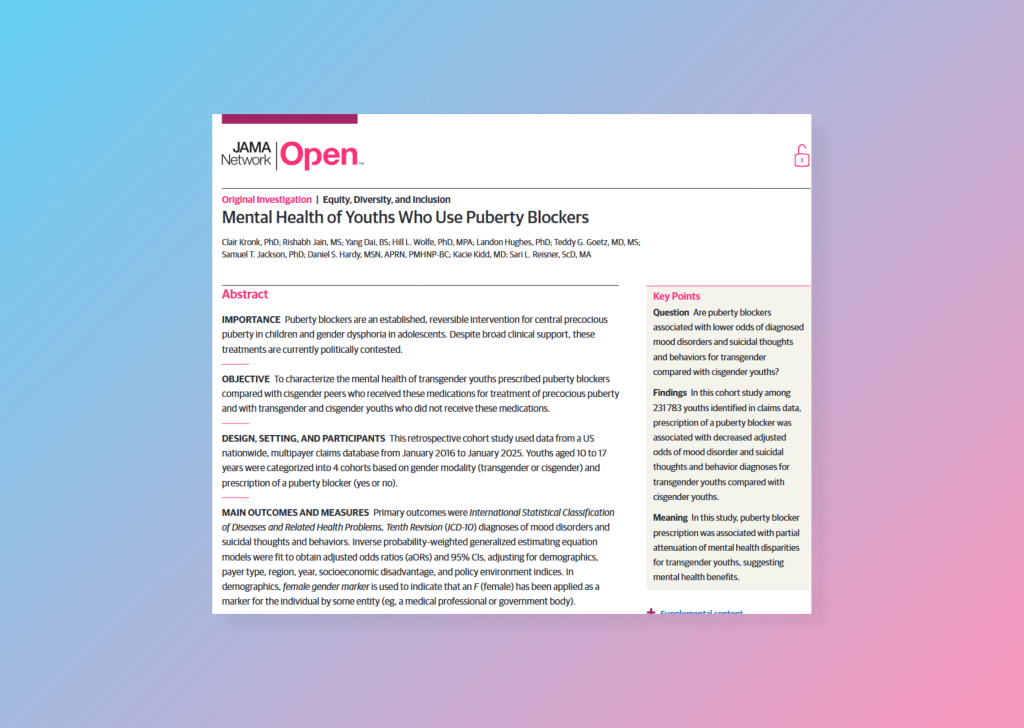
Puberty Blockers and Suicidality: New Study of 230,000 Youths
Lower Suicidality Among Transgender Youths
Read more
Without consent: the scientific misconduct scandal at Norway’s national centre for trans youth
Illegitimate research on trans minors
Read more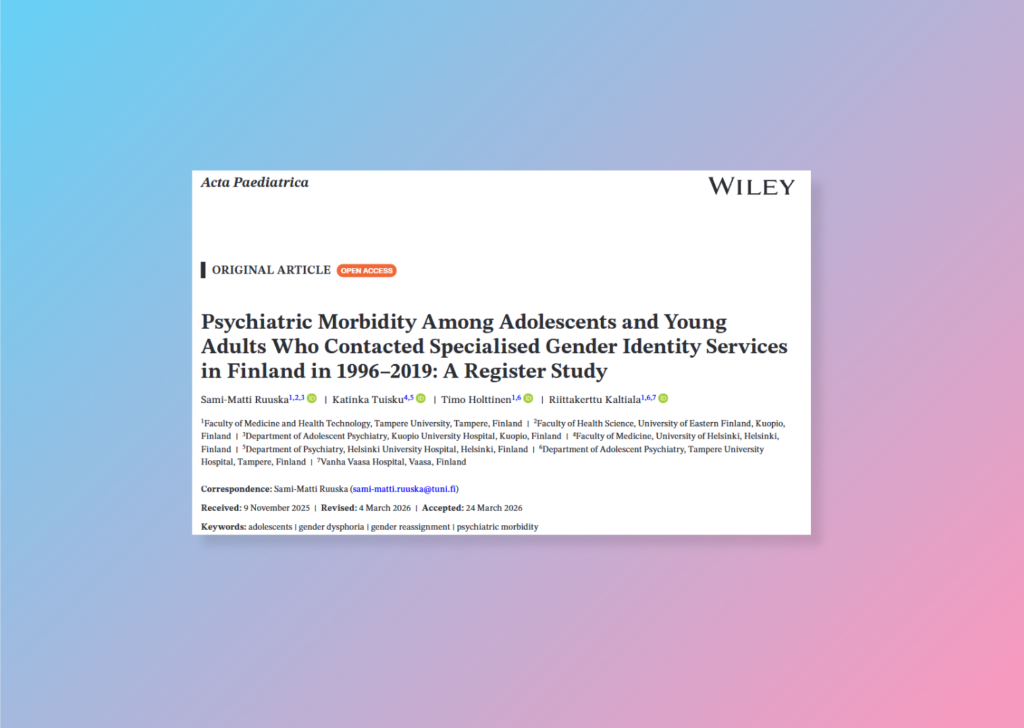
It Is False to Say That Medical Transitions Worsen Young People’s Mental Health
On the pseudoscientific exploitation of a study
Read more
Webinar “A Trans-Skeptical Parenthood” on July 2 at 6:30 p.m.
Trans Youth Trajectories webinar
Read more
2.2% of young people in France are trans or non-binary
Findings from a nationally representative survey
Read more