


A retrospective study conducted by Luke Allen and his colleagues, recently accepted by the Journal of Pediatrics, provides expanded data on a sensitive topic: changes in suicidality among trans adolescents after the initiation of gender-affirming hormone therapy. By analyzing 432 medical records from a specialized pediatric clinic in the U.S. Midwest, the researchers observed a statistically significant reduction in suicidal thoughts and behaviors between the initial assessment and a mean follow-up of nearly two years. This cohort, much larger than the one studied by the same team in 2019, confirms a signal previously identified on a smaller scale: an association between access to hormones and improvement in a critical mental health indicator.
Regarding the study protocol, included adolescents were between 12.7 and 20.2 years old and had all received at least three months of hormone treatment, whether testosterone, estrogens, or combinations including anti-androgens or progestins. Suicidality was assessed at two time points using the ASQ, a standardized four-question screening tool. Certain institutional modifications to this tool required manual review of medical records to harmonize the data, a step the authors describe in detail to ensure comparability of results. Statistical analyses, based on a repeated-measures ANCOVA, included adjustments for age and treatment duration and met standard validity criteria.
The results are clear: mean suicidality scores declined significantly between treatment initiation and follow-up, with an effect size indicating a clinically meaningful benefit. The proportion of youth showing no suicidal indicators increased from 78.7% to 92.6%, while documented recent suicide attempts decreased from 3% to 0.46%. This improvement did not vary according to age at treatment initiation or sex assigned at birth, and appeared relatively independent of the duration of hormone exposure, suggesting a rapid or threshold effect rather than a cumulative one. Over the observed period, only 7 adolescents (1.6%) discontinued hormones, including 4 (0.9%) for reasons related to gender retransition (while remaining within the spectrum of gender diversity).
The study emphasizes that individual trajectories remain heterogeneous: a minority of young people show increased scores, which the authors interpret as an expected phenomenon in any adolescent psychological follow-up rather than a negative effect attributable to the hormones themselves. Adolescents who had previously received pubertal suppression present lower baseline suicidality, mechanically limiting the magnitude of possible improvements in this subgroup, though this discussion remains exploratory. The authors note that suicidality is influenced by a plurality of factors – family support, social stability, psychiatric comorbidities – which the study design does not allow to be fully disentangled.
A central point of the article is that hormone therapy is not delivered in isolation. It is embedded within a gender-affirming care ecosystem that combines psychological support, social interventions, endocrinological follow-up, and, more broadly, a secure medical framework. The observed benefits may be explained by this combination of elements, which reduce dysphoria, strengthen social recognition, and mitigate minority stress factors known to increase suicide risk. In other words, the observed effect may reflect an integrated care pathway rather than the impact of a medication taken in isolation.
The authors do not downplay the limitations: the absence of a randomized control group, the limited demographic diversity of the cohort, and the difficulty of generalizing the findings to less specialized clinical settings. They also remind readers that somatic risks do exist – erythrocytosis with testosterone, thromboembolic risks with estrogens, fertility-related issues – but that these risks are well known, monitored, and manageable. Despite these caveats, the study strengthens a body of converging evidence: within a structured clinical setting, access to hormones is associated with a measurable reduction in suicidality among trans adolescents. It thus helps to inform a highly charged scientific and political debate by adding another layer of evidence drawn from real-world clinical practice.
More news

The Netherlands strengthens its gender-affirming care model for trans minors
The evidence supports gender-affirming care
Read more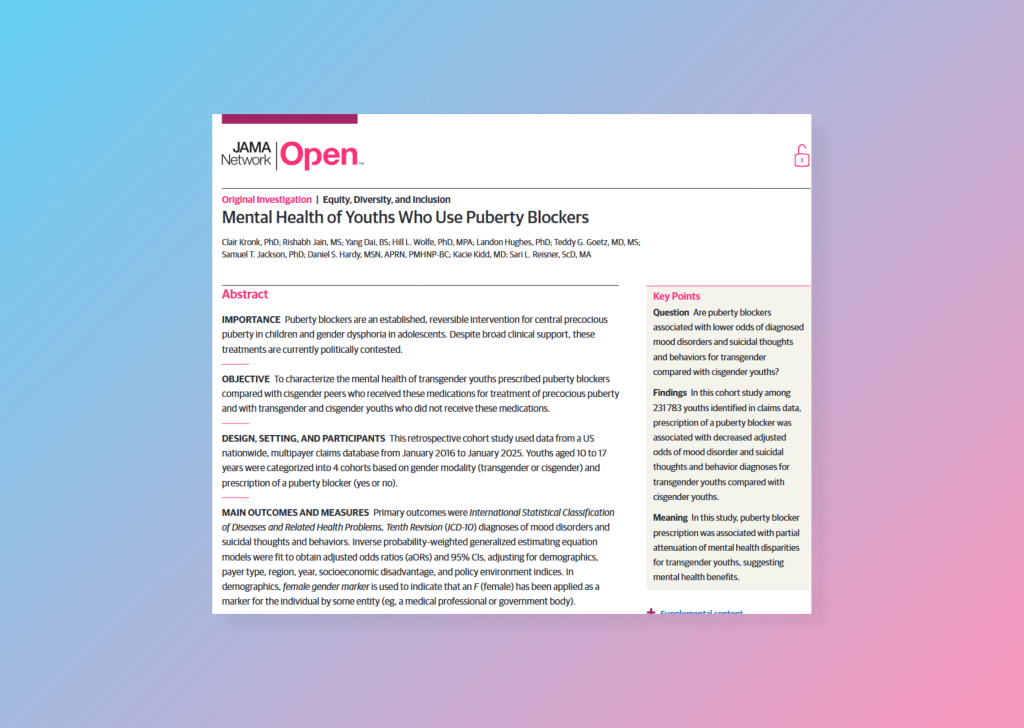
Puberty Blockers and Suicidality: New Study of 230,000 Youths
Lower Suicidality Among Transgender Youths
Read more
Without consent: the scientific misconduct scandal at Norway’s national centre for trans youth
Illegitimate research on trans minors
Read more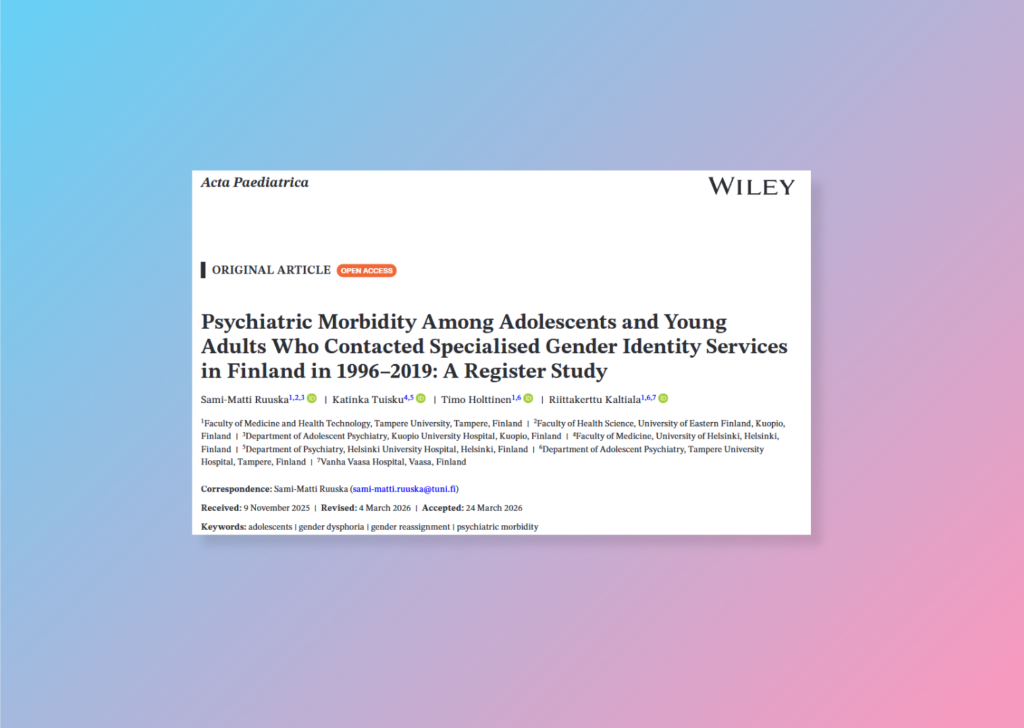
It Is False to Say That Medical Transitions Worsen Young People’s Mental Health
On the pseudoscientific exploitation of a study
Read more
Webinar “A Trans-Skeptical Parenthood” on July 2 at 6:30 p.m.
Trans Youth Trajectories webinar
Read more
2.2% of young people in France are trans or non-binary
Findings from a nationally representative survey
Read more