


A few days after the publication of the first French professional recommendations on gender-affirming hormonal care for trans adolescents, the European Society for Paediatric Endocrinology (ESPE) published the first professional European recommendations on this subject, developed by a group of experts that includes Professor Laetitia Martinerie, a member of TYT.
The text recommends that the initiation of the diagnostic or evaluation process be carried out by a mental health professional embedded within a multidisciplinary team. The involvement of a mental health professional is justified in particular by the need to build a perspective on psychosocial, cognitive, and emotional development, while also being able to detect and address frequently co-occurring mental health needs (anxiety, depression, self-harm, suicidality, autism, etc.).
However, a diagnosis of gender incongruence does not imply that gender-affirming hormonal care is appropriate, or even desired, by the young person and their parents. Nevertheless, when such care is desired, it must be approved by a multidisciplinary team. This team should include at least a specialized psychologist, a child and adolescent psychiatrist, and a pediatric endocrinologist. It is also strongly recommended to extend discussions to all potential stakeholders: surgeons, fertility specialists, service user representatives, and others. Follow-up and assessments should take place every 3 to 6 months. At these visits, the young person’s satisfaction with their care should be evaluated, as well as their ability to understand indications, contraindications, and the long-term consequences of any potential change in treatment. Referral to support groups organized by associations of concerned individuals (trans people and/or parents of transgender children) is recommended.
The goal of hormonal care is to improve quality of life in both the short and long term, and this must be balanced with the disadvantages inherent to a treatment that, for some people, may be lifelong. Therefore, experts emphasise the importance of considering alternative forms of support, especially psychological support, without implying that these alternatives aim to alter gender identity. Psychosocial support should be considered throughout the hormonal treatment and for young people expressing doubts or desires to pause or stop treatment or transition.
The experts note low uptake of fertility preservation among young people, despite expressed parental desires. Puberty blockers do not have a negative effect on future fertility, but because many young people who use them will subsequently begin gender-affirming sex hormones – particularly oestrogens, which can affect future fertility – discussion of fertility preservation options is recommended before the start of puberty blockers and throughout follow-up.
Puberty blockers are described as medications that temporarily pause puberty, offering young people respite to explore their gender identity before considering potentially irreversible interventions. Several studies – though not all – have reported positive effects on psychological wellbeing and quality of life. The great majority of people using these medications will subsequently start gender-affirming hormone treatment that they will continue into adulthood, suggesting high satisfaction with treatment and very low rates of regret or detransition. Although puberty blockers are considered fully reversible, long-term data remain insufficient, which is why experts recommend limiting their prescription to reference centres after an in-depth psychological evaluation, and subject to specific criteria such as:
- Confirmation of gender dysphoria/incongruence by an experienced mental health professional;
- Clinical evidence of puberty, at least Tanner stage G2 (testicular volume > 4 mL) or B2;
- Absence of medical, psychiatric, or psychosocial contraindications, meaning that any co-occurring issues that could interfere with the treatment or be worsened by it have been addressed, so that the adolescent’s situation and functioning are sufficiently stable to initiate treatment;
- The transgender adolescent and the parents/guardians understand the consequences of the treatment and have given their informed consent in accordance with regional and national legislation;
- Provision of information on fertility;
- Parental/tutor support;
- Ongoing support during treatment by an experienced mental health professional and a paediatric endocrinologist.
With regard to gender-affirming sex hormones (testosterone or estradiol), their aims are to align secondary sex characteristics with gender identity, reduce gender dysphoria, and improve well-being. Although improvements in mental health associated with these treatments are documented, experts note that some transgender youth continue to experience serious mental health difficulties, justifying ongoing support from the multidisciplinary team, including a mental health professional.
Ethical considerations
Experts discuss the ethical issues they regularly face. There is ongoing debate about the appropriate timing for initiating hormonal treatments. Recent guidelines recommend starting puberty blockers at Tanner stage B2/G2 and gender-affirming hormone therapy around age 16, although the WPATH Standards of Care do not set an age limit. Some advocate lowering or raising this age threshold. Two ethical concepts are at stake: the best interests of the child and the child’s autonomy to decide on medical treatments. The “right to an open future” suggests that medical decisions should be postponed until the child reaches adulthood. However, this can also mean preventing the development of unwanted sex characteristics in order to make future treatments less invasive. Traditional paradigms such as “abstain when in doubt” and “do no harm” must be reconsidered in the current context: not treating may not be neutral and could exacerbate distress and mental health difficulties related to gender incongruence.
As adolescents approach adulthood, their involvement in medical decision-making increases, gradually replacing the standard of “best interests” with their own values and preferences. According to international guidelines on care for trans adolescents, an important condition for initiating treatment is the capacity to provide informed consent. However, adolescents’ decision-making competence remains a point of disagreement, as treatments have long-term consequences. A recent study using the MacCAT-T tool showed that the majority of adolescents are competent to decide about puberty suppression. Moreover, the long-term risks and benefits of available treatments are not yet fully established, making informed consent complex, as with any relatively new treatment. For this reason, experts consider it essential that care teams participate in interdisciplinary and international registries and research.
One of the most significant long-term effects of transition is the potential loss of fertility. The collection and preservation of sperm or oocytes can be offered to post-pubertal youth, but these options present major barriers, including invasive procedures. In the future, it may be possible to differentiate pre-pubertal gonadal tissue in culture to obtain mature sperm or oocytes, or to use assisted reproductive technologies such as in vitro gametogenesis to allow trans people to conceive children. However, current experiences of trans people with assisted reproduction services are often negative. Ethical and legal debate therefore remains necessary to address issues of equality, non-discrimination, and the right to reproduce.
In conclusion, experts emphasise the multidisciplinary approach to hormonal care for adolescents, the role of mental health professionals in the initial assessment, and the need for ongoing attention to information about treatment effects and possible side effects. As for the uncertainty that still surrounds long-term outcomes, it justifies implementing the systematic collection of clinical data alongside care as much as possible, in order to advance research and improve care.
To read the recommendations in English, click here.
More news

The Netherlands strengthens its gender-affirming care model for trans minors
The evidence supports gender-affirming care
Read more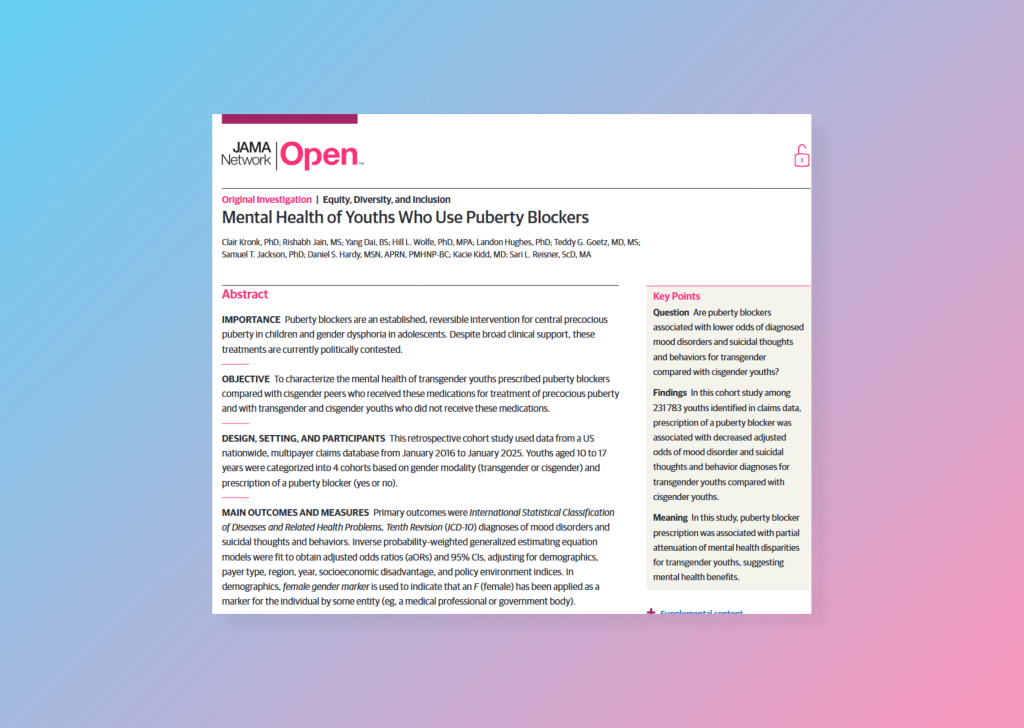
Puberty Blockers and Suicidality: New Study of 230,000 Youths
Lower Suicidality Among Transgender Youths
Read more
Without consent: the scientific misconduct scandal at Norway’s national centre for trans youth
Illegitimate research on trans minors
Read more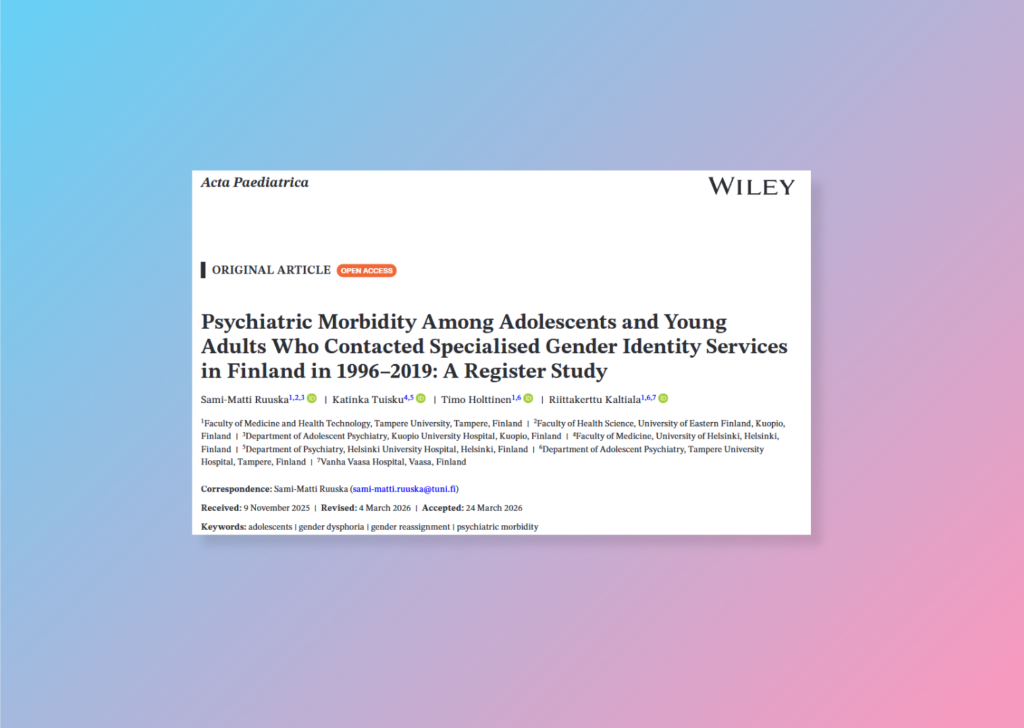
It Is False to Say That Medical Transitions Worsen Young People’s Mental Health
On the pseudoscientific exploitation of a study
Read more
Webinar “A Trans-Skeptical Parenthood” on July 2 at 6:30 p.m.
Trans Youth Trajectories webinar
Read more
2.2% of young people in France are trans or non-binary
Findings from a nationally representative survey
Read more