


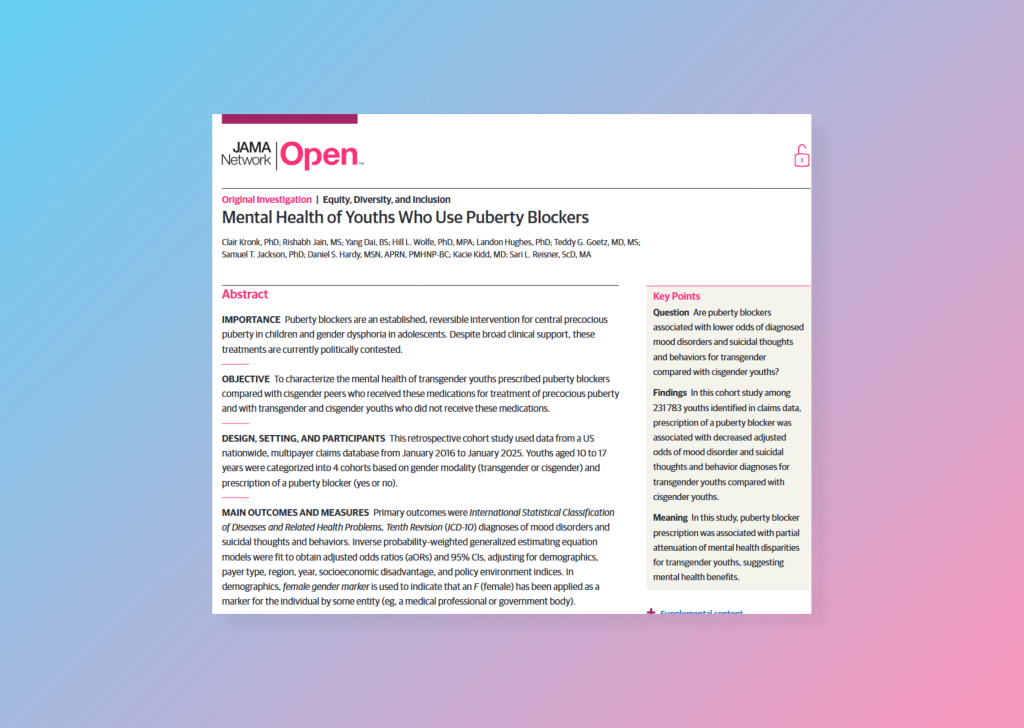
A large US study published in July 2026 in JAMA Network Open provides new evidence on the mental health of transgender youths receiving puberty blockers. Its strengths include its large sample size – 231,783 youths -, a follow-up period spanning nearly ten years, and the comparison of four groups: transgender youths with or without a puberty blocker prescription, cisgender youths receiving these medications for precocious puberty, and cisgender youths not receiving them. This longitudinal approach, based on approximately 1.85 million annual observations from different health insurance plans, makes it possible to examine associations between prescriptions and diagnoses on a large scale. Among transgender youths, puberty blocker prescription was primarily associated with a significant attenuation of suicidal thoughts and behaviours.
Four Groups Compared Using Health Claims Data
The researchers analysed US health insurance claims collected between January 2016 and January 2025. Youths aged 10 to 17 years were classified as transgender when at least one diagnosis associated with transgender identity appeared in their records. Puberty blocker prescriptions were identified using National Drug Codes, while cases in which these medications could have been used for another indication were excluded.
The sample included 1,260 transgender youths with a puberty blocker prescription, 40,212 transgender youths without a prescription, 78,111 cisgender youths treated with puberty blockers for precocious puberty, and a random sample drawn from more than 22 million cisgender youths without a puberty blocker prescription.
The analyses focused on two categories of diagnoses: mood disorders – a broad category including depression, anxiety, and adjustment disorders – and suicidal thoughts or behaviours. The models accounted for age, year, insurance type, region, various sociodemographic factors, area-level deprivation, and the political environment surrounding transgender rights.
Major Mental Health Disparities
Overall, 30.7% of transgender youths had received a diagnosis within the mood disorder category, compared with 10.8% of cisgender youths. Diagnoses related to suicidal thoughts or behaviours concerned 5.6% of transgender youths, compared with 0.9% of cisgender youths.
Among transgender youths, diagnoses related to suicidality were less frequent among those who had received puberty blockers: 3.65%, compared with 5.65% among those without a prescription. After adjustment, transgender youths remained considerably more likely than cisgender youths to have received a diagnosis of a mood disorder or suicidality. However, the association between transgender status and poor mental health was partially attenuated when youths had received puberty blockers. This difference was particularly pronounced for suicidal thoughts and behaviours (aOR = 0.20).
These findings do not mean that puberty blockers alone are sufficient to eliminate the mental health inequalities faced by transgender youths. However, they provide no evidence of a specific deterioration in their mental health and instead show a particularly clear favourable association regarding suicidality.
Findings Consistent With Previous Research
This new study is consistent with a substantial body of previous research. For example, in 2020, Turban and colleagues found that transgender people who had wanted puberty blockers during adolescence reported suicidal ideation less frequently when they had been able to access them. A prospective study published in 2022, which examined access more broadly to puberty blockers or gender-affirming hormones, also found reductions in depression and suicidal thoughts during the first year of care. The mechanisms involved have been explored in several qualitative studies, including Cal Horton’s research with transgender youths and their families, in which puberty blockers were frequently described as providing relief from feared bodily changes and allowing more time to consider the next stages of care. In the current US political context, where these forms of care are being directly restricted by President Trump, the findings of Clair Kronk and colleagues reinforce the importance of ensuring that transgender youths have effective access to care supported by the best available scientific evidence.
Note: TYT science news articles are now written and translated with the assistance of artificial intelligence tools. Their content nevertheless rests on a systematic and complete human reading of the studies presented, ensuring the accuracy of the information and allowing the TYT team to contextualize, editorialize, and freely put current research into perspective.
More news

The Netherlands strengthens its gender-affirming care model for trans minors
The evidence supports gender-affirming care
Read morePuberty Blockers and Suicidality: New Study of 230,000 Youths
Lower Suicidality Among Transgender Youths
Read more
Without consent: the scientific misconduct scandal at Norway’s national centre for trans youth
Illegitimate research on trans minors
Read more
It Is False to Say That Medical Transitions Worsen Young People’s Mental Health
On the pseudoscientific exploitation of a study
Read more
Webinar “A Trans-Skeptical Parenthood” on July 2 at 6:30 p.m.
Trans Youth Trajectories webinar
Read more
2.2% of young people in France are trans or non-binary
Findings from a nationally representative survey
Read more