


A recently published British study by Fysh and colleagues (accessible here), conducted as part of a research program using the same sample as the study by Kallitsounaki and colleagues (summarized on TYT here), examines the links between autism and gender identity among cisgender and transgender youth. The two studies, produced by the same research team, address similar questions but adopt different approaches. Whereas the study by Kallitsounaki and colleagues focused on the internal coherence of gender identity by drawing on social psychology tools – notably the Implicit Association Test – to examine implicit and explicit alignment between self and gender identity, the study by Fysh and colleagues instead concentrates on the behavioral phenotype of gender identity. In other words, it investigates what young people feel, express, or anticipate regarding their gender, as well as how these dimensions are similarly distributed among their parents. While the first study analyzed psychological mechanisms, the second examines the concrete manifestations of gender identity.
To carry out this work, the authors recruited 219 young people aged 7 to 16, divided into four perfectly matched groups: autistic and non-autistic, cisgender and transgender. This crossed design makes it possible to clearly distinguish the effect of diagnostic status (autism vs non-autism) from that of gender identity (cisgender vs transgender). The participants completed a set of standardized instruments assessing several dimensions: gender typicality (the extent to which they feel their preferences and appearance resemble those of most people of the same assigned sex); satisfaction with their assigned sex; parent-reported gender dysphoria; and anticipated future identity, a crucial issue for young people in a key developmental period.
The results first reveal a stark contrast between cisgender and transgender youth. Across all measures, transgender youth reported lower satisfaction with their assigned sex, greater incongruence, lower gender typicality, and future identity expectations aligned with their lived identity rather than their assigned sex. Parents also reported much higher levels of gender dysphoria in their children, confirming the coherence between self-report and parental observation. These differences, robust and highly significant, validate the instruments used and show that the study accurately captures what behaviorally distinguishes cisgender from transgender youth.
But the most important result – and the one that gives the study its clinical significance – concerns the comparison between autistic and non-autistic youth. Once the groups are separated by gender identity, autistic youth do not differ from non-autistic youth in terms of gender typicality, satisfaction with assigned sex, gender dysphoria, or anticipated future identity. The profiles of autistic trans youth are statistically indistinguishable from those of non-autistic trans youth, and autistic cisgender youth do not differ from their non-autistic peers. This result holds across all analyses. The study thus shows that autistic young people who express a trans identity do so in ways comparable to non-autistic trans youth, in terms of feelings, behaviors, and identity trajectories.
Parents of trans youth report higher levels of gender incongruence traits in themselves than parents of cisgender youth, suggesting a degree of familial aggregation of gender diversity. However, here again, no differences emerge depending on whether the child is autistic or not. Parents’ recollections of gendered activities in their own childhood, as well as their current experiences of gender, do not vary according to the child’s diagnosis. This finding reinforces the idea that, in families of trans youth, gender variation follows similar patterns regardless of autism.
In conclusion, the study by Fysh and colleagues makes a major contribution: it shows that gender diversity among autistic youth has no distinct behavioral signature compared to that observed among non-autistic youth. The results of this study, taken together with the companion study by Kallitsounaki and colleagues, have a clear implication: there is nothing in the data to suggest that transgender identities expressed by autistic youth are “less authentic” than those of other young people. Together, these two studies provide converging evidence that gender diversity among autistic youth does not appear to stem from autism-specific characteristics (such as an obsessive or stereotyped interest in gender), but rather from an authentic experience of gender, potentially facilitated by reduced conformity to social norms.
Note: TYT’s scientific news articles are now written with the assistance of AI. Their content nonetheless relies on a systematic, full human reading of the studies reported, ensuring factual accuracy and allowing for independent editorial framing of the scientific news.
More news

The Netherlands strengthens its gender-affirming care model for trans minors
The evidence supports gender-affirming care
Read more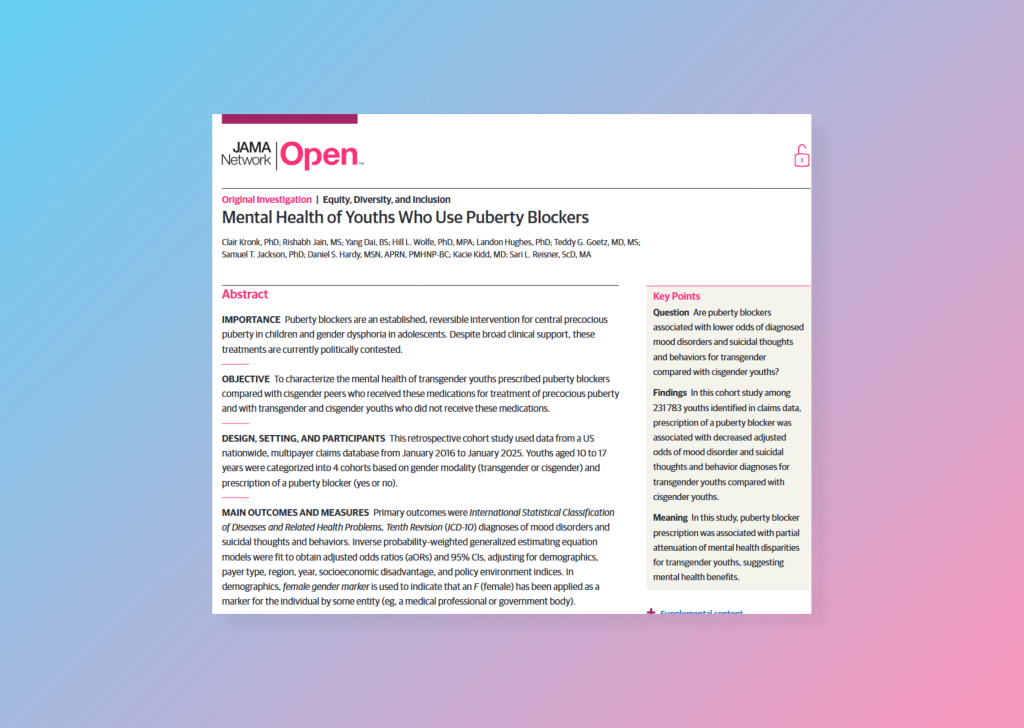
Puberty Blockers and Suicidality: New Study of 230,000 Youths
Lower Suicidality Among Transgender Youths
Read more
Without consent: the scientific misconduct scandal at Norway’s national centre for trans youth
Illegitimate research on trans minors
Read more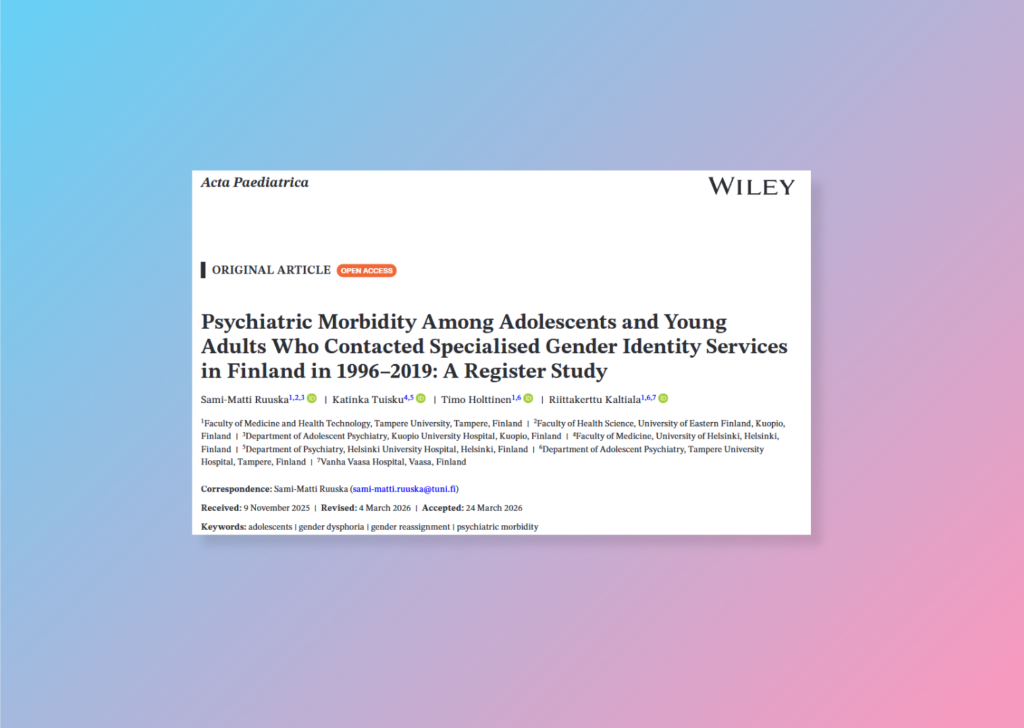
It Is False to Say That Medical Transitions Worsen Young People’s Mental Health
On the pseudoscientific exploitation of a study
Read more
Webinar “A Trans-Skeptical Parenthood” on July 2 at 6:30 p.m.
Trans Youth Trajectories webinar
Read more
2.2% of young people in France are trans or non-binary
Findings from a nationally representative survey
Read more