


Why are there more transmasculine youth in pediatric gender diversity clinics? This question had already been addressed in a study published by Claire Vandendriessche and David Cohen from TYT, summarised on our website here. Drawing on a sample of nearly 120,000 LGBT individuals across 30 European countries, these researchers ruled out the hypothesis that psychopathology is linked to a more rapid transgender identification among transmasculine adolescents who make intensive use of social media, compared with comparable transfeminine adolescents.
In response to the discredited hypothesis of “social contagion” among youth assigned female at birth – the ROGD (rapid-onset gender dysphoria) hypothesis – these researchers proposed an alternative explanation for the predominance of transmasculine adolescents over transfeminine adolescents in recent studies. They observed that LGBT individuals assigned male at birth (AMAB) tend to come out later than those assigned female at birth (AFAB), even though both groups become aware of their LGBT identity at the same age, and this pattern held true for both transgender people and cisgender LGB individuals. The researchers discussed the possibility of a stronger social penalty for transgressing norms of masculinity among those assigned male at birth, compared with the transgression of norms of femininity among those assigned female at birth.
A study published a few days ago by Kahn and colleagues in the International Journal of Transgender Health strongly supports this latter hypothesis. The authors conducted a retrospective study of two cohorts of patients referred to public gender clinics in Australia (Melbourne) and the Netherlands (Amsterdam). In total, the medical records of 1,903 individuals in Australia and 2,044 individuals in the Netherlands were examined, covering comparable periods from 2016 to 2019. By categorising the data according to sex assigned at birth and age at first consultation, the researchers were able to construct an analysis of care-access trajectories across different stages of life.
The results highlight a strong variation in the sex-assigned-at-birth ratio according to age. Among children under the age of 10, AMAB youth are in the majority. By contrast, during adolescence (ages 10-19), AFAB youth clearly predominate among requests for care. This trend reverses from the age of 20 onward, with a growing majority of AMAB patients, particularly pronounced after age 30. These patterns are similar in both countries, despite their distinct cultural contexts. This interregional consistency strengthens the robustness of the findings and suggests the influence of global societal factors rather than local ones.
Situating these results within the scientific literature, the authors explicitly challenge the controversial ROGD hypothesis, which has been widely criticised for its methodological biases. Rather than interpreting the increase in AFAB adolescents as evidence of “social contagion”, Kahn and colleagues propose a more structural explanation: transfeminine adolescents (AMAB) face heightened forms of intolerance and transmisogyny, which delay their access to care. This postponement until adulthood reconciles the disparities observed in clinical settings with the balanced distribution found in population-based studies of adult transgender people.
The study also notes that among young children (under 10 years old), parents generally express greater concern about boys who do not conform to gender norms, which may explain their overrepresentation in paediatric services. This trend fades during adolescence, when social pressure and fear of stigmatisation become major barriers for transfeminine youth. The authors also point to historical trends, such as the declining average age of puberty onset among AFAB youth, which – through the potentially dysphoria-inducing aspects of puberty – may contribute to their earlier referral to specialised services.
The qualitative analyses proposed by the research team further suggest that barriers to self-expression among AMAB individuals may also be linked to gender and sexuality dynamics. Some trans women who are attracted to women may, as long as they do not disclose their gender modality, benefit from a form of social privilege associated with a perceived masculine, cisgender and heterosexual identity. Anticipating the loss of this privilege may delay their transition, making the analysis of the determinants of transition pathways more complex.
Over the years, earlier studies conducted notably by Steensma and de Graaf have shown significant shifts in sex-assigned-at-birth ratios within clinics, moving from a predominance of AMAB youth to a majority of AFAB youth during adolescence. The work of Kahn and colleagues supports these trends while offering a nuanced interpretation grounded in the social and psychological dynamics of gender development. The authors stress the need to better account for the differential effects of gender norms on trans trajectories, depending on sex assigned at birth.
The methodological approach, based on comprehensive clinical data and a rigorous categorisation of age groups, provides a valuable contribution to understanding pathways of access to care. However, the authors acknowledge certain limitations, notably the rise of private services not included in the Australian data, which could bias the results by underrepresenting adult trans care pathways.
Ultimately, this article contributes to the deconstruction of simplistic and pathologising narratives about trans youth, demonstrating that the differences observed in access to paediatric gender services do not necessarily reflect pathological phenomena, but rather differential social dynamics in access to free gender expression. In particular, the hypothesis of transmisogyny experienced by many transfeminine adolescents would help explain delayed access to paediatric care, followed by a catch-up in access to care in adulthood. Population-based studies showing a balanced sex-assigned-at-birth ratio across all age groups (approximately 50/50 trans women and trans men in national censuses) lend further support to this hypothesis. The article thus calls for health policies more sensitive to the specific barriers faced by trans people according to perceived and assigned gender, while also encouraging continued research on trans trajectories at a global scale.
More news

The Netherlands strengthens its gender-affirming care model for trans minors
The evidence supports gender-affirming care
Read more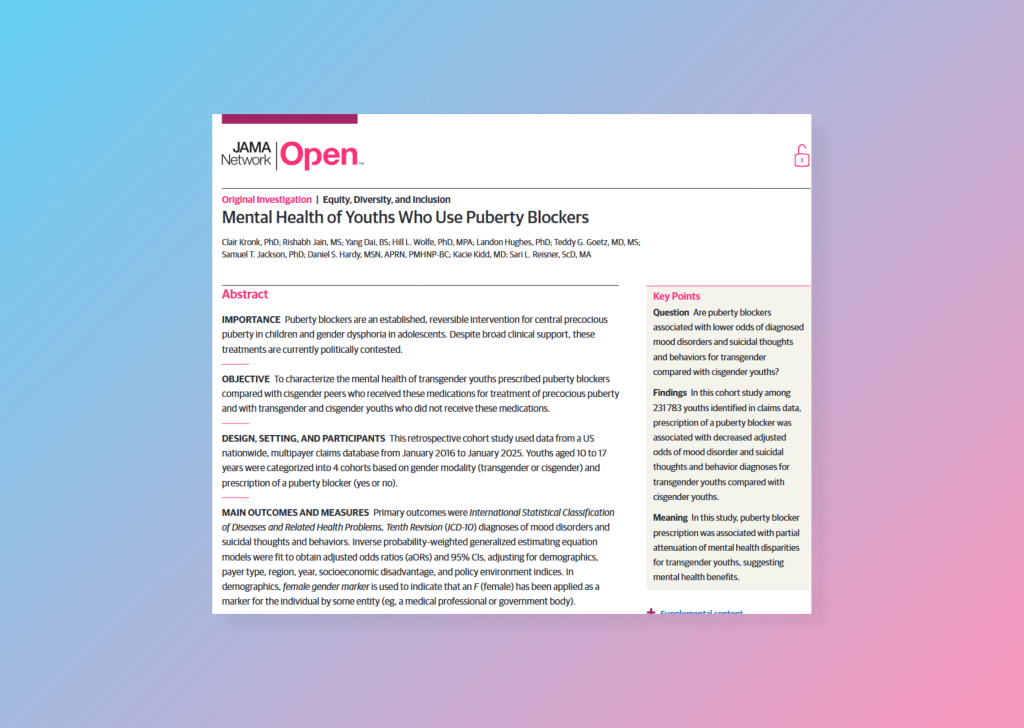
Puberty Blockers and Suicidality: New Study of 230,000 Youths
Lower Suicidality Among Transgender Youths
Read more
Without consent: the scientific misconduct scandal at Norway’s national centre for trans youth
Illegitimate research on trans minors
Read more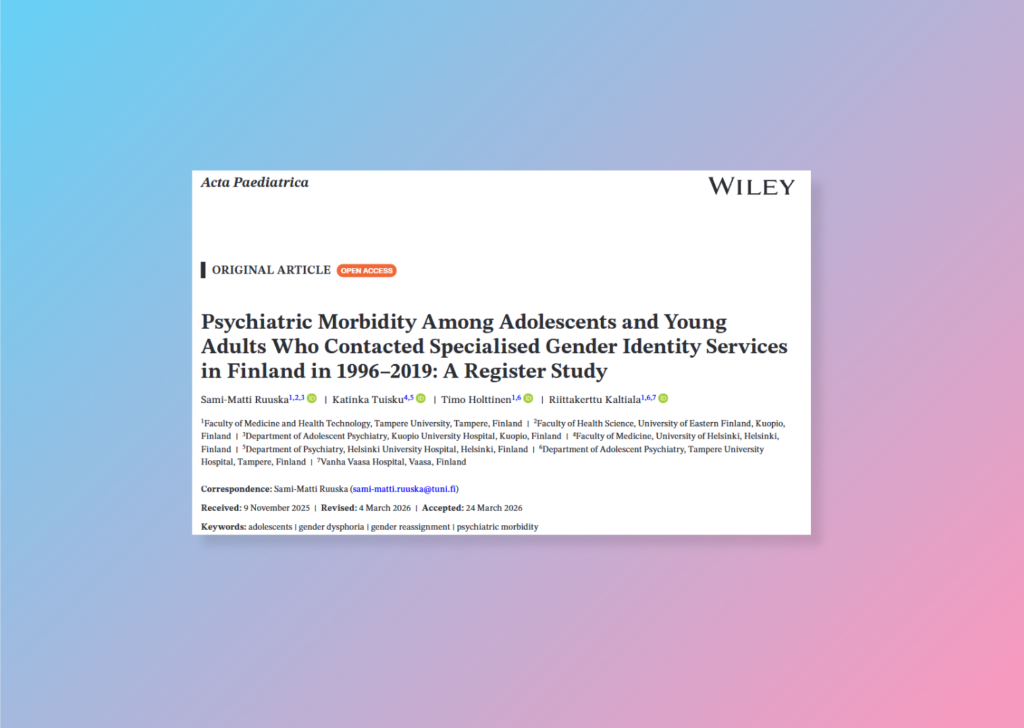
It Is False to Say That Medical Transitions Worsen Young People’s Mental Health
On the pseudoscientific exploitation of a study
Read more
Webinar “A Trans-Skeptical Parenthood” on July 2 at 6:30 p.m.
Trans Youth Trajectories webinar
Read more
2.2% of young people in France are trans or non-binary
Findings from a nationally representative survey
Read more