


From 26 to 30 September, the 28th Scientific Symposium of the World Professional Association for Transgender Health (WPATH) was held in Lisbon. The delegation from Trans Youth Trajectories, made up of six healthcare professionals from the Gender Diversity Consultation at the Pitié-Salpêtrière Hospital and five association representatives (Acceptess-T, Espace Santé Trans, OUTrans), attended the conference.
Two people from these associations each presented a scientific poster describing the peer support groups they organise. The schedule of OUTrans’s peer support groups – open to a wide audience, in person and without registration – is available on their website here. In contrast, the peer support groups organised by Espace Santé Trans take place with registration here. these groups are smaller (around ten people) and offer an 8-session series with one meeting per week.
Malo Radureau, clinical psychologist at the Gender Diversity Consultation at the Pitié-Salpêtrière, presented oral results from the peer support groups for trans and questioning adolescents and their parents. Eight semi-structured interviews were conducted with adolescents who participated in the groups for an average of 20 months. Four main themes emerged from analysing the interviews. Experiences included personal difficulties such as family tensions and social isolation. Challenges related to group participation included feelings of apprehension at the outset; while the benefits of participation included high satisfaction with the groups, transformative effects on daily life in terms of self-affirmation and self-expression, connection with others, and the ability to project into the future. The support groups for parents (separate from the adolescent groups) helped relieve parents and greatly improved communication with their child. Overall, the results indicate a greatly positive experience for adolescents participating in these peer support groups.
For access to Malo Radureau’s thesis, click here.

Claire Vandendriessche, association coordinator of Trajectoires Jeunes Trans, presented again the study previously presented at EPATH (2023), which had received the conference’s Best Poster Award. Since the previous year, the study design has been slightly improved, leading to marginal changes in the results. These provide partial support for the hypothesis of rapid-onset gender dysphoria among transmasculine adolescents, who are heavier users of social media than transfeminine adolescents, but are nevertheless not in poorer health than others. Claire Vandendriessche and Prof. David Cohen (head of the Child and Adolescent Psychiatry Department at Pitié-Salpêtrière Hospital) revisited the unanimously shared observation of a predominance of youth assigned female at birth among adolescents. Drawing on data from the European Union Agency for Fundamental Rights (~ 100,000 cis LGB individuals, ~ 20,000 trans individuals), they explain this phenomenon by the greater difficulty for youth assigned male at birth to come out during adolescence. This finding is also observed among cisgender LGB youth: cis gay boys, like trans women, have more difficulty coming out during adolescence than cis lesbian girls or trans men, which the authors attribute to greater difficulty in transgressing masculinity than femininity. Later in adulthood, the proportions reverse, favoring coming out among people assigned male at birth, such that gender ratios between people assigned male and those assigned female appear to balance out, both in the general transgender population and in the general cis LGB population. The later coming out of LGBTQI+ people assigned male at birth is observed in each of the 30 European countries studied, with variations suggesting an influence of national policies that are more or less repressive toward these populations.
Several unpublished studies attracted the TYT team’s attention, including five focusing on the long-term effects of gender-affirming care in adolescents.
Dr. Diane Chen presented a study on the mental health trajectories of transgender youth over the four years following the initiation of gender-affirming hormones. Previous research generally shows improvements in mental health after the start of these treatments, but it is limited by short follow-up periods (around one year) and focuses mainly on internal symptoms such as anxiety or depression. Chen’s study (unpublished) followed 316 transgender youth (mostly transmasculine) over four years and identified three distinct trajectories: 25 % of youth consistently had low levels of anxiety and risk behaviors, 56 % showed a decrease in these problems, and 18 % had persistently high levels. The study found that 95 % of youth who received early gender-affirming care showed either improvement or low levels of mental health problems. Identified protective factors included parental support, lower loneliness, less gender minority stress, and emotional support. The study emphasizes that hormones alone do not resolve mental health challenges for transgender youth who are isolated or facing anti-trans hostility, and that more targeted supports are needed for those with persistently high levels of distress.
Dr Laura Kuper presented preliminary results from a longitudinal study of 738 trans youth (starting ages 6–18, mean age ~15) and their parents over up to nine years. The study examined quality of life, anxiety, depression, and body dissatisfaction, and recently added measures of gender dysphoria, socio-political stress, and regret. Among youth who started and later stopped hormone treatments, 10 % discontinued oestrogens and 32 % discontinued testosterone, often due to access difficulties or satisfaction with changes; nearly half later resumed treatments. Most youth and parents expressed high satisfaction with hormone initiation decisions, and only ~2 % expressed regret. After five years, significant decreases in body dissatisfaction and slight improvements in depression and anxiety were observed, though scores sometimes remained elevated, especially for those on testosterone. Quality of life scores improved overall. The study noted that mental health improvements should not be the sole criterion for justifying gender-affirming care, particularly for youth with good social support and satisfactory pre-pubertal mental health; and that trans youth in Texas experience significant socio-political stress influencing mental health outcomes.
Dr. Kristina Olson presented a study on satisfaction, regret, and continuity of care among transgender adolescents regarding gender-affirming care (puberty blockers and hormones). This research, based on the Trans Youth Project, prospectively followed 317 transgender youth who had socially transitioned between the ages of 3 and 12, primarily in the United States, every 1 or 2 years over a period of 7 to 11 years. Transgender youth were compared with their siblings or with other cisgender youth; parents of the transgender youth were also surveyed. The youth, who on average began puberty blockers at age 11 and hormones at age 13, showed very high levels of satisfaction with treatment: mean satisfaction scores ranged from 6.4 to 6.5 on a scale from 1 to 7 for the youth and from 6.7 to 6.9 for parents, with very low levels of regret (1.0 to 1.5 on a scale from 1 “no regret” to 7 “strong regret”). Among the 220 transgender youth who responded to the questionnaire, only 2 % had discontinued gender-affirming care; the figure was 4 % among those who did not respond to the survey but for whom data on continuity of care were available. The study also shows that most youth would have liked to start treatment earlier or felt they started at the right time. In addition, the study demonstrates a dissociation between regret (4 % of respondents, i.e. 9 individuals out of 220) and discontinuation of care: people who stop hormones do not necessarily regret having taken them, and people who regret starting hormones do not necessarily stop taking them. The group of transgender youth shows mental well-being comparable to that of their cisgender peers, but faces more difficult access to gender-affirming care for subsequent generations due to new barriers to care for transgender youth in the United States.
Dr. Marijn Arnoldussen from the Netherlands presented a study on the long-term outcomes of transgender people who underwent medical transition during adolescence. The study focused on adults who had received puberty blockers and gender-affirming hormones more than 9 years earlier, with 72 participants out of 145 eligible individuals. The vast majority (94.4 %) did not change their gender identity from the start of their medical transition at a mean age of 14.85 years to their current mean age of 29.1 years. Eighty-three percent reported no regret or doubts regarding their medical transition, while 17 % expressed doubts or regret, mainly related to choices of surgical techniques or loss of fertility. Only one participant regretted the hormones and surgery they had received. Most participants (69.4 %) felt they would have been able to make decisions about their transition at an even younger age than that allowed by the Dutch model; 23.6 % considered the timing of the decision to be appropriate. Overall, 98.6 % of participants were satisfied with their social and medical transition, although some regretted part of their medical transition. Regret was mainly associated with surgical aspects, often influenced by the strict transition criteria and legal constraints of the time.
Dr. van der Meulen from the Netherlands presented a study on sexual dysfunction among transgender adults who had undergone early or later medical transition during adolescence. The study included 70 transgender adults with a mean age of 29 years, including 50 trans men and 20 trans women, comparing those who had received puberty blockers from early puberty (Tanner stages 2 or 3) with those who had received them later in adolescence (Tanner stages 4 or 5). The results show that sexual dysfunction was generally low across these groups, with no significant difference between those who transitioned early or later. Among trans men, 18 % reported low sexual desire, and 24 % reported difficulty achieving orgasm. Among trans women, 20 % reported low sexual desire, and 35 % reported difficulty achieving orgasm. Rates of sexual dysfunction varied slightly depending on the age at transition, but the study emphasizes that other factors, as well as better consideration of the experiences and perspectives of transgender people, are needed to better understand these findings.
More news

The Netherlands strengthens its gender-affirming care model for trans minors
The evidence supports gender-affirming care
Read more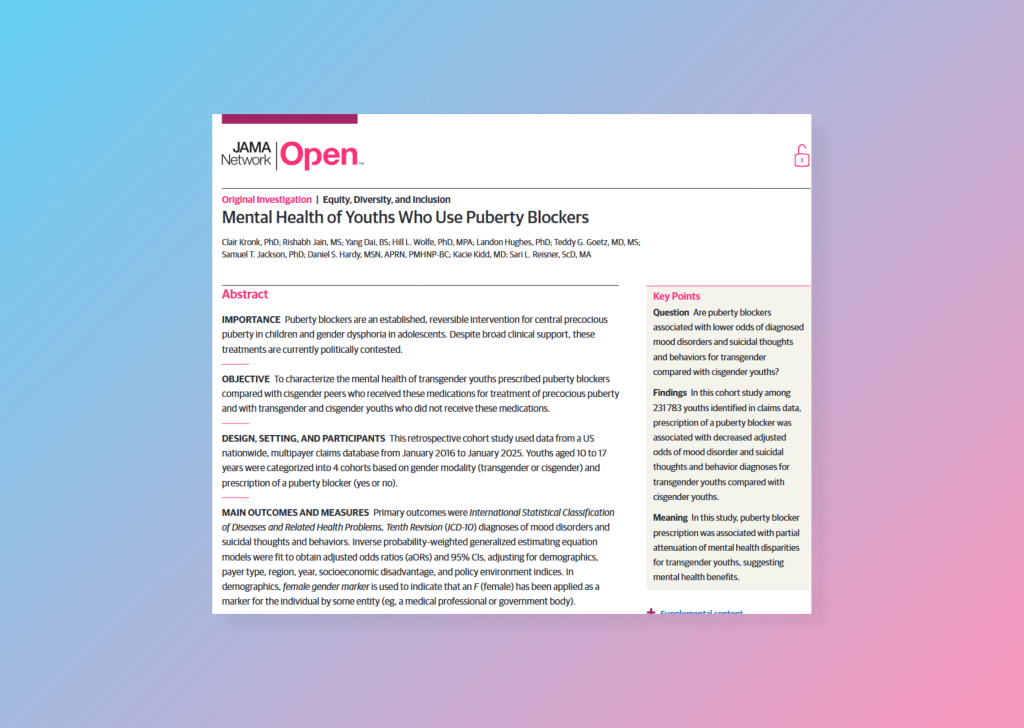
Puberty Blockers and Suicidality: New Study of 230,000 Youths
Lower Suicidality Among Transgender Youths
Read more
Without consent: the scientific misconduct scandal at Norway’s national centre for trans youth
Illegitimate research on trans minors
Read more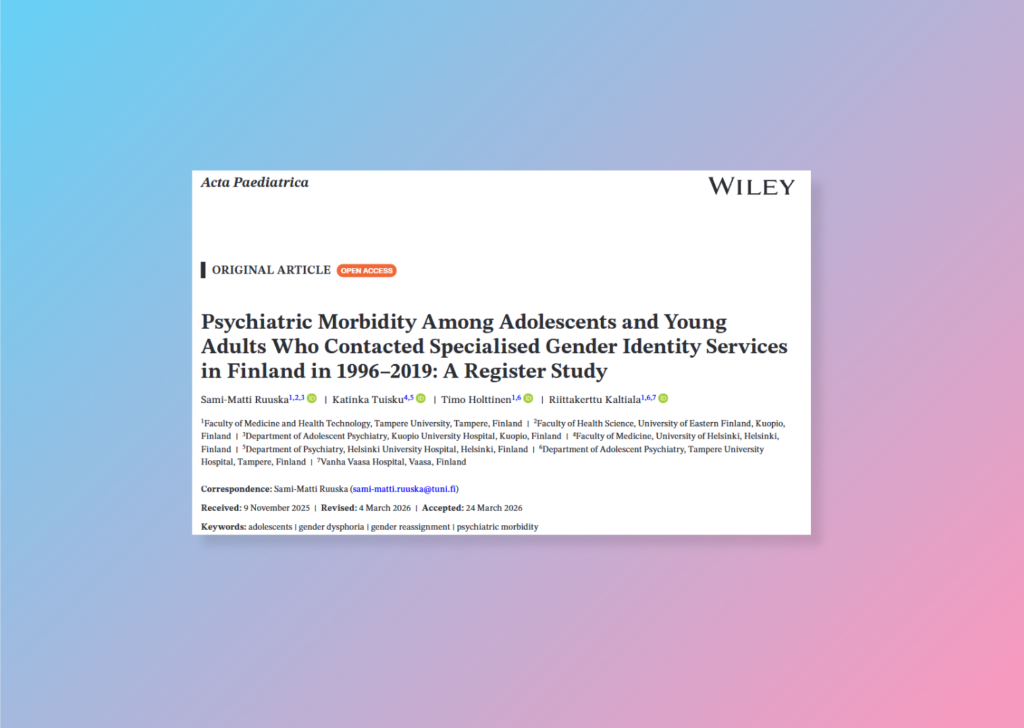
It Is False to Say That Medical Transitions Worsen Young People’s Mental Health
On the pseudoscientific exploitation of a study
Read more
Webinar “A Trans-Skeptical Parenthood” on July 2 at 6:30 p.m.
Trans Youth Trajectories webinar
Read more
2.2% of young people in France are trans or non-binary
Findings from a nationally representative survey
Read more