


Two years after the publication in English of the best-practice recommendations on care for trans people by the World Professional Association for Transgender Health (WPATH), the official French translation has now been released.
The more than 300-page document, informed by nearly 1 500 scientific studies, represents the updated scientific consensus on the best practices for supporting trans people based on medical evidence.
Two chapters mainly concern the support of young trans people: the chapter on children and the chapter on adolescents.
If prepubertal children never require specific trans-related somatic medical care, it is nevertheless recommended that they – and their parents – receive medical information around the onset of puberty about possible gender-affirming care in adolescence, its effects on fertility, and available fertility preservation options (Statement 7.11, pages 87-88). The WPATH also recommends support from parents and caregivers for children who wish to be recognised in the gender corresponding to their internal sense of gender identity (Statement 7.12, pages 88-89). However, WPATH further recommends that gender exploration may continue throughout childhood, independently of social transition (Statement 7.13, page 89).
Regarding adolescents, WPATH recommends that clinicians facilitate gender exploration and expression in an open and respectful manner, so that no particular identity is favored (Statement 6.2, p. 58). When adolescents request medical transition-related care, appropriately trained clinicians are recommended to carry out a comprehensive biopsychosocial assessment, in collaboration with and in support of the young person (Statement 6.3, pp. 58-60). WPATH recommends ongoing follow-up of the young person and their family (Statement 6.8, pp. 64-65), including collaboration with mental health professionals to determine whether medical transition-related care remains indicated (Statement 6.9, pp. 65-66). Parents should be involved in participation in medical decision-making, as long as their involvement is not considered harmful to the adolescent or impossible to implement (Statement 6.11, pp. 67-68).
With respect to gender-affirming care for adolescents (puberty blockers, sex hormones, or surgeries), WPATH recommends that such care be provided to young people who request it only if the following conditions – among others – are met (Statement 6.12, pages 68-77):
- A diagnosis of gender incongruence as defined by the ICD-11 (WHO) has been made.
- The experience of gender diversity/incongruence is marked and sustained over time.
- The adolescent demonstrates the emotional and cognitive maturity necessary to give informed assent/consent to treatment.
- Any mental health concerns that could interfere with clear diagnosis, capacity for consent, or gender-affirming medical treatments have been addressed.
- The adolescent has been informed about reproductive effects, including potential loss of fertility and available fertility preservation options, and these have been discussed in the context of the adolescent’s developmental stage.
- The adolescent has reached Tanner Stage 2 for puberty suppression.
Regarding conversion therapies, WPATH recommends that clinicians do not offer therapies that “aim to change a person’s gender or gender expression to make it more consistent with the sex they were assigned at birth” (Statement 6.5, pp. 61-62). It notes that “these efforts to block reversible social expression or transition may include choosing not to use the young person’s chosen name, pronouns, and grammatical markers, or restricting self-expression in clothing and hairstyles,” and that they “generally seek to reinforce the idea that a young person’s gender identity/expression should align with the gender associated with the sex assigned at birth or with expectations based on sex assigned at birth.” WPATH bases this recommendation against conversion therapies on their lack of ethical justification, the absence of evidence of their effectiveness, and evidence of their harmfulness. It should also be recalled that conversion therapies are illegal in France, including those carried out against transgender minors, since January 2022.
Access the French version of the international WPATH recommendations by clicking here.
More news

The Netherlands strengthens its gender-affirming care model for trans minors
The evidence supports gender-affirming care
Read more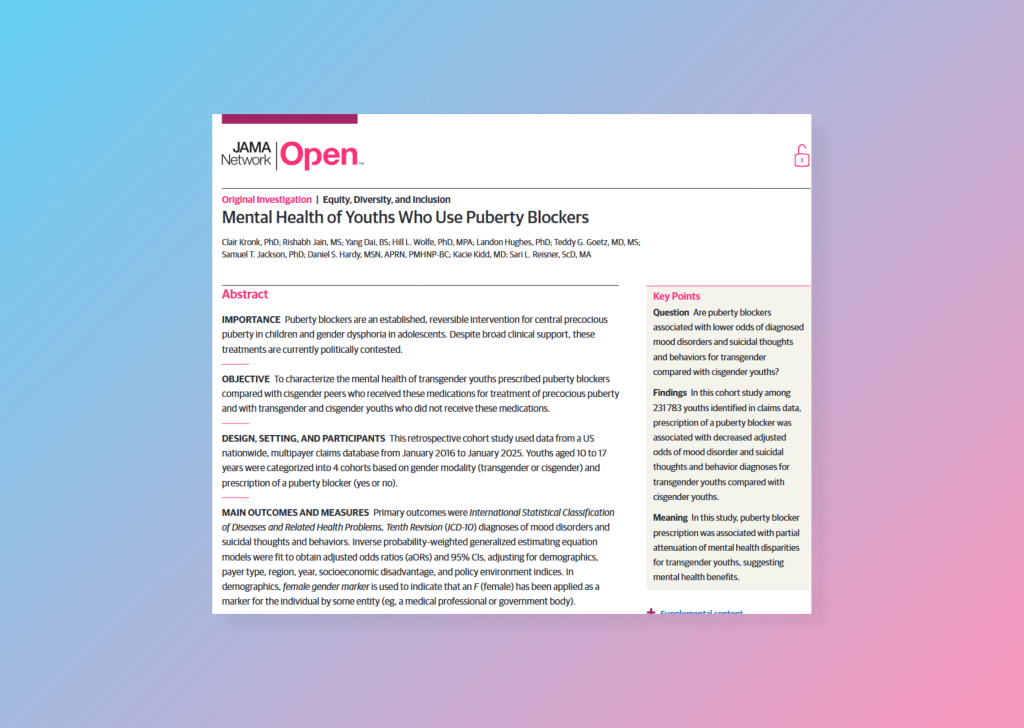
Puberty Blockers and Suicidality: New Study of 230,000 Youths
Lower Suicidality Among Transgender Youths
Read more
Without consent: the scientific misconduct scandal at Norway’s national centre for trans youth
Illegitimate research on trans minors
Read more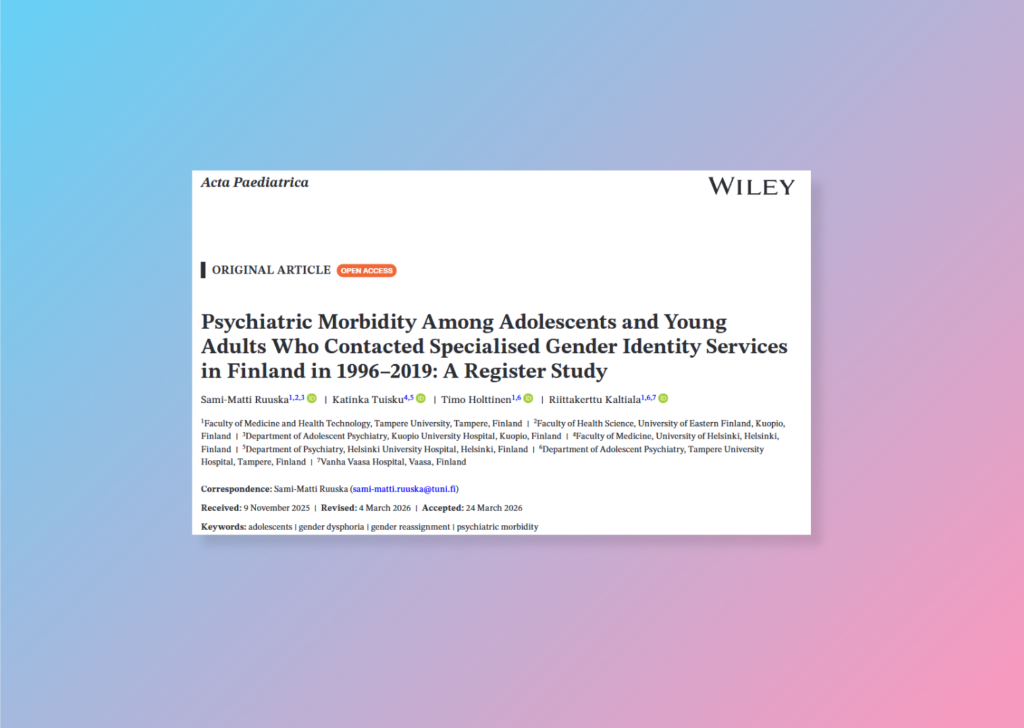
It Is False to Say That Medical Transitions Worsen Young People’s Mental Health
On the pseudoscientific exploitation of a study
Read more
Webinar “A Trans-Skeptical Parenthood” on July 2 at 6:30 p.m.
Trans Youth Trajectories webinar
Read more
2.2% of young people in France are trans or non-binary
Findings from a nationally representative survey
Read more