


At the Gleneagle Centre in Killarney (Ireland), from 26 to 28 April, the EPATH conference – the European organisation of trans health professionals – was held. The Trans Youth Trajectories delegation, numbering about a dozen members, took part and actively contributed to the conference, presenting eight oral presentations and one scientific poster.
The team from the Pitié-Salpêtrière presented results from its Gender Diversity consultation. The presentation, which will lead to a scientific publication, summarised data on 239 trans and gender-questioning children and adolescents followed in the consultation since 2012. It showed that, after review by a multidisciplinary case meeting, 11 % of them received puberty blockers (at an average age of 13.8 years); 44 % received masculinising or feminising hormone treatment (on average at about 16.8 years); and 20 % of young trans men received chest masculinisation surgery (on average at 18.4 years). The average time between the first consultation and initiation of hormone treatment among those who received it was one year. Regarding social transition, 40 % had already socially transitioned before the first consultation; by the end of follow-up, 74 % had socially transitioned within the family and 61 % at school.
Read the full summary of the presentation here.
Three presentations coordinated around a mini-symposium, “Health Democracy in Paris,” were presented jointly by healthcare professionals from Pitié-Salpêtrière and representatives of user associations. On different scales, the talks discussed the public health principle of including people with lived experiences in the implementation of their care – both in shared medical decision-making (notably since the inclusion of the association OUTrans in multidisciplinary case meetings), and in the organisation of care (Trans Youth Trajectories), as well as in the training of community-based physicians (through the Réseau Santé Trans).
Read the full summaries of the presentations here.
Within the mini-symposium “Community Health and Research,” two presentations from Espace Santé Trans, a member of Trans Youth Trajectories, showcased the activities of that association, which in 2021 trained nearly 300 mental health professionals. Their suicide risk reduction programme “Sentinelle”, funded by the Regional Health Agency of Île-de-France, enabled the training of dozens of trans community members to recognise signs of suicidality – which are very common in this population – and to refer them to a network of trained mental health professionals. The association also presented results from its weekly psychological listening service, recently held at the LGBTQI+ centre La Bulle in Paris.
Read the full summaries of the presentations here
Fanny Poirier, a psychologist at the Gender Diversity consultation at Pitié-Salpêtrière, presented his thesis on the construction of non-binary identity in young people (ages 16–25), under the supervision of Laurie Laufer and Ouriel Rosenblum. Drawing on results from 79 semi-structured interviews (with trans and/or non-binary people and cis people), the study offers a complex portrait of the emergence of non-binary identities in France. To access the thesis, you can contact Fanny Poirier directly.
Read the full summary of the presentation here
Nicolas Mendes, a psychologist at the CECOS of Jean Verdier Hospital led by Prof. Florence Eustache, presented results on fertility preservation activity at CECOS for trans adolescents and young trans women who wish to pursue hormonal transition (which can affect fertility). Among 71 trans patients followed at CECOS between 2018 and 2022 (average age: 17.5 years), 43 % expressed a desire for parenting and 43 % were unsure, with the majority (77 %) nonetheless wishing to pursue gamete preservation. Reasons for refusal of gamete preservation among other patients included lack of parental desire, delays in initiating hormone transition, or the inherent challenges of gamete preservation.

In a poster, which will soon lead to a scientific publication, Claire Vandendriessche, associative coordinator of Trans Youth Trajectories, and David Cohen, head of the child and adolescent psychiatry department at Pitié-Salpêtrière, revisited the unanimously shared observation of a predominance of adolescents assigned female at birth among young people, and – drawing on data from the European Union Agency for Fundamental Rights (~100,000 cis LGB people, ~20,000 trans people) – explain this phenomenon by the greater difficulties that young people assigned male at birth have in coming out during adolescence. This finding is also observed among cis LGB youth: cis gay youth, like young trans women, have more difficulty coming out in adolescence than cis lesbian youth or young trans men, which the authors attribute to the greater difficulty in transgressing masculine norms compared with feminine ones. Later, in adulthood, proportions reverse, favouring coming out by those assigned male at birth, so that gender ratios between people assigned male or female at birth seem to balance out, both in the general trans population and in the cis LGB general population. The later coming out of LGBTQI+ people assigned male at birth is observed across the 30 European countries studied, with variations suggesting an influence of more or less repressive national LGBTQI+ policies.
To access the poster, awarded EPATH best conference poster, contact here the main author of the study.
The date and location for the next EPATH conference – to be held in Hamburg in 2024 – are already set, with anticipation also for the upcoming WPATH (World Professional Association for Transgender Health) scientific conference in Lisbon in 2023.
More news

The Netherlands strengthens its gender-affirming care model for trans minors
The evidence supports gender-affirming care
Read more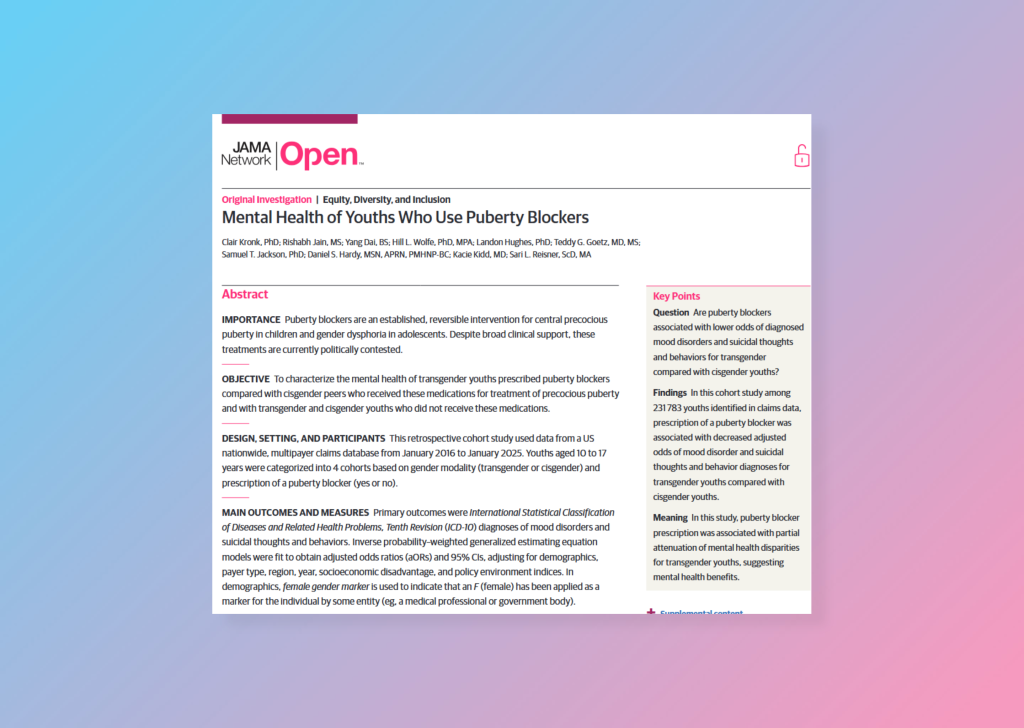
Puberty Blockers and Suicidality: New Study of 230,000 Youths
Lower Suicidality Among Transgender Youths
Read more
Without consent: the scientific misconduct scandal at Norway’s national centre for trans youth
Illegitimate research on trans minors
Read more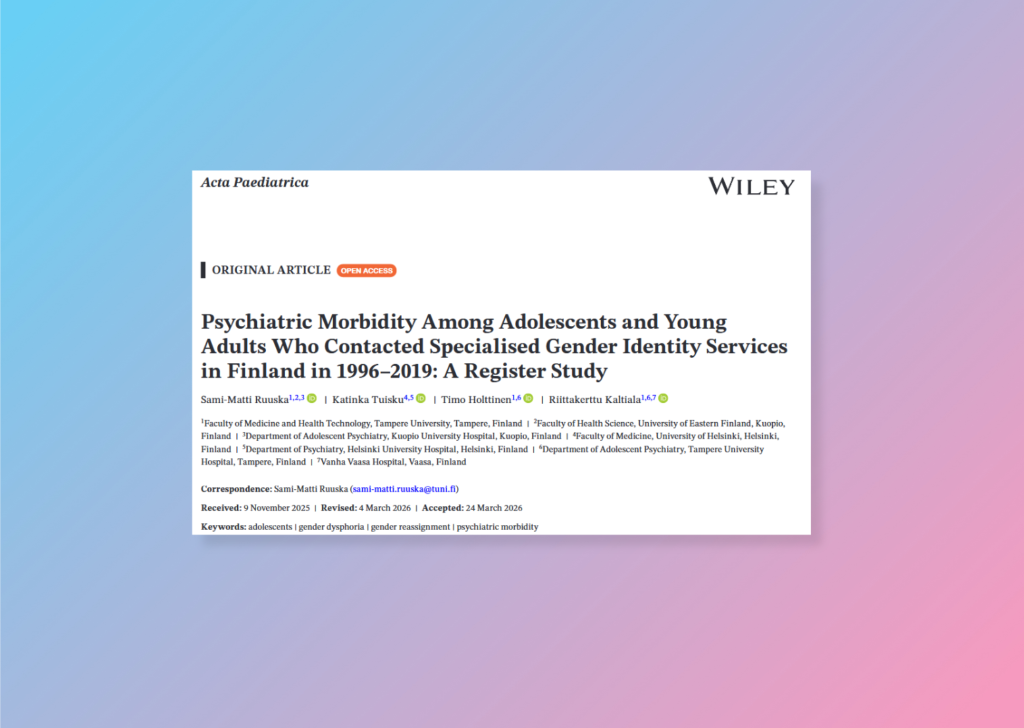
It Is False to Say That Medical Transitions Worsen Young People’s Mental Health
On the pseudoscientific exploitation of a study
Read more
Webinar “A Trans-Skeptical Parenthood” on July 2 at 6:30 p.m.
Trans Youth Trajectories webinar
Read more
2.2% of young people in France are trans or non-binary
Findings from a nationally representative survey
Read more