


As part of the Study Group on Discrimination and LGBTQI-phobias of the French National Assembly, co-chaired by Members of Parliament Emmanuel Grégoire and Éric Martineau, Trans Youth Trajectories was able to engage in discussions with MPs and parliamentary staff from different political parties during a working day focused on the issues facing trans youth, on the occasion of Transgender Day of Visibility, on Monday, 31 October 2025.
The first half-day provided an opportunity for representatives of partner organisations of people directly concerned, working alongside TYT, to discuss the rise of transphobic discourse and acts in France and internationally, and to address their psychological impact on the development of young people targeted by such rhetoric and violence. As a large-scale U.S. study has shown, anti-trans laws have a very significant effect on suicidality among trans youth, leading to increases of up to +72% in annual suicide attempts. This half-day also gave associations the opportunity to advocate for supportive and unconditional accompaniment of trans students, respectful of their gender identity, throughout their schooling. They also expressed the wish for dejudicialisation of legal sex marker changes, as the current procedure is lengthy and discriminatory for those concerned, and moreover inefficient and very costly for public finances, as recently demonstrated by the association Toutes des Femmes.

The second half-day brought together several TYT healthcare professionals – including a psychologist, child and adolescent psychiatrists, and a paediatric endocrinologist – to provide clear and accurate information on the current debates surrounding gender-affirming care for trans adolescents, and to dismantle misconceptions that are sometimes deliberately spread. The clinicians explained affirmative approaches supported by international and national guidelines (including SFEDP in France, ESPE in Europeand AWMF in German-speaking countries), which are themselves evidence-based. The professionals emphasised that, contrary to certain media myths, care is not provided too quickly nor without evaluation; that puberty blockers are not fundamentally “dangerous and irreversible” and have been used for decades in non-trans minors; and that, based on the overall body of evidence, large-scale detransition among youth does not occur. On this last point, the Cass Review is particularly telling: among 3,306 trans youth seen at the Tavistock clinic in London, fewer than 10 detransitioned. Only one of them had received medical treatment (puberty blockers). This corresponds to a detransition rate of 0.3% (Cass Review, p. 168).
We warmly thank the MPs co-chairing the Study Group on Discrimination and LGBTQI-phobias of the French National Assembly, Emmanuel Grégoire and Éric Martineau, for organising this day of study on such a symbolic date, as well as all the MPs and parliamentary staff with whom we exchanged and/or with whom we will have the opportunity to continue discussions when the report of this day is circulated.
More news

The Netherlands strengthens its gender-affirming care model for trans minors
The evidence supports gender-affirming care
Read more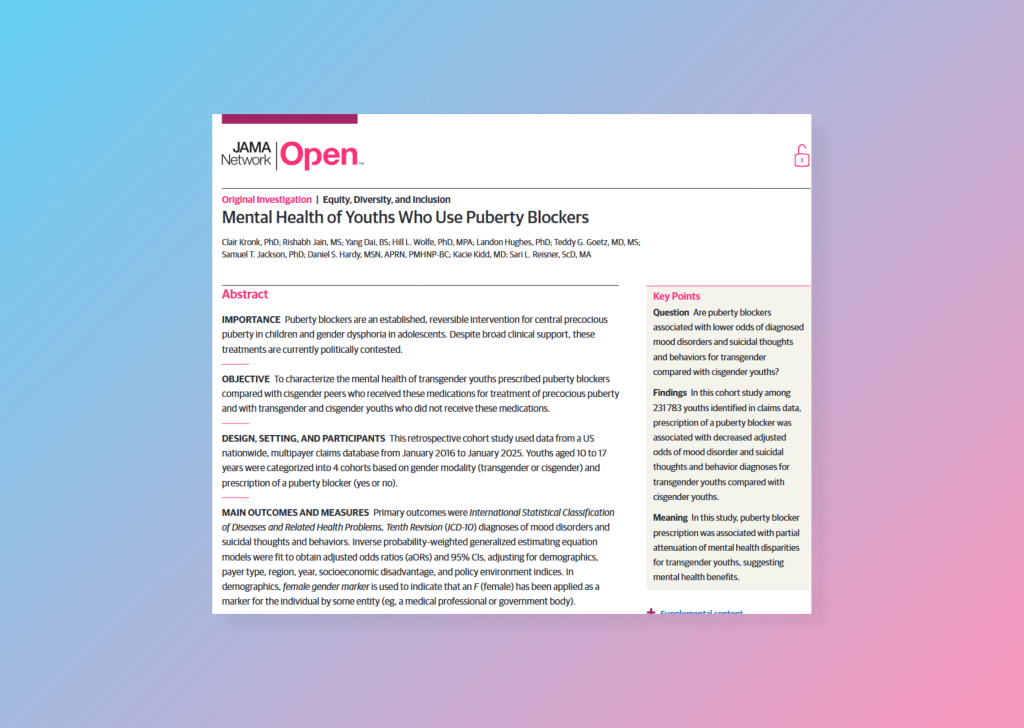
Puberty Blockers and Suicidality: New Study of 230,000 Youths
Lower Suicidality Among Transgender Youths
Read more
Without consent: the scientific misconduct scandal at Norway’s national centre for trans youth
Illegitimate research on trans minors
Read more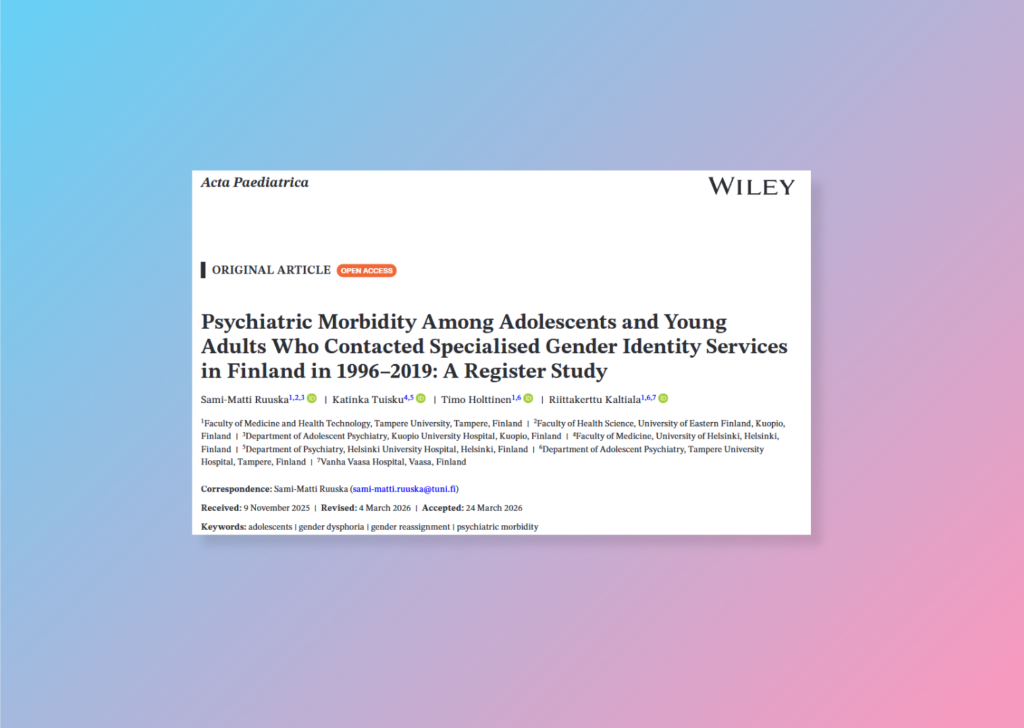
It Is False to Say That Medical Transitions Worsen Young People’s Mental Health
On the pseudoscientific exploitation of a study
Read more
Webinar “A Trans-Skeptical Parenthood” on July 2 at 6:30 p.m.
Trans Youth Trajectories webinar
Read more
2.2% of young people in France are trans or non-binary
Findings from a nationally representative survey
Read more