


In a deeply polarized U.S. legislative landscape, a study (accessible here) by Sara Mar and her colleagues highlights a major contradiction at the heart of laws restricting access to medical care for trans minors. Since 2021, 28 states have adopted bans targeting gender-affirming treatments for minors, presented as protective measures against interventions portrayed as risky or insufficiently evidence-based. Yet these same laws systematically provide exceptions for physically comparable procedures when they concern children presumed to be non-transgender, particularly intersex children. This asymmetry, documented in the study, reveals a structural bias in how states assess the medical and moral legitimacy of interventions affecting minors’ sexual anatomy – not on the basis of risks or benefits, but according to normative prejudices about sex and gender.
Methodologically, the study conducts a systematic legislative review of U.S. laws adopted between January 1, 2021 and December 31, 2024 across all U.S. states (as well as the District of Columbia, territories, and tribal jurisdictions) that restrict gender-affirming care for minors. For each identified law, the authors extracted and analyzed legislative language: definitions of sex and gender, types of prohibited care (hormonal, surgical, etc.), the rationales invoked by lawmakers, exceptions (notably for intersex individuals), and penalties for non-compliance. They then compared these provisions across states to highlight inconsistencies.
The authors show that the gender-affirming treatments denied to trans adolescents are, in nearly all cases, forms of care requested by the young people themselves, supported by their parents, and validated by medical teams following established protocols. States sidestep these elements by asserting that parental consent and minors’ assent are insufficient to authorize such interventions, citing risks of error or immaturity. Yet this same caution disappears when laws explicitly allow invasive and irreversible interventions on intersex children through stated exceptions – procedures often performed in early childhood, with no possibility of consent at all.
The study reminds readers that these operations aim to “normalize” bodies that are otherwise healthy, without medical urgency, and that no robust evidence demonstrates long-term benefit – a point that is nonetheless central to critiques leveled against gender-affirming care.
This asymmetry is clearly visible in the maps and tables included in the study. All of them, without exception, include exemptions for interventions on minors with intersex traits. Some laws go so far as to invoke the notion of “unambiguous” genitalia to determine what is deemed acceptable or prohibited, revealing a legalistic approach grounded in a strictly binary view of sex that runs counter to current scientific standards.
The study emphasizes that these legal definitions of sex – based on potential gametes or interpretations of internal organs – correspond neither to medical practice nor to contemporary knowledge in the biology of sexual development.
The central paradox highlighted by the researchers is the following: while states invoke the protection of trans minors to justify banning consensual treatments, they simultaneously authorize – and sometimes facilitate – interventions performed without consent on intersex children whose bodies are infantilized and not medically threatened. Advocates of the bans claim to want to avoid irreversible practices carried out too early in life, yet the normalizing procedures imposed on intersex children – including genital surgeries, gonadectomies, or hormonal treatments – are precisely those performed earliest, most frequently, and without any request from the child. The study thus shows that the argument of medical caution is not applied uniformly: it is used to block gender-affirming care while legitimizing non-essential interventions on intersex children.
The authors note that this asymmetry rests on pathologization in both cases: trans identity is framed as requiring active prohibition of care that could allow it to be expressed, while intersex traits are viewed as anatomical anomalies to be corrected as early as possible. In both cases, the legislative response consists in denying bodily self-determination: denying care to trans adolescents, or imposing care on intersex children. These two dynamics rely on the same political logic of controlling bodies in accordance with sex assigned by medicine. The study stresses that neither position is compatible with contemporary principles of bioethics, which are grounded in consent, autonomy, and respect for the psychological development of children and adolescents.
In conclusion, the article by Mar and her colleagues demonstrates that restrictive laws on gender-affirming care in the United States operate as a systematic violation of minors’ self-determination when their bodies or identities depart from binary sex norms. By banning consensual treatments for trans youth while allowing non-consensual interventions on intersex children, these laws protect neither minors’ health nor their bodily integrity: they instead reinforce a normative hierarchy of sex and gender. The authors call for health policies grounded in ethical coherence, respect for bodily autonomy, and equal access to care, regardless of an individual’s conformity to social definitions of sex or gender.
Note: TYT’s scientific news articles are now written with the assistance of AI. Their content nonetheless relies on a systematic, full human reading of the studies reported, ensuring factual accuracy and allowing for independent editorial framing of the scientific news.
More news

The Netherlands strengthens its gender-affirming care model for trans minors
The evidence supports gender-affirming care
Read more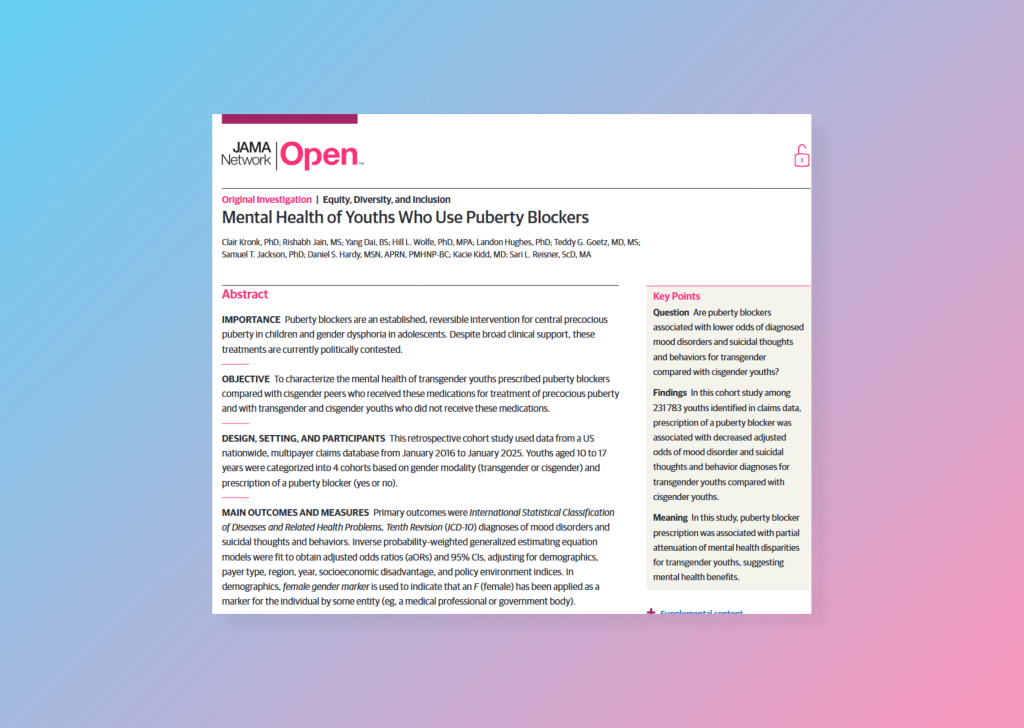
Puberty Blockers and Suicidality: New Study of 230,000 Youths
Lower Suicidality Among Transgender Youths
Read more
Without consent: the scientific misconduct scandal at Norway’s national centre for trans youth
Illegitimate research on trans minors
Read more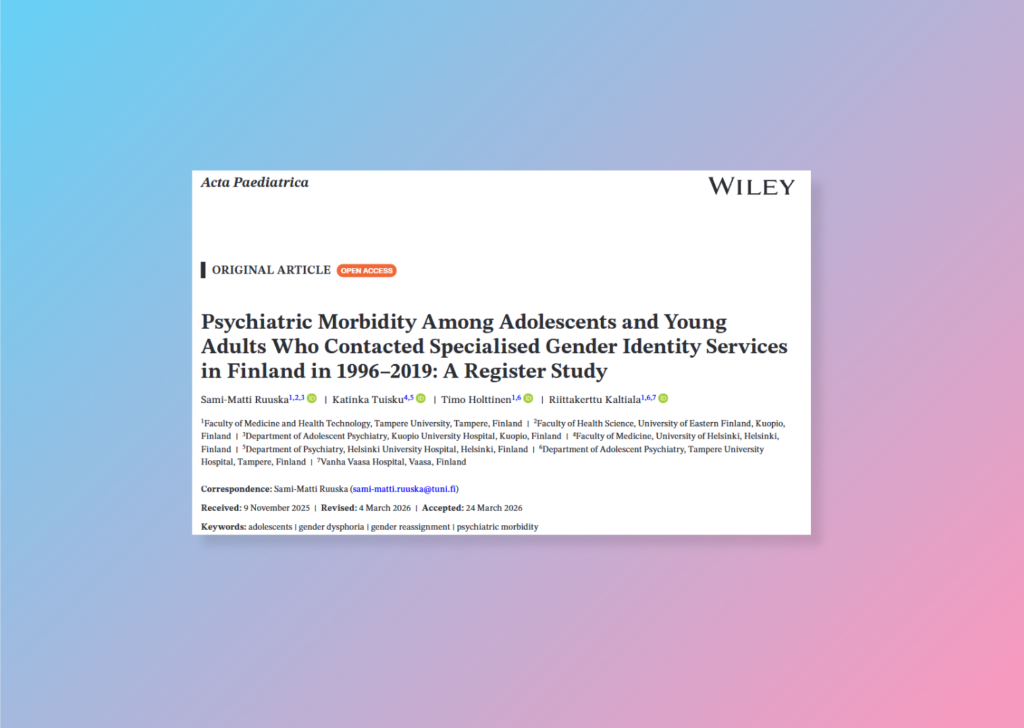
It Is False to Say That Medical Transitions Worsen Young People’s Mental Health
On the pseudoscientific exploitation of a study
Read more
Webinar “A Trans-Skeptical Parenthood” on July 2 at 6:30 p.m.
Trans Youth Trajectories webinar
Read more
2.2% of young people in France are trans or non-binary
Findings from a nationally representative survey
Read more