


A new study conducted by Kinnon MacKinnon and his colleagues (including Annie Pullen Sansfaçon, a member of TYT), involving 957 people aged 16 to 74, systematically explores experiences of detransition and interrupted transitions in the United States and Canada. Using latent class analysis, the authors identified four distinct profiles (A, B, C, and D), each representing a coherent set of reasons, trajectories, and psychosocial contexts. This approach makes it possible to move beyond traditional categories that too simplistically associated detransition with regret, by showing that this phenomenon takes multiple forms, sometimes voluntary and sometimes constrained. The study thus contributes to a conceptual renewal by highlighting the plurality of pathways and emphasizing that detransition encompasses very different realities depending on the individual.
Class A includes individuals who report the highest levels of psychological distress, neurodivergence, and internal identity change. They also express greater dissatisfaction with treatments. These participants, predominantly AFAB (assigned female at birth) and relatively young, are also those who least affirm a trans identity at the time of the survey. Their profile corresponds to what other studies have described as detransitions centered on profound identity reconfigurations. They also show the highest levels of regret, both regarding social and medical transition, as illustrated in Figure 7 (below), where their scores, often close to the maximum, clearly exceed those of the other classes. These data highlight that, for this group, detransition unfolds within a complex dynamic in which psychological vulnerabilities, unmet expectations, and identity revisions intersect.

Figure 7: Regret scores related to social and medical transition by latent class
Class B presents a very different picture. These individuals, also predominantly AFAB, report a relatively positive experience of treatment, moderate satisfaction, and a gradual evolution of identity. Their detransition is generally not accompanied by a complete break from a trans or queer identity, and their experience reflects a redefinition of self rather than a reversal. In Figure 7, their regret scores are significantly lower than those of Classes A and C and are concentrated at the lower end of the scale. This illustrates the study’s central argument: one can detransition without regret, through identity maturation or personal adjustment. Class B thus occupies an intermediate position, revealing a type of detransition that is non-dramatic and low-conflict, rooted in continuity rather than rupture.
Class C is characterized by high exposure to social adversity: discrimination, interpersonal conflict, family rupture, and minority stress. These participants also show the highest ACE (adverse childhood experiences) scores, indicating more frequent childhood adversities. In terms of regret, Figure 7 shows elevated scores, though less extreme than those of Class A. This group embodies a profile in which detransition is sometimes constrained or difficult to carry out (in 29.1% of cases): individuals may wish to modify their transition but encounter structural, social, or relational barriers. For these people, regret, minority stress, and interpersonal adversity combine to form a landscape in which detransition is less an autonomous choice than a tension-filled process shaped by past and present vulnerabilities.
Class D, finally, represents those who interrupted their transition primarily due to external factors such as lack of support or discrimination. The vast majority continue to affirm a trans or non-binary identity, which distinguishes this class from the other three. Although they often had to suspend a desired transition, their regret scores are the lowest among the four classes, as illustrated in Figure 7, where the triangles cluster at low values and never reach the peaks observed elsewhere. This group embodies “interrupted transitions” or “forced detransitions”: these are less detransitions desired by the individual than pathways constrained by transphobia, sometimes later resuming in the form of retransition.
Overall, the DARE study shows that regret, identity, and detransition do not form a simple continuum. Some people detransition with profound regret (Class A), others detransition without regret (Class B), others wish to detransition but encounter obstacles (Class C), and some are forced to interrupt their transition while maintaining a clearly affirmed trans identity (Class D). By making these distinct profiles visible – notably through Figure 7 – the study calls for more nuanced clinical practices and a renewed understanding of detransition, far removed from oversimplifications. The authors emphasize the need to integrate the possibility of non-linear pathways into care, including transitions, pauses, revisions, or retransition, and to distinguish between regret, constraint, and identity development in clinical support.
More news

The Netherlands strengthens its gender-affirming care model for trans minors
The evidence supports gender-affirming care
Read more
Puberty Blockers and Suicidality: New Study of 230,000 Youths
Lower Suicidality Among Transgender Youths
Read more
Without consent: the scientific misconduct scandal at Norway’s national centre for trans youth
Illegitimate research on trans minors
Read more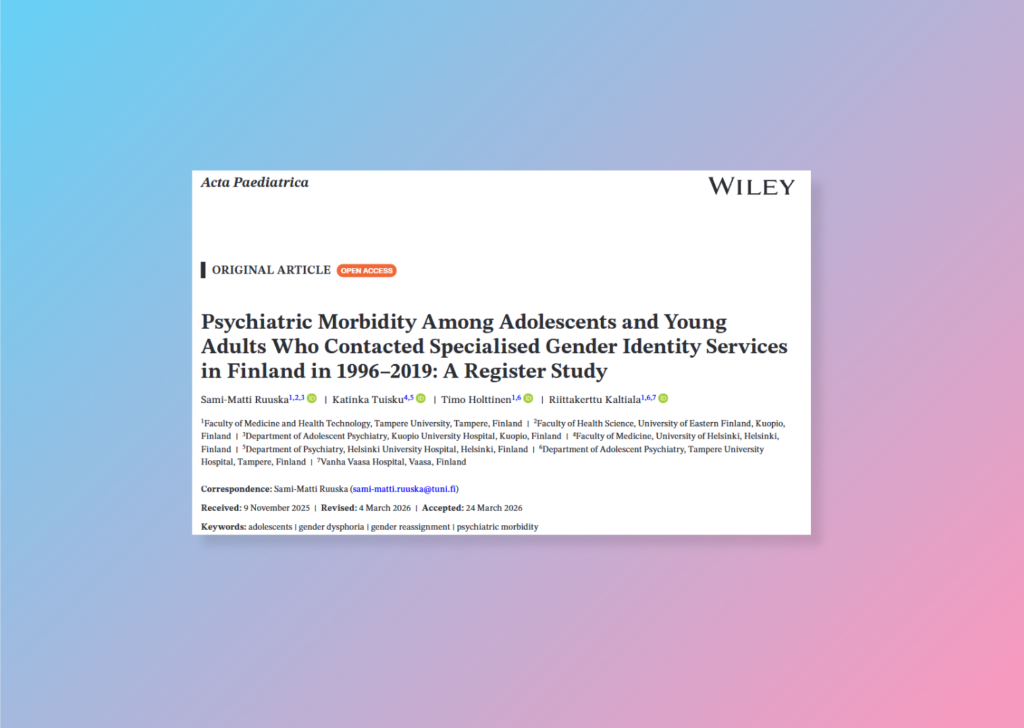
It Is False to Say That Medical Transitions Worsen Young People’s Mental Health
On the pseudoscientific exploitation of a study
Read more
Webinar “A Trans-Skeptical Parenthood” on July 2 at 6:30 p.m.
Trans Youth Trajectories webinar
Read more
2.2% of young people in France are trans or non-binary
Findings from a nationally representative survey
Read more