


Juliette Bouzy and her colleagues from the Trans Youth Trajectories platform have published in the journal Psychiatry Research a literature review on trans identities and autism, which are often associated.
The authors find large differences both among studies on the frequency of autism in the transgender population and among those evaluating the frequency of trans people in the autistic population. At Pitié-Salpêtrière, among 239 transgender participants aged 3 to 20 years, 9 % had an autism diagnosis (results forthcoming).
The gender ratio between autistic transfeminine and transmasculine people is balanced in many studies that assess it. However, in some other studies, a predominance of people assigned female at birth who are both trans and autistic has been reported, which the literature explains by a more marked intensity of puberty among those assigned female at birth.
Explanatory theories of the co-occurrences of trans identities and autism are highlighted. One theory advanced by the authors suggests that social difficulties linked to autism may lead to reduced identification with gender norms and less pressure to conform to those norms, resulting in greater gender diversity among autistic people.
Several studies reported by the authors examine the clinical and social consequences of this co-occurrence, emphasizing the accumulation of risk factors that arise from it: lower quality of life, physical health, emotional and social well-being, and school functioning; more co-occurring psychiatric conditions than among autistic cisgender people; and distress sometimes associated with trans identity that may be accentuated by certain autistic cognitive traits, leading to severe self-injurious behaviours.
Numerous studies reaffirm the importance of providing specialized care to trans autistic people and that autism is not a contraindication to gender-affirming care, including sex hormones. The beneficial effects of the latter on mental health, on executive functions, and on overall functioning including social functioning of trans autistic people are demonstrated. According to one study, prolonged prescription of puberty blockers in trans and autistic youth may have negative effects on executive functions. Studies looking at social transition note negative effects in terms of anxiety and increased social difficulties, as well as positive effects, recommending that the desires of trans and autistic people be supported so as not to risk exacerbating social isolation.
Overall, care for trans and autistic people must be adapted to certain cognitive specificities, and the high risks of discrimination and harassment they experience must be known by caregivers in supporting their transition.
More news

The Netherlands strengthens its gender-affirming care model for trans minors
The evidence supports gender-affirming care
Read more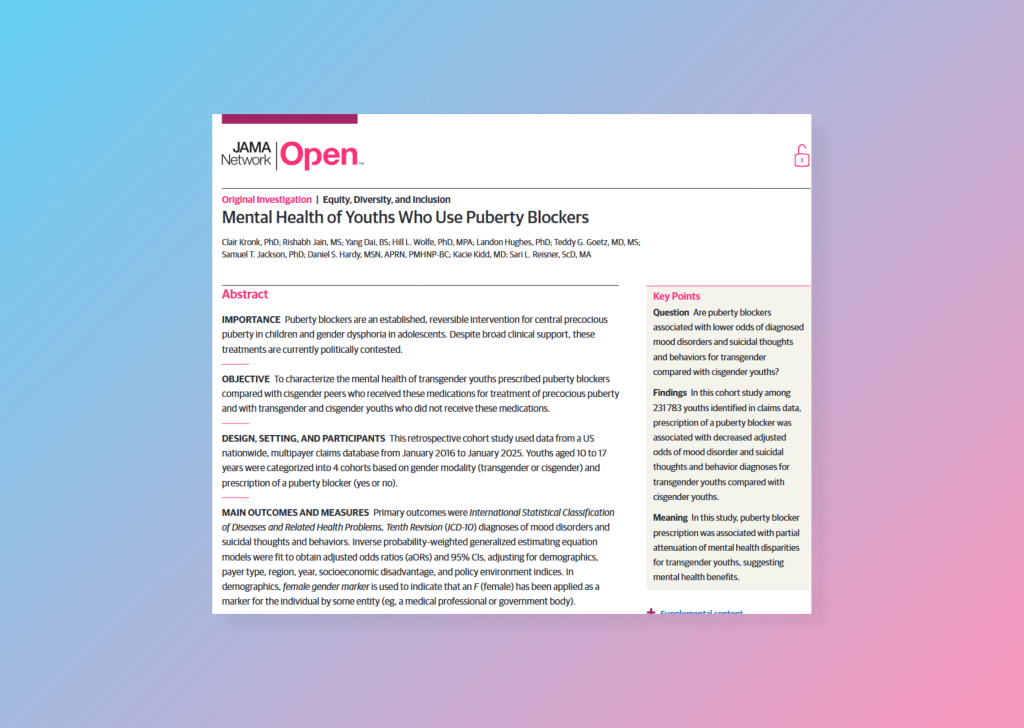
Puberty Blockers and Suicidality: New Study of 230,000 Youths
Lower Suicidality Among Transgender Youths
Read more
Without consent: the scientific misconduct scandal at Norway’s national centre for trans youth
Illegitimate research on trans minors
Read more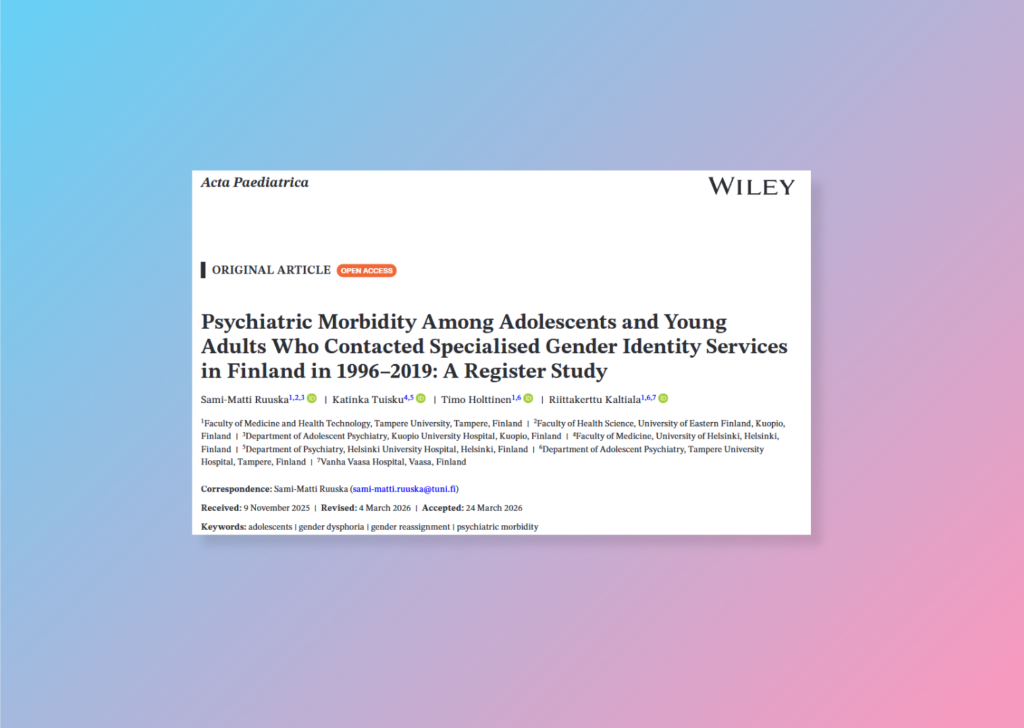
It Is False to Say That Medical Transitions Worsen Young People’s Mental Health
On the pseudoscientific exploitation of a study
Read more
Webinar “A Trans-Skeptical Parenthood” on July 2 at 6:30 p.m.
Trans Youth Trajectories webinar
Read more
2.2% of young people in France are trans or non-binary
Findings from a nationally representative survey
Read more