


A study recently published in Current Psychology by Scott W. Semenyna and Christopher J. Ferguson provides empirical insight into a question that has become a cultural battleground: are young people who identify as transgender influenced by their exposure to screens and social media? To address this question, the researchers drew on large-scale, representative data from the Youth Risk Behavior Survey (YRBS), conducted by the US Centers for Disease Control (CDC). By combining several waves of this survey – notably those from 2019, 2021 (Florida), and 2023 (national level) – they examined whether time spent online or on social media was associated with a higher likelihood of identifying as transgender among adolescents, while controlling for key variables such as age, sex, race, mental health, and adverse childhood experiences.
The results are unequivocal: no statistically significant or practically meaningful association was observed between screen use or social media use and transgender identity in adolescence. In the first analysis (2019–2021), an extremely weak statistical link appeared between screen time and transgender identification, but its magnitude – an odds ratio of 1.13, corresponding to a correlation of only r = 0.03 – is far below the threshold the authors considered the minimum for real-world significance (r = 0.10). In other words, the observed association is so small that it is almost certainly attributable to chance or to methodological noise inherent in very large samples. In the second study (2023), the result is even clearer: no relationship was found between the frequency of social media use and transgender identity.
Notably, among adolescents assigned female at birth, an inverse trend even emerges – those who use social media most intensively are slightly less likely to identify as transgender, a weak effect but one that directly contradicts the so-called “social contagion” hypothesis. This hypothesis therefore does not appear effective in explaining the predominance of adolescents assigned female at birth in clinical and population-based studies, unlike the hypothesis of transmisogyny, which would delay coming out among adolescents assigned male at birth – a hypothesis discussed in detail here on Trans Youth Trajectories.
The authors’ findings are situated within a scientific context in which the question of media influence is highly contested. Some writers, such as Lisa Littman or Abigail Shrier, have suggested that the increase in transgender identification – particularly among adolescents assigned female at birth – might be amplified by social and digital dynamics, with online networks acting as vectors of collective identification. However, the analyses by Semenyna and Ferguson in no way support this idea. The authors point out that “social contagion” hypotheses imply robust and consistent correlations between media exposure and the adoption of behaviours or identities – which is simply not observed here. On the contrary, the results can be seen as converging with a more cautious body of literature, according to which recent increases in transgender identification are more closely linked to reduced stigmatisation and greater social visibility than to any technological influence.
The researchers also stress the need to distinguish correlation from causation. Even if a link between social media use and gender identity had been detected, it would still be impossible to infer a unidirectional causal effect: transgender adolescents might just as well turn to online communities to find support and representation, rather than being “influenced” by them. The cross-sectional nature of the Youth Risk Behavior Survey does not allow the direction of relationships to be established, and the authors call for longitudinal studies to better understand the chronology of these processes, if they exist at all. For now, they note, the only robust associations identified involve other factors: depression, self-harming behaviours, and adverse childhood experiences are significantly higher among transgender youth, confirming earlier findings of their heightened psychological vulnerability in a still-discriminatory social context.
One of the major contributions of this study lies in its methodological rigor. The authors defined a smallest effect size of interest (SESOI) of r = 0.10 to distinguish meaningful correlations from statistical artifacts in psychological analyses of large datasets. This choice, made prior to conducting the analyses and rarely applied in media debates, helps avoid overinterpreting tiny but purely mathematically “significant” differences. In fact, none of the associations between digital media use and transgender identity exceeded this threshold, leading the researchers to conclude that the observed fluctuations reflect noise rather than a true signal. Robust correlations, by contrast, concerned mental health and certain sociodemographic characteristics (sex, race), not media behavior. In other words, the available data contradict the idea that social media “produce” transgender identities.
Finally, Semenyna and Ferguson’s conclusion strikes a balanced tone, reflecting the authors’ own divergent starting hypotheses: they emphasise that no solid empirical evidence currently supports or definitively refutes the idea. As they write, “claims that social contagion leads to widespread adoption of transgender identity should be tempered until stronger evidence is available.” In sum, the main lesson of this work is clear: there is currently no significant link between social media use and transgender identification in adolescence, and explanations based on post hoc intuitions – such as those advanced by Littman – should give way to more demanding science, grounded in testable hypotheses and transparent data.
More news

The Netherlands strengthens its gender-affirming care model for trans minors
The evidence supports gender-affirming care
Read more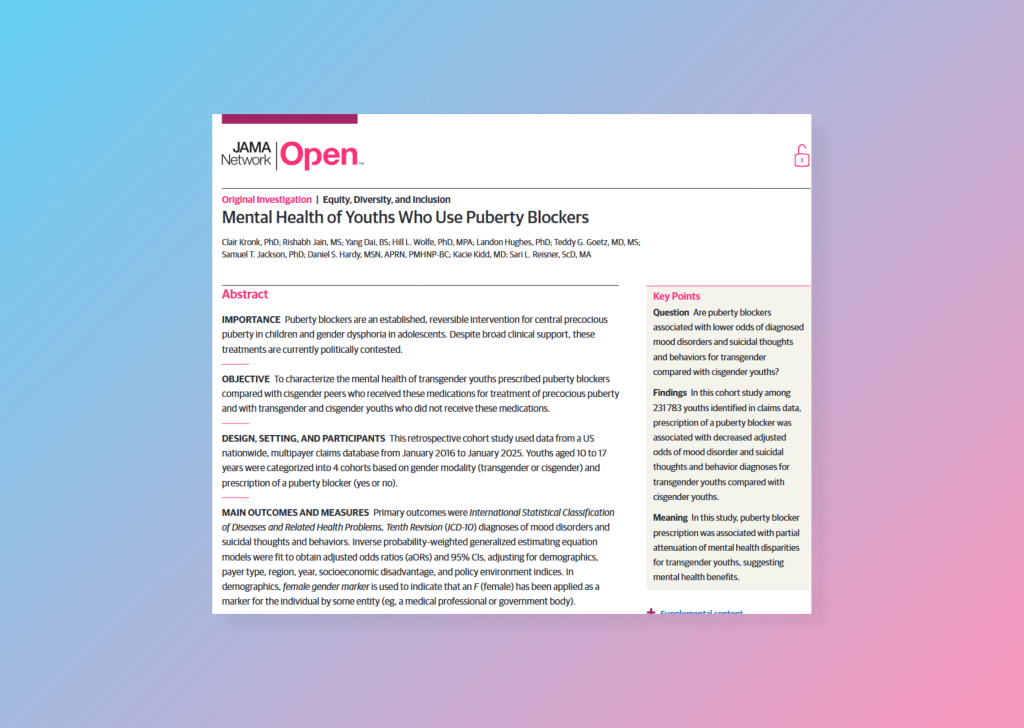
Puberty Blockers and Suicidality: New Study of 230,000 Youths
Lower Suicidality Among Transgender Youths
Read more
Without consent: the scientific misconduct scandal at Norway’s national centre for trans youth
Illegitimate research on trans minors
Read more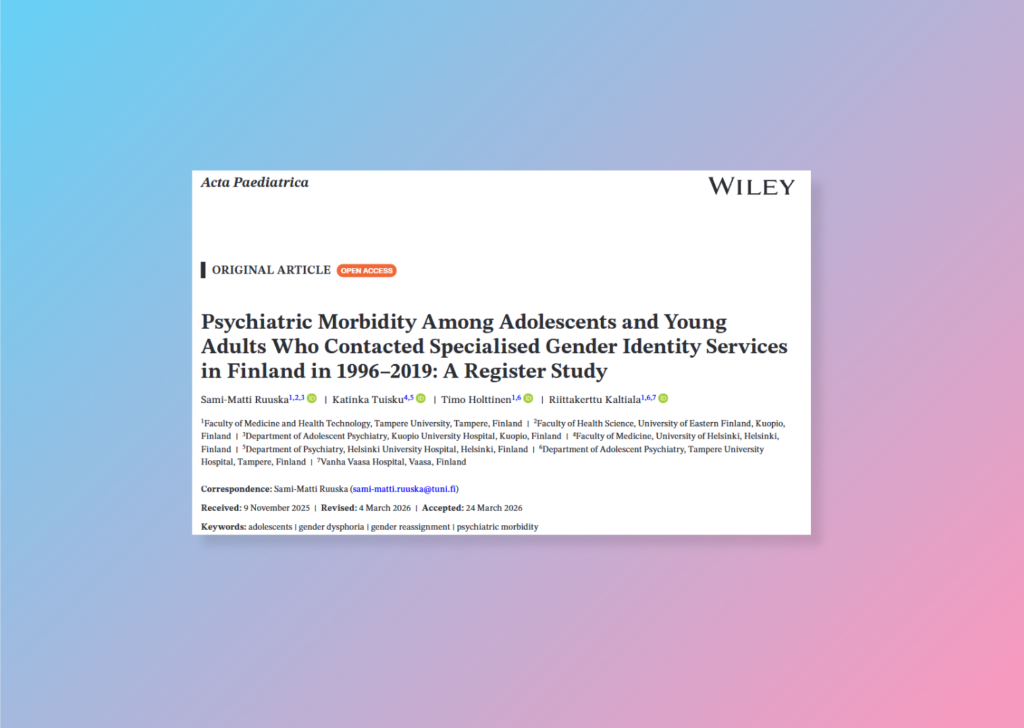
It Is False to Say That Medical Transitions Worsen Young People’s Mental Health
On the pseudoscientific exploitation of a study
Read more
Webinar “A Trans-Skeptical Parenthood” on July 2 at 6:30 p.m.
Trans Youth Trajectories webinar
Read more
2.2% of young people in France are trans or non-binary
Findings from a nationally representative survey
Read more