


Over the past decade, debates about gender-affirming medical care for transgender and non-binary young people have become increasingly polarised, often dominated by abstract arguments about evidence rather than by the lived realities of those directly concerned. A qualitative longitudinal study conducted by Naomie Jade-Ladry, Morgane Gelly and Annie Pullen Sansfaçon (member of TYT), in Quebec and published last week offers a rare opportunity to listen closely to those realities over time, following seven trans and non-binary adolescents and their families across a full year as the young people entered or progressed through puberty and, in most cases, began gender-affirming medical care. Drawing on in-depth interviews at T0 (the moment when young people first expressed a wish to access care) and again at T1 one year later, the researchers illuminate how well-being evolves at the intersection of bodies, relationships, institutions and social recognition.
At T0, puberty itself looms as a source of acute distress for many participants, even before any irreversible physical changes have occurred. Cameron, a trans boy interviewed at T0, captures this anticipatory anxiety vividly when he explains, “I’m scared that… we have a prescription for hormone blockers when it starts, but I’m kind of scared. I ask… like, has it started? And that’s the stress” (Cameron, 11 years old, T0). For these young people, puberty blockers are not experienced as dramatic interventions but as a way of regaining time and control. By T1, Cameron describes a subtle yet profound shift: “Yes, I was happy. Not euphoric, but I was really happy” (Cameron, 12 years old, T1). The absence of unwanted bodily change becomes, in itself, a source of calm, allowing anxiety to recede and making space for everyday concerns to return.
For others, puberty has already left its mark by T0, generating intense dysphoria linked to specific bodily processes. Sloan, a trans boy, speaks with his mother Lindsey about menstruation as something that “generates a lot of dysphoria, which we can’t even name” (Lindsey, mother of Sloan, 14, T0). One year later, after starting puberty blockers, that distress has eased considerably. “I don’t have it anymore because of the Lupron… I definitely feel better,” Sloan says at T1, locating relief not in transformation but in the suspension of an unwanted cycle (Sloan, 15, T1). These accounts underscore how gender-affirming care can function as harm prevention, reducing suffering rather than producing instant happiness.
Hormone therapy, accessed by some participants between T0 and T1, brings more visible changes and, with them, moments of what the study terms gender euphoria. Michael, a trans boy who moved from blockers to testosterone, recalls the sting of being misgendered in public at T0, an encounter his mother Madison remembers as having “really upset him for days” (Madison, mother of Michael, 13, T0). By T1, however, the tone has shifted dramatically. “They call me ‘sir’… That’s my greatest victory,” Michael (14, T1) says. Recognition by strangers, fleeting though it may be, becomes a powerful affirmation, easing social dysphoria and reinforcing a sense of legitimacy in the world.
Not all effects of gender-affirming care are dramatic or immediately perceptible. Kelly, a trans girl on puberty blockers, describes her experience at T0 in almost neutral terms, noting only mild irritation about body hair: “I just take it off… [hair on the arm] I feel like it’s annoying kind of” (Kelly, 12, T0). By T1, this concern has faded into the background, replaced by a general sense of bodily peace. The absence of crisis is itself meaningful here, reminding us that well-being does not always announce itself through visible transformation. Sometimes, as the researchers note, it appears as continuity, stability and the quiet relief of not getting worse.
Crucially, changes in well-being are not confined to individual bodies but ripple outward into social and family life. Sam, a trans boy, enters the study at T0 describing the pain of a friendship that could not survive his transition: “She was supportive at first. Then, at one point, she said it was too much for her” (Sam, 16, T0). One year later, his parents describe a very different picture, marked by social inclusion and confidence. “He had his prom, he looked amazing, and everyone told him: ‘You look so handsome!’” says Jessie at T1, linking Sam’s improved social life to better grades and visible happiness (Jessie, T1). Sam himself reflects that feeling better in his body made it easier to open up to others, creating a virtuous circle between self-confidence and social acceptance.
Yet the study is careful not to present a simplistic or uniformly positive narrative. Even as medical care alleviates certain forms of dysphoria, new tensions emerge. Cameron, now feeling more able to “pass”, worries at T1 about being recognised as trans when starting high school: “I didn’t know who would recognise me” (Cameron, 12, T1). Sloan speaks frankly about losing friends during his transition, while also reframing this loss as an escape from “toxic” relationships (Sloan, 15, T1). Persistent dysphoria continues to shape everyday activities for some, particularly in contexts like sport or swimming, where binders, changing rooms and swimwear remain sources of discomfort despite medical progress.
Perhaps the most important reminder of diversity comes from Ash, a non-binary participant, who does not pursue gender-affirming medical care at all. At T0, aged 11, and again at T1, aged 12, Ash expresses comfort with their body and a strong sense of self, supported by an affirming family and school environment. Their trajectory echoes wider Canadian data: the national survey Being Safe, Being Me (2019) found that while a minority (44 %) of trans and non-binary youth had taken hormones, the majority had not, with 20 % reporting no intention to pursue medical treatment and a further 36 % remaining uncertain. Ash’s experience complicates any transnormative assumption that medical intervention is either inevitable or necessary for well-being. Instead, it reinforces the study’s central message: gender-affirming medical care can be vital and even life-changing for many young people, but it is not the sole pathway to flourishing, and works best when embedded in supportive social contexts that recognise multiple ways of being trans or non-binary.
To access the study, click here
Note: TYT’s science news articles are now written and translated with the assistance of AI. Their content nevertheless relies on a systematic, full human reading of the studies discussed, ensuring the accuracy of the information and allowing the TYT team to freely contextualize and editorialize current research.
More news

The Netherlands strengthens its gender-affirming care model for trans minors
The evidence supports gender-affirming care
Read more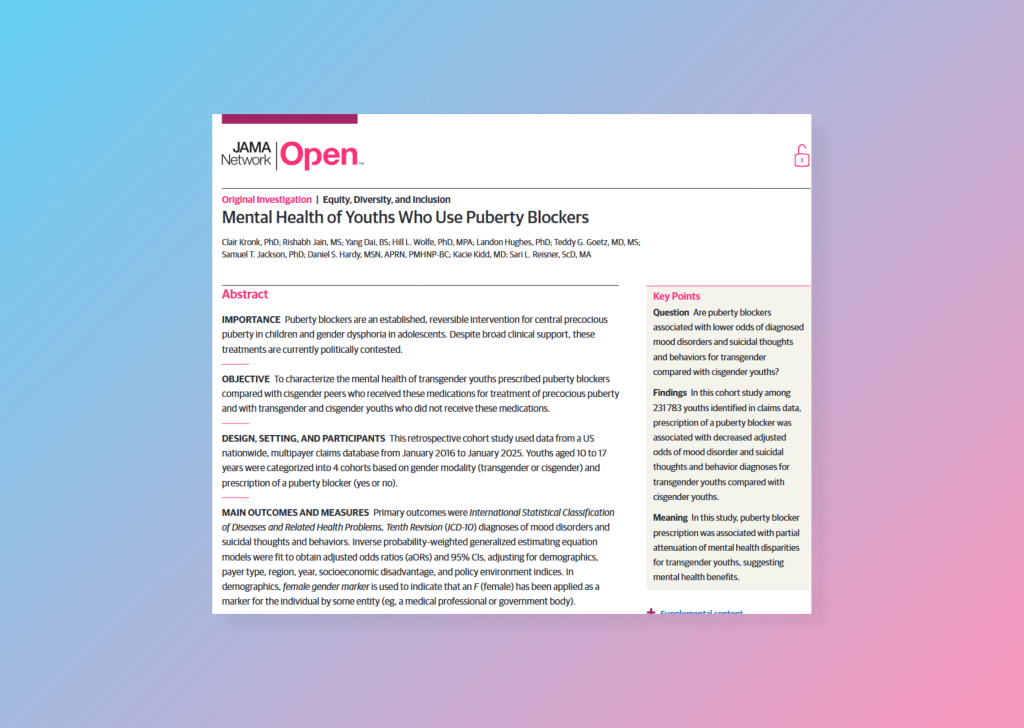
Puberty Blockers and Suicidality: New Study of 230,000 Youths
Lower Suicidality Among Transgender Youths
Read more
Without consent: the scientific misconduct scandal at Norway’s national centre for trans youth
Illegitimate research on trans minors
Read more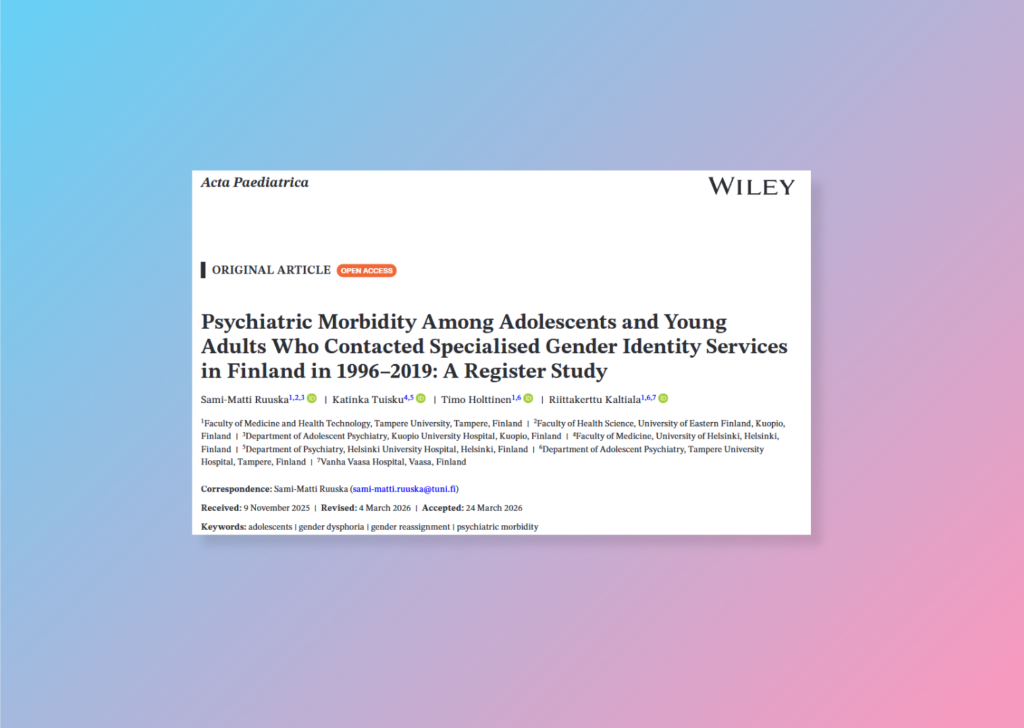
It Is False to Say That Medical Transitions Worsen Young People’s Mental Health
On the pseudoscientific exploitation of a study
Read more
Webinar “A Trans-Skeptical Parenthood” on July 2 at 6:30 p.m.
Trans Youth Trajectories webinar
Read more
2.2% of young people in France are trans or non-binary
Findings from a nationally representative survey
Read more