


Several psychologists who are members of Trans Youth Trajectories have recently published an article in the journal Dialogue on supporting trans youth and, in particular, their families.
According to the authors, coming out as trans is a crucial and often upheaving moment for both young people and their families, disrupting family bonds and generating various fears. Young people seek immediate support from their closed ones for their social and medical transition, but the urgency they feel often contrasts with parents’ need for time to reflect. Parents often express shock at this revelation and a desire for time to accept the situation, fearing that it may be a transient adolescent crisis. This gap reinforces in young people the feeling that they must “prove” the legitimacy of their identity, while parental incomprehension – accentuated by concerns about minors’ capacity to consent to treatment – highlights the need for a balance between respecting young people’s autonomy and ensuring protection.
For the authors, this coming out triggers in many parents a sense of complex grief, an “ambiguous loss” as defined by Jenni Wahlig, because the child is still physically present. This grief, linked to the difficulty of recognizing a child whose gender differs from that assigned at birth, embodies a rupture between the imagined child, shaped by parental projections, and the real child. As illustrated by the testimonies, parents experience this transition as a disruption of the family order, sometimes affecting intergenerational relationships, particularly when coming out to grandparents. The loss of the name given at birth can also intensify this symbolic rupture. This process often requires professional support to help parents redefine their relationship with the child, as maintaining this bond is essential for the mental health of transgender youth.
In the context of gender transition, families create their own rites of passage to mark acceptance of their child’s new identity in the absence of adapted social rituals. These moments – such as celebrations, trips, or changes of environment – offer symbolic space where the transition becomes shared and integrated into the family fabric. Negotiating the new name is particularly revealing: it allows families to reconcile continuity and novelty while preserving attachment to family roots. Trans young people, faced with varying degrees of parental support – between “affirming support” and “conditional support” – may sometimes feel distanced or lead a “double life” to avoid conflicts. Nevertheless, concrete gestures of support, such as choosing clothes or using new names, strengthen family bonds and help navigate this identity crisis, contributing to collective adaptation.
The authors mention various cases encountered in their practice, including Pauline, a trans woman rejected by her family after revealing her trans identity, leading her to experience a difficult period marked by wandering and isolation. She nevertheless finds support and stability in a “chosen family” made up of trans and queer peers, helping her rebuild her life and begin her transition. Later, she gradually restores contact with her parents, although they still show reluctance to fully accept her identity by refusing to use the name “Pauline.” This experience highlights the challenges of autonomy and subjectivation in gender transition, which can reorganise or weaken family ties. A supportive family is beneficial for the mental health of trans youth, reducing the risk of depression and self-harm. When family support is lacking, trans young people often find refuge in peer groups, which function as a “chosen family” offering love, solidarity and validation of their identity. This community – inspired by support networks in queer communities – allows trans people to strengthen their self-affirmation and “restore a sense of belonging to the human community.”
The authors emphasise the importance of adopting a prejudice-free approach to understand the realities of trans people and their loved ones, including siblings who are often overlooked. They highlight the crucial role of professionals in creating a supportive environment for families, thereby promoting safety, well-being and the empowerment of trans youth in a sometimes hostile social context.
To access the full article, click here.
More news

The Netherlands strengthens its gender-affirming care model for trans minors
The evidence supports gender-affirming care
Read more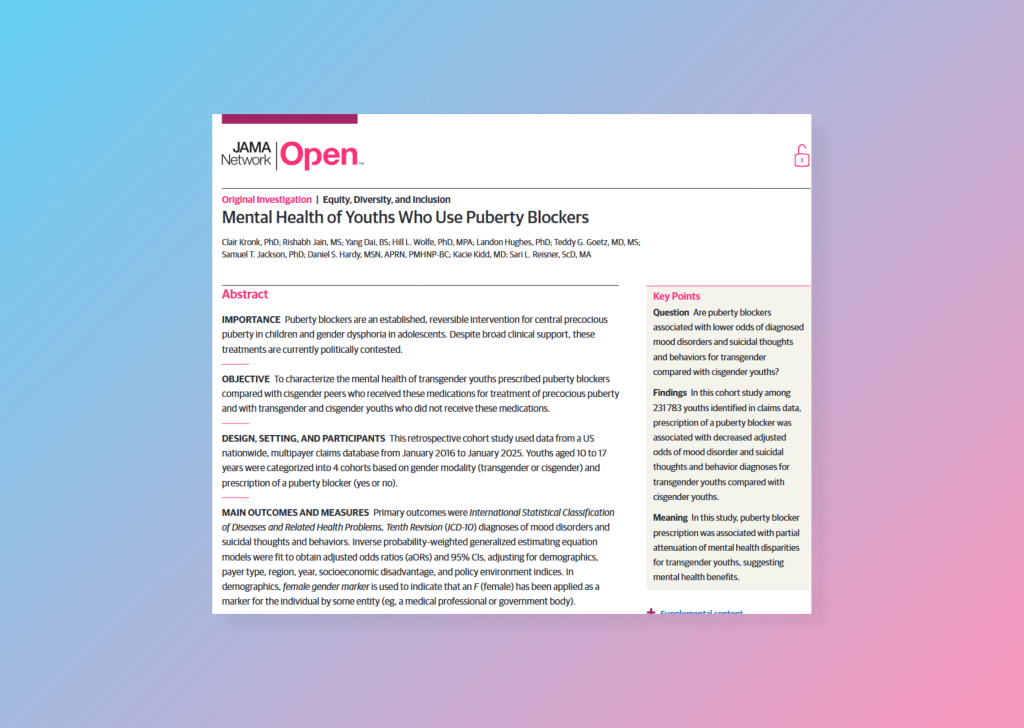
Puberty Blockers and Suicidality: New Study of 230,000 Youths
Lower Suicidality Among Transgender Youths
Read more
Without consent: the scientific misconduct scandal at Norway’s national centre for trans youth
Illegitimate research on trans minors
Read more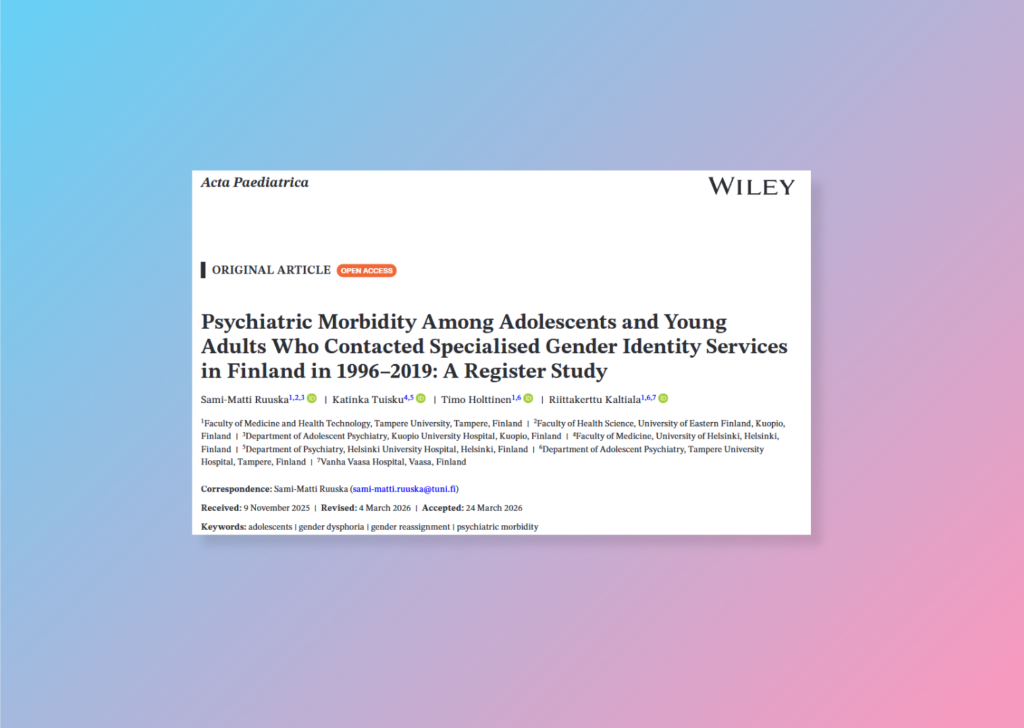
It Is False to Say That Medical Transitions Worsen Young People’s Mental Health
On the pseudoscientific exploitation of a study
Read more
Webinar “A Trans-Skeptical Parenthood” on July 2 at 6:30 p.m.
Trans Youth Trajectories webinar
Read more
2.2% of young people in France are trans or non-binary
Findings from a nationally representative survey
Read more