


A legal analysis of proposed bills and public discourse aimed at banning healthcare for trans minors in France has just been published in the Revue des Droits de l’Homme. The author, Antoine Infantolino, examines in this article the legal legitimacy of proposed restrictions on minors’ access to gender-affirming care, deconstructing arguments based on so-called “medical necessity” (Article 16-3 of the French Civil Code). He first explains that, despite the removal of trans identity from psychiatric pathology classifications (ICD-11, DSM-5), the French legal framework continues to condition healthcare on a medical necessity established through diagnosis. This paradox therefore forces minors to undergo psychiatric validation, rooted in current legal principles, despite an evolving medical discourse.
The article highlights that this diagnostic requirement is criticised because it maintains the pathologisation and psychiatrisation of trans identity, compelling those concerned to fit into an essentialist model of gender in order to make their gender identity intelligible and have their need for care recognised. Yet, the analysis notes, French law does not categorically prohibit healthcare in the absence of medical necessity, as demonstrated by the existence of numerous exceptions in minors’ healthcare (abortion, contraception, cosmetic surgery, etc.). Infantolino concludes that banning transition-related care on the grounds of lack of medical necessity would be neither constitutional nor legally mandatory.
The article then focuses on the central role of consent in access to such care. It recalls that, for minors, medical consent is in principle given by parents or legal guardians, meaning that a minor cannot decide alone to undergo medical transition. However, the law provides for exceptional situations in which a minor may consent alone to medical care, notably in cases of serious danger to their health or to preserve medical confidentiality. These provisions could potentially apply to transition-related care, leaving room for legal interpretation.
In detail, Infantolino examines the argument that minors are too easily influenced to consent to transition-related care. He notes that the law already allows physicians to disregard consent if it is deemed not informed, not freely given, or expressed under pressure. Thus, the legal framework already includes safeguards to protect vulnerable minors, without the need to resort to an explicit ban on such care.
The fundamental role of judges and physicians in these dynamics is highlighted: it is they who, through their interpretation, decide whether a given medical act falls within the exceptions provided for by law. In the absence of clearly established case law, the responsibility lies with them to determine whether puberty blockers or hormone treatments should be qualified as indispensable care or not.
Infantolino sheds light on the potential obstacles that overly broad interpretations of the law might encounter. The risk of conflict with parents, judicial litigation, and fears of stigmatisation of practitioners are all factors that encourage caution before administering care without explicit parental consent.
The author also emphasises that critiques directed at the system – accusing the current legal framework of being insufficient – often rest on value judgments. According to him, these critiques stem from political or ideological preferences rather than from objective legal analysis. Discourses denouncing a supposed “first scandal of the 21st century” operate by opposing transition-related care to other medical acts, without always grounding their claims in comparable normative frameworks. Regarding such narratives, the author states that they are “the product […] of political opinions – which by definition can be neither true nor false – and these discourses cannot be qualified as scientific.”
Finally, the article stresses that, even in the absence of a clear framework allowing autonomous access by minors to transition-related care, French law remains sufficiently flexible to accommodate such practices through the existing exceptions. Any explicit ban would not only require circumventing current principles of health law, but would also have to contend with obligations arising from the European Convention on Human Rights and European Union law.
In conclusion, Infantolino considers that the depathologisation of care and the empowerment of minors in their transition are legally possible, provided that judges and physicians interpret the law in this direction. A clear legislative evolution, rather than a ban, could then ensure both legal certainty and respect for the fundamental rights of trans youth.
To access the full article, click here.
More news

The Netherlands strengthens its gender-affirming care model for trans minors
The evidence supports gender-affirming care
Read more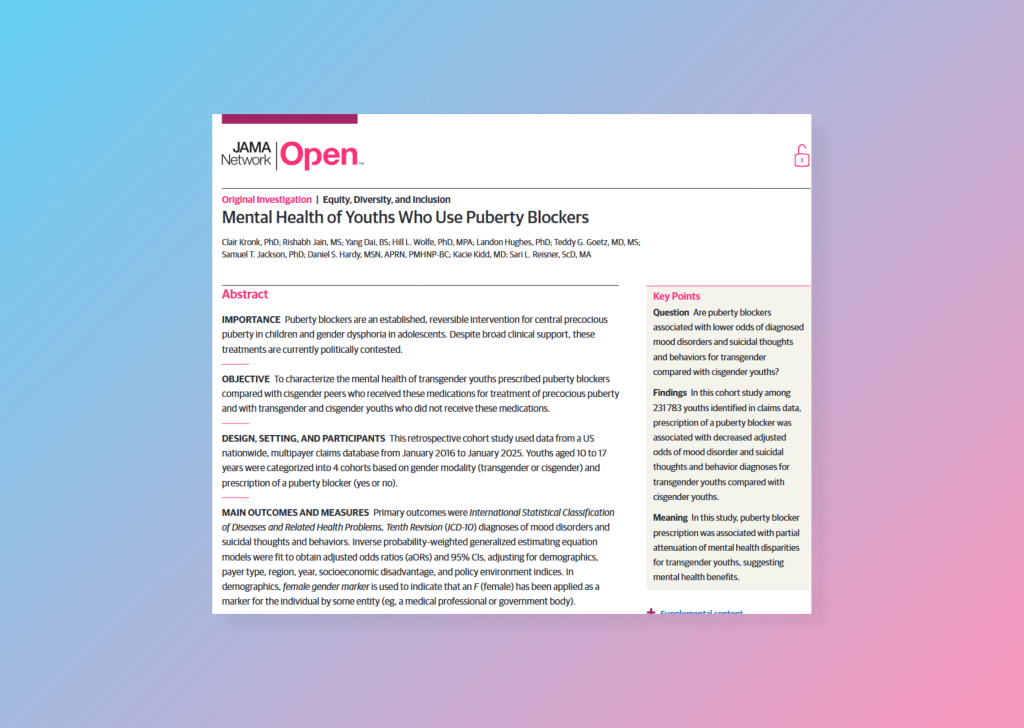
Puberty Blockers and Suicidality: New Study of 230,000 Youths
Lower Suicidality Among Transgender Youths
Read more
Without consent: the scientific misconduct scandal at Norway’s national centre for trans youth
Illegitimate research on trans minors
Read more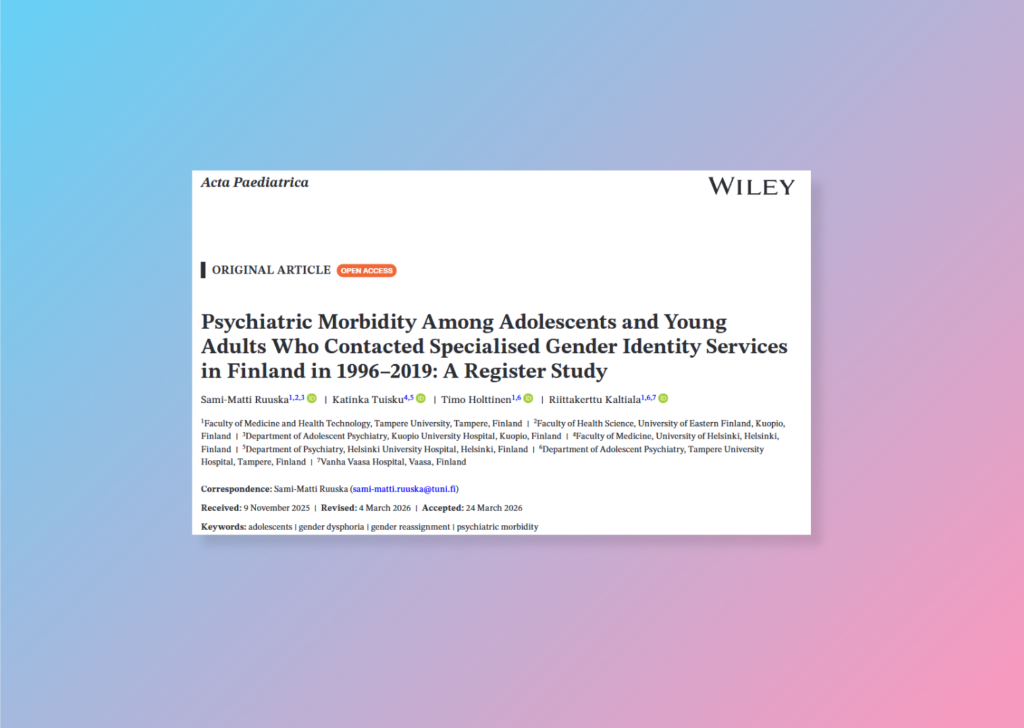
It Is False to Say That Medical Transitions Worsen Young People’s Mental Health
On the pseudoscientific exploitation of a study
Read more
Webinar “A Trans-Skeptical Parenthood” on July 2 at 6:30 p.m.
Trans Youth Trajectories webinar
Read more
2.2% of young people in France are trans or non-binary
Findings from a nationally representative survey
Read more