


A study published in the journal Developmental Cognitive Neuroscience, authored by psychologists, psychiatrists, and neuroscientists from the University of Pittsburgh in the United States, reviews what is known about neurodevelopment during adolescence and clarifies under which circumstances adolescents can decide to obtain gender-affirming care. Indeed, neuroscientific studies are often cited in support of legislation that bans access to gender-affirming care, arguing that maturity of the prefrontal cortex is only reached in adulthood – which would therefore rule out any major decision before that age. The issue raised by the authors is that these studies do not take into account the context in which medical decisions about gender affirmation are made.
Cognitive control in adolescence
Current understanding in the field of adolescents’ neurocognitive development indicates that adolescents can make goal-oriented decisions at the same level as adults, including decisions with long-term consequences, provided they have the appropriate context – which includes adult support, longer time frames, and the information needed to evaluate outcomes. More specifically, laboratory findings assessing cognitive control have shown that during adolescence, prefrontal systems can be recruited in a way that is similar to adults, albeit at a slower pace and with greater variability.
Adolescence is marked by an increase in impulsive, reward-focused, sensation-seeking behaviours that can lead to risky decision-making, exacerbated in the presence of peers (risk-taking behaviours, substance misuse, etc.). These risk-taking behaviours are associated with an asynchronous maturation of striatal reward systems and prefrontal executive systems.
These impulsive and risky behaviours are more likely to occur in “hot” decision-making contexts – that is, when a decision must be made within a short time frame or under heightened emotion. However, these “hot” contexts are not those of medical decisions, which unfold over an extended period, are deliberated, involve adult support, and engage neurocognitive processes different from those characterised in “impulsive” decision-making.
“Cold” decision-making contexts, by contrast, promote more thoughtful planning, deliberation, and the ability to reflect on and simulate the potential costs and benefits of decisions, thereby reducing the level of uncertainty inherent to decisions made in “hot” contexts.
Medical decision-making contexts for gender affirmation are typically “cold” contexts, involving periods of several months – or even several years depending on the country – and engaging adults in shared decision-making and support, including healthcare professionals.
Evidence suggests that adolescents as young as 12 years old have the capacity to participate in medical decisions insofar as they can communicate their choice, understand the information provided about the proposed medical treatment, reason (deliberate about risks and benefits), and appreciate both the options and the personal consequences of their decision. Overall, the neurodevelopment literature indicates that adolescents possess the neurocognitive maturity required to make long-term decisions, including decisions about gender-affirming care, in so-called “cold” contexts and with adequate time for reflection and deliberation.
Developmental consequences of psychopathology among trans and non-binary adolescents
Although the mechanisms increasing mental health problems at puberty are not yet fully established, the onset of puberty has been consistently associated with an increase in psychopathology, suggesting that puberty may contribute to the higher prevalence of psychiatric disorders during adolescence. Depression and anxiety associated with pubertal changes are particularly pronounced among trans and non-binary youth, for whom pubertal physical changes (that is, breast development, facial hair growth, voice deepening, the onset of menstruation) can frequently cause additional distress and discomfort, as their bodies begin to look and feel increasingly misaligned with their gender identity.
The emergence of psychopathology – notably depression and anxiety – among trans and non-binary adolescents is attributed to two population-specific factors, in addition to puberty-related factors: gender minority stress and gender dysphoria. The former refers to external social stress generated by stigma, discrimination, penalisation, or pathologisation of gender nonconformity. The latter refers to internal distress related to bodily developments that are incongruent with one’s gender identity. These stressors translate, for example, into poverty that is twice as common among trans youth (1/3 of trans and non-binary youth in the USA are poor, and roughly as many are homeless) compared with cis youth. Some young people experience the combination of both factors: social rejection and inner distress.
These adolescent stressors can alter developmental trajectories of nervous systems, notably reducing the potential window of adaptive prefrontal plasticity known to be critical for brain development. The challenges related to interactions between elevated cortisol (a stress-related hormone) and pubertal hormonal development can profoundly affect adolescent trajectories, with consequences for adult outcomes.
Gender-affirming care reduces mental health risks
Although trans and non-binary youth are at increased risk of psychopathology and stress, gender-affirming care appears to reduce these risks. Studies tend to show a reduction among trans adolescents (compared with trans adults) in long-term depressive and suicidal risk linked to gender-affirming hormonal care, whether puberty blockers or sex hormones.
According to the authors, an effective healthcare system for trans and non-binary youth seeking gender-affirming care should include two key components : first, training healthcare professionals to provide well-informed and culturally competent care to trans and non-binary youth; and second, effectively assessing the decision-making capacity of trans and non-binary adolescents, jointly with their parents and with support from healthcare professionals, to determine their understanding of the interventions, their short-, medium-, and long-term benefits and risks, and their ability to make medical decisions autonomously with the consent and support of caregivers and parents.
To read the full study, click here
More news

The Netherlands strengthens its gender-affirming care model for trans minors
The evidence supports gender-affirming care
Read more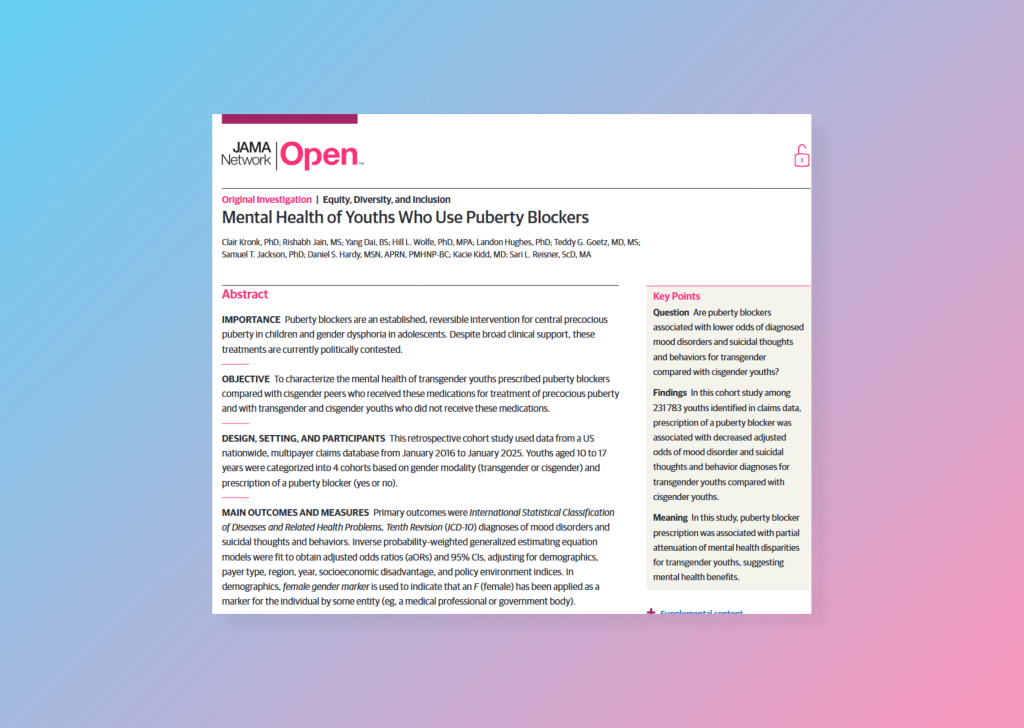
Puberty Blockers and Suicidality: New Study of 230,000 Youths
Lower Suicidality Among Transgender Youths
Read more
Without consent: the scientific misconduct scandal at Norway’s national centre for trans youth
Illegitimate research on trans minors
Read more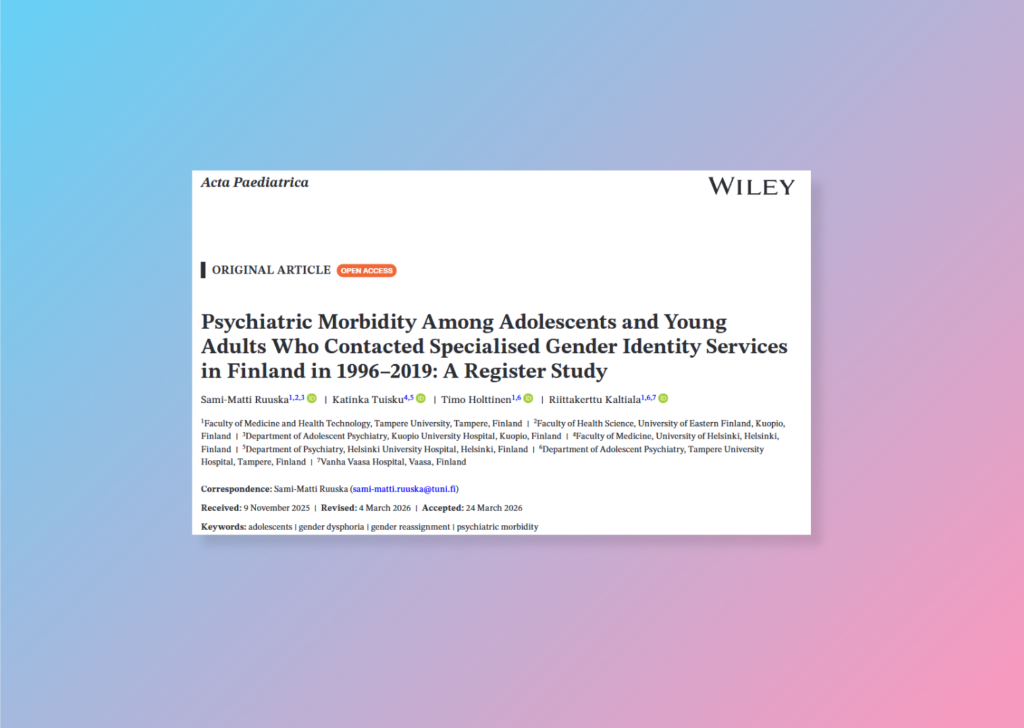
It Is False to Say That Medical Transitions Worsen Young People’s Mental Health
On the pseudoscientific exploitation of a study
Read more
Webinar “A Trans-Skeptical Parenthood” on July 2 at 6:30 p.m.
Trans Youth Trajectories webinar
Read more
2.2% of young people in France are trans or non-binary
Findings from a nationally representative survey
Read more