


In this article co-written by Florence Ashley, bioethicist and lawyer and member of Trans Youth Trajectories, the authors develop ethical reflections around major clinical issues affecting trans health, using the framework of modern bioethics: the study of principles, or “principlism.”
The principlism approach aims to balance, in a healthcare decision, four non-hierarchized ethical principles established by Tom Beauchamp and James Childress: respect for autonomy, beneficence, non-maleficence, and justice.
Respect for autonomy refers to the right of patients to choose between clinical options based on their own values, beliefs, and preferences. To respect this principle, clinicians have the duty to provide patients with the necessary information so they can make a decision. In trans healthcare, this principle refers to bodily autonomy and gender self-determination. It requires informing the patient and obtaining their consent (or assent). Although it supports access to gender-affirming care, it does not obligate clinicians to provide it if, for example, those treatments are deemed non-beneficial.
Beneficence is the obligation for caregivers to provide care that benefits others. To respect this principle, the intervention must improve well-being or provide another advantage. This principle supports facilitating access to gender-affirming care positively, encouragingly, and without judgment. Supporting a gender-affirming process has been shown to improve the mental health and psychosocial functioning of the individual.
Non-maleficence, summarized in the proverb “first, do no harm” (“primum non nocere”), is the obligation not to cause unnecessary harm. This principle involves limiting harm, side effects, and other involuntary damage. Suspending or refusing access to gender-affirming care is often justified by this principle due to the risks of adverse effects or future regret. However, it is important not to rely solely or exaggerate this principle of non-maleficence, because the simple presence of a risk cannot alone justify refusing a treatment – few health interventions are completely risk-free.
Beneficence and non-maleficence are often considered together in studying the benefit–risk balance of a clinical intervention. But in ethical practice, risks (non-maleficence) must be studied not only by comparison with benefits (beneficence), but also with respect for autonomy and justice. In the scientific uncertainty that characterizes gender-affirming care, a cautious approach is to proceed carefully, giving attention to the wishes of the person concerned (autonomy), choosing treatments with potentially beneficial effects (beneficence), and starting with the most reversible care options to minimize unforeseen harm (non-maleficence).
The principle of justice lies in the equitable distribution of benefits and burdens in society. It supports access to care for people disadvantaged economically, for example, but also equity in the levels of evidence required to access otherwise similar care (for example, the prerequisites in terms of medical evidence for the use of puberty blockers in a trans adolescent should not be disproportionately higher than for central precocious puberty in a cisgender adolescent).
In pediatric gender care, the principle of non-maleficence is often invoked to delay or block access to gender-affirming care because of the possibility that gender dysphoria in these young people might spontaneously resolve. The authors acknowledge that earlier studies suggested that gender dysphoria diagnosed in childhood did not “persist” into adolescence, but they criticize the childhood diagnostic conditions that did not allow distinguishing between trans children desiring social transition and gender-nonconforming children identifying with their assigned gender. Indeed, recent studies mobilized by the authors contradict this notion of spontaneous resolution of gender dysphoria into adolescence: 97.5% of trans children who began social transition continued five years later to identify in a gender different from that assigned at birth.
This social transition in childhood is also subject to ethical considerations by the authors. Delaying a social transition desired by the child obstructs both the principle of respecting the development of the child’s autonomy and the principle of justice, which implies rejecting double standards that would privilege one identity over another. In this context, clinicians should encourage parents to follow their child’s initiative in exploring their gender, including regarding social transition, without external assumptions of a predetermined gender trajectory. They can do so by helping parents create a safe and supportive environment for their children to explore and express their gender identity and choices about social transition, regardless of age.
With regard to puberty blockers, the principles of autonomy and justice invoked by the authors argue in favor of access to them. Not providing these treatments when they are requested implies that clinicians are preferring an endogenous puberty that is irreversible and potentially distressing. Such a stance signals that one identity (cisgender) is being privileged over another, which is not a neutral decision. With respect to the principle of non-maleficence, the authors rely on medical evidence indicating the full reversibility of puberty blockers in terms of fertility, while nevertheless recommending that a fertility preservation consultation be offered in view of the future choices the adolescent may make in their transition pathway. The researchers consider that puberty blockers could be offered to adolescents questioning their gender who need more time to explore their gender identity, regardless of whether gender dysphoria is present or how long it has existed.
For sexual hormones, ethical questions arise on non-maleficence in adolescents due to their partially irreversible nature and risks of future regret. The authors distinguish future regret from detransition, noting that most people who have detransitioned do not regret their transition, and this regret remains very rare compared with other medical interventions.
Beyond weighing benefits (beneficence) shown for sexual hormones in adolescents who express the need, and risks (non-maleficence), which are equally difficult to ethically ascertain through randomized controlled trials, there is also the need to balance these principles with autonomy and justice. This implies that hormonal care could only be refused if there is clear evidence that risks outweigh benefits – not merely due to lack of clear evidence that benefits outweigh risks.
The role of clinicians is not to determine whether an adolescent should receive gender-affirming care, but rather to facilitate a collaborative decision-making process involving the young person and their parents. Clinicians must offer listening, support, informational guidance, and a space free from ideology so that the young person and their parents can explore concerns and doubts, weigh risks and benefits associated with gender-affirming medical treatment, and thus make decisions that best reflect their desires, values, and priorities.
To access the complete study, click here.
More news

The Netherlands strengthens its gender-affirming care model for trans minors
The evidence supports gender-affirming care
Read more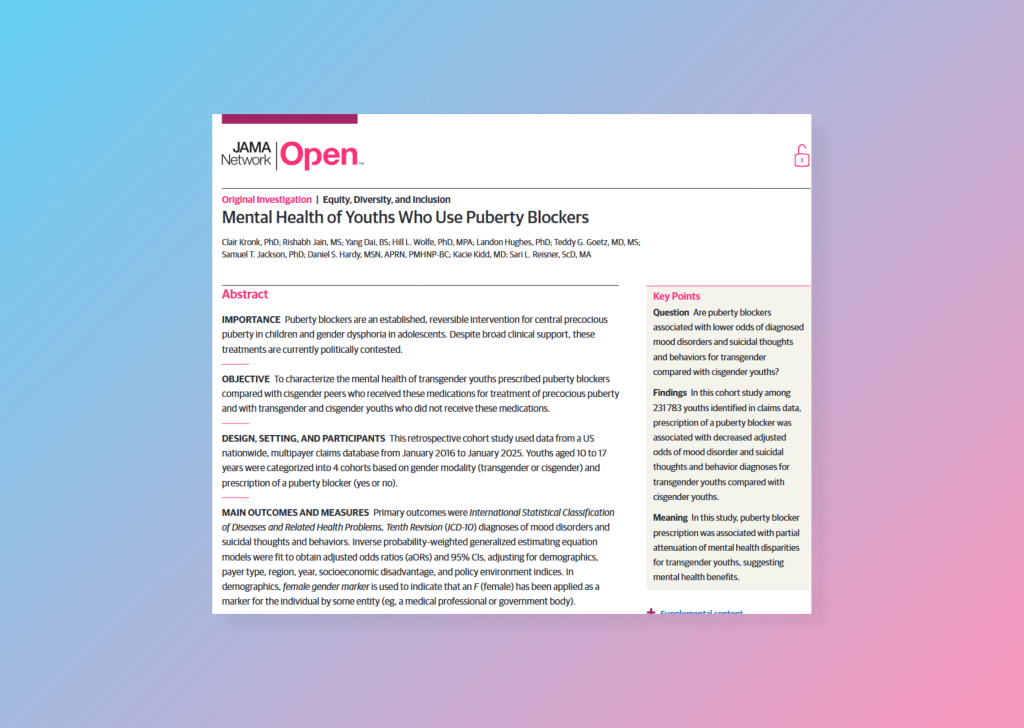
Puberty Blockers and Suicidality: New Study of 230,000 Youths
Lower Suicidality Among Transgender Youths
Read more
Without consent: the scientific misconduct scandal at Norway’s national centre for trans youth
Illegitimate research on trans minors
Read more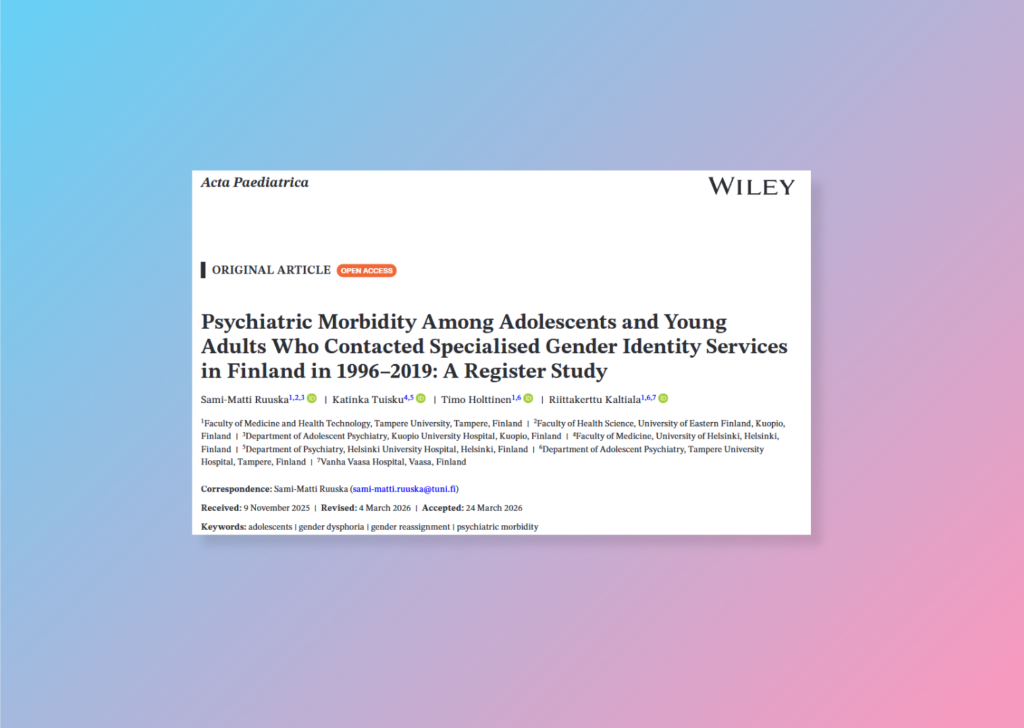
It Is False to Say That Medical Transitions Worsen Young People’s Mental Health
On the pseudoscientific exploitation of a study
Read more
Webinar “A Trans-Skeptical Parenthood” on July 2 at 6:30 p.m.
Trans Youth Trajectories webinar
Read more
2.2% of young people in France are trans or non-binary
Findings from a nationally representative survey
Read more