


A newly published study led by Annie Pullen Sansfaçon – a member of TYT – and her team examines a still little-explored question: how do parental reactions and support shape the trajectories of young people who have begun and then interrupted a gender transition? Between 2020 and 2022, the researchers conducted 25 semi-structured interviews with young people aged 16 to 25 who had started and then stopped a social, legal, or medical transition, and who were based in the United States, Canada, Europe, and Indonesia. These interviews aimed to retrospectively analyze changes in perceived parental support before, during, and after transition and detransition.
The findings identify four types of parental support trajectories: stable and supportive, stable and non-supportive, progressively supportive, and unstable (ambiguous and/or conditional). Stable forms of support remain very rare, but they clearly foster young people’s resilience. Conversely, ambiguous or conditional attitudes – such as verbal support without practical recognition – can fuel doubt, gender-related pressures, and identity confusion. In this way, the quality of the parental relationship directly influences how young people experience their transition or detransition. The authors also note that parental gender rigidity and lack of support can lead to secret or unsupervised transitions and may also play a role in some detransitions.
The testimonies show that parental support is not linear: it evolves, is redefined, and sometimes erodes over time. For Yaël, a non-binary young person, rejection took a brutal form. Yaël recounts : “When I brought a girl home when I was 15, [my mother] kind of kicked me out and eventually took me back and when I came out as trans [ ..] she didn’t talk to me for a week, and then she pretended to accept it, but in fact she forced herself to… for a very long time she forced herself to use my deadname and my wrong… wrong… to misgender me, and in fact you could see it because when she wasn’t thinking, she used the right name, […] and the right pronouns, and when she was thinking, she made sure to use the wrong ones.” This ambivalence illustrates the tension between parental love and normative rigidity. For Yaël, this attitude ultimately resulted in another eviction from the family home: “She kicked me out again, I was 18… 19 years old at the time.”
Another testimony, that of Eleanor, reveals the psychological violence that can result from a total absence of support. She recalls that when she came out, her mother screamed for hours and called her a “freak”. She had to take refuge in the bathroom and lock the door. Because of her mother’s non-acceptance, Eleanor continued her social transition in secret at school at the age of 15, living in constant fear that her transition would be discovered by her mother and that her trans identity would be revealed to her friends. These accounts reflect the same pattern: when the home becomes hostile, young people lose control over their bodies and their identities, and sometimes find themselves forced to act in secret, in situations of precarity and isolation.
Some, like Théo, tried to regain control over their trajectory by obtaining hormones on their own: “I discovered that it was possible to get hormones without a prescription. See, I, I wasn’t… my parents had said some things that make… made me think they’d be not, uh, entirely [on board] with me transitioning and [..] by the time I was 16, I was getting really very desperate. […] I managed to get together enough money; I opened up a PO box in [name of city], and I was able to get the hormones that I wanted.” These situations of hidden transition illustrate the consequences of a parental environment perceived as threatening, where fear of rejection pushes young people to isolate themselves or take medical risks. The lack of family support thus becomes a factor of precarity and danger.
By contrast, accounts of stable and affirmative support show the protective effects of open and supportive parenting. Two young people describe parents who took the time to inform themselves or to arrange medical appointments for their child. Sasha, for example, emphasizes her mother’s kindness: “When I started IDing as trans, yeah, I, you know, told my mom first, and you know she was really confused, but she wanted to be supportive and was always supportive and did tons of research, and everything was just trying to do the best thing.” Such behaviors strengthen self-confidence and young people’s ability to later go through a detransition without shame or guilt. This autonomy developed within the family also makes it easier to withstand transphobic attitudes, as explained by Kit, a 24-year-old non-binary person: “I am just able to ignore it and not care, and roll my eyes a little bit and move on immediately …because I get so much acceptance in the other parts of my life because I have such positive experiences being, like, truly understood and recognized […] by my friends, […] my roommates, and by most of my family members who I talk with on a regular basis.”
The progressive support trajectory is more common than the previous one. Several participants, like Lea, describe parents who were initially wary or overwhelmed but who eventually came to accept their child over time, often following the involvement of health professionals or support groups. Lea, speaking about her mother, explains: “She joined a group for parents of trans kids […] run by a couple of people who worked at [a] counseling service. And I think when she was there, she kind of came around, and I think that was mostly because all those questions she had, they could answer them there. And I think they were able to reassure her that it wasn’t the end of the world – and stuff like that. And how to have conversations with me that I would need to have, and how to use my pronouns or how to react when she accidentally used the wrong ones, and stuff like that. So, I think it was that group that really made the difference.” This type of trajectory demonstrates the importance of dialogue, but also the possibility of parental change. For the research team, these examples show that support can be learned and is not limited to families who are already informed.
By contrast, unstable forms of support – which may fluctuate between conditional and/or ambiguous support – plunge young people into a sense of emotional insecurity, with constant emotional back-and-forth making sustained self-affirmation difficult. Conditional support is offered only at certain stages and under certain expectations, creating the impression that it can be granted or withdrawn at any time, and therefore is never truly secure. Henry, a young man who detransitioned after a transfeminine pathway, summarizes the effects of this conditional support, which his parents offered only for his detransition: “Though if I had a choice, I would still want to be a female. If given the chance, without those embarrassments, those people looking down on me and being neglected by my family. If I had that free will, I would still love to be a female.” Ambiguous support, for its part, is characterized by contradictory and inconsistent parental attitudes stemming from misunderstanding or doubt, where words and actions do not align, reflecting above all an inner conflict between stated values and difficulty accepting the child’s situation. Emma, for example, recalls her father’s reaction: “I told him like, ‘hey, I don’t feel like a woman.’ He just kind of said like, ‘okay.’ And like, nodded. We didn’t really go beyond that. I’m not sure why; I think he was uncomfortable with that, with being told that. (..) I think he thought he had failed as a parent, or something, because by the look on his face, he seemed so worried. ‘What do you mean, you don’t feel like a woman? Where did I go wrong?’ Type thing.”
The researchers situate these testimonies within a polarized political context. Media coverage of the concept of rapid-onset gender dysphoria (ROGD) has contributed to fueling parental anxieties and public debates about the legitimacy of affirmative parental support. This climate of suspicion heightens fear of regret and increases parental control over transition pathways. The study warns that this moral panic surrounding transition may discourage parents from fully supporting their children.
Annie Pullen Sansfaçon’s team emphasizes the responsibility of professionals in supporting parents. Practitioners must be properly informed in order to recognize the diversity of transition pathways, which include possible detransitions – without hierarchy or pathologization. This research highlights a central fact: unconditional parental support emerges as a key determinant of young people’s freedom and gender autonomy. Whether in the context of transition or detransition, such support – when stable or progressive, and unconditional – becomes the foundation for healthy identity exploration. Conversely, the absence or instability of parental support fosters emotional precarity, shame, and secrecy. The participants’ voices testify powerfully to this reality: what matters above all is being heard, understood, and loved without conditions.
This article was translated from French into English using artificial intelligence tools. Verbatims excerpts are from the original study.
More news

The Netherlands strengthens its gender-affirming care model for trans minors
The evidence supports gender-affirming care
Read more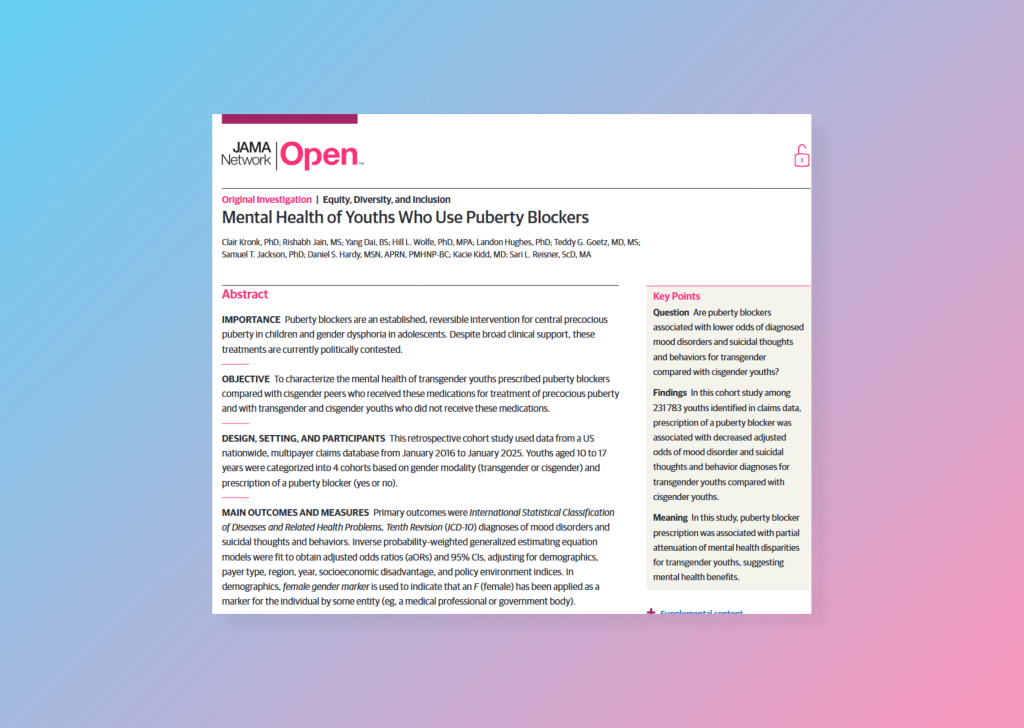
Puberty Blockers and Suicidality: New Study of 230,000 Youths
Lower Suicidality Among Transgender Youths
Read more
Without consent: the scientific misconduct scandal at Norway’s national centre for trans youth
Illegitimate research on trans minors
Read more
It Is False to Say That Medical Transitions Worsen Young People’s Mental Health
On the pseudoscientific exploitation of a study
Read more
Webinar “A Trans-Skeptical Parenthood” on July 2 at 6:30 p.m.
Trans Youth Trajectories webinar
Read more
2.2% of young people in France are trans or non-binary
Findings from a nationally representative survey
Read more