


The study led by Morgane A. Gelly, Sidonie Atgé-Delbays and Annie Pullen Sansfaçon, a member of TYT, examines how youth who have detransitioned perceive social, media and scientific discourses about their experience. Detransition, defined as the interruption or reversal of a gender transition process, is still poorly understood and often misrepresented. For these young people, dominant narratives neither reflect the diversity nor the complexity of their lived experiences, generating a feeling of invisibility. Dylan, 22, shares: “I’ve never met anyone else who stopped. Never heard of anyone else who stopped, like your email [to participate in the research].” These gaps in representation feed their social isolation and reinforce personal misunderstanding.
Media discourses, in particular, tend to simplify and homogenise detransition experiences. Often these narratives emphasise regret or error, overlooking the diversity of trajectories. Emma, 18, states: “In every media piece that I’ve seen featuring trans people, it’s always, like, they just know, like, ‘I am this gender from the get-go.’ and there’s no portrayal of exploration and changing your mind and the dis-comfort and all that” This reductive portrayal recognises neither positive aspects nor the ambivalent feelings often mentioned by these youth. The article highlights that such limited representation fuels harmful stereotypes.
Another source of frustration for participants is the instrumentalisation of their journey in public debates. They denounce the use of their experience as an argument against trans rights. Jada, 22, explains: “They take an element of my story, and they use it to justify […] that nobody should transi-tion, so we have to change all these laws so that people don’t get access to transitioning. And […] it makes me feel bad because, like, that’s not what I believe, and it’s not my motive.” This political appropriation, often driven by gender-critical groups, further marginalises them and deprives them of their own narrative.
Some detrans youth condemn narratives that portray them as influenced by external pressures, questioning their autonomy. Theo, a 19-year-old trans woman, criticises the idea that “they claim that there are, like, mysterious Internet grooming gangs or something going after them,” calling it “ridiculous and misogynistic.” Eleanor, 24, notes that some people view detransition as due to a lack of support, but emphasises that this remains a minority view. These narratives, although different, neglect the agency of young people in their decisions.
Many detrans youth report feeling excluded or silenced, notably by trans communities. Aren, a 24-year-old agender person, testifies: “But, like, people were obviously really mad at me because they thought I was a TERF.” Others, like Shane, agender and 21, describe losing online support: “But once I started to come out about these things, I lost a lot of support and […] community, just because these people felt like I’m a traitor now.” Some choose silence to avoid criticism or the instrumentalisation of their story. Sasha, 21, explains: “I want to talk about this and, like, you know, do some-thing, but I don’t want, like, my story to be used for, like, an agenda either.” This forced silence fuels invisibility and limits constructive dialogue about their paths.
Facing this rejection, some young people turn to gender-critical groups, even if they don’t share their ideology. Sun, 20, describes this dilemma: “At the time, I was just bored and then quarantined and attention starved. And suddenly all these TERFs were like jumping on me, like bowing down to me. And I stupidly was like, “Oh, this is fine, I guess. Like “I’m being listened to for once. I actually have a lot of really nuanced things to say, and these people are listening to me, so I’m going to keep feeding it to them’.” This need for support, combined with a lack of alternative representations, places them in ambivalent situations where they must navigate between belonging and critical distance.
The impacts of these polarised discourses go beyond individuals. They fuel political debates that restrict access to gender-affirming care, notably for trans youth. Participants express concern about this dynamic, where their experience is exploited to justify restrictive policies. Theo, 19, declares: “The only people who benefit is rightoid politicians with their idiot culture wars and nobody else, which is, I think, quite sad.” These diverted uses respond neither to their needs nor to those of trans people.
One major issue raised by the article is the impact of these narratives on the resilience of detrans youth. The saturation of negative discourses, often centred on regret and mistakes, reinforces feelings of sadness, confusion and self-deprecation. Sun illustrates this point: “They’re calling bodies like mine mutilated. And I just kind of got addicted to it because it was, in some ways, cathartic. […] It was literally self-harm [laughs]. But, yeah so, I just felt mutilated.” These representations harm their ability to overcome challenges related to their path.
The authors also highlight a form of epistemic injustice, where dominant narratives invisibilise or distort detrans youth’s experiences. By depicting them as exceptions or proof of error, these discourses reinforce cisnormative norms and exclude any diversity of paths. Sasha, 21, laments: “You know, when I was first realizing all of this, like, I searched things, like, I tried to find things, and you know, what I found was just so minimal, and it was very upsetting to me.”
This invisibility also translates into a lack of research and accessible information on detransition. Several participants, like Jona, 23, joined the study to help fill this gap. “I really want the information to be, um, available. And I, I think studies are really important,” she confides. This absence of data reinforces their isolation and complicates their ability to find answers to their questions.
Detrans youth judge representations of their paths as insufficient and biased, fuelling a sense of invisibility and injustice. These dominant narratives minimise their credibility and diversity, fostering isolation and confusion. Some, in search of recognition, turn to gender-critical groups, although these regret-focused narratives sometimes reinforce self-hatred. By invisibilising nuanced experiences, these stories support a cisnormative and binary view of gender identities, denying the complexity of individual paths.
Instrumentalising detransition to restrict trans rights does not address the needs of detrans youth and deepens divisions between communities. Detransphobia, reinforced by stereotypes such as the idea that detrans people are transphobic, contributes to their silencing. The authors call for creating inclusive and safe spaces, allowing detrans youth to share their experiences without fear of being marginalised or used for political purposes.
To read the study in English, click here.
More news

The Netherlands strengthens its gender-affirming care model for trans minors
The evidence supports gender-affirming care
Read more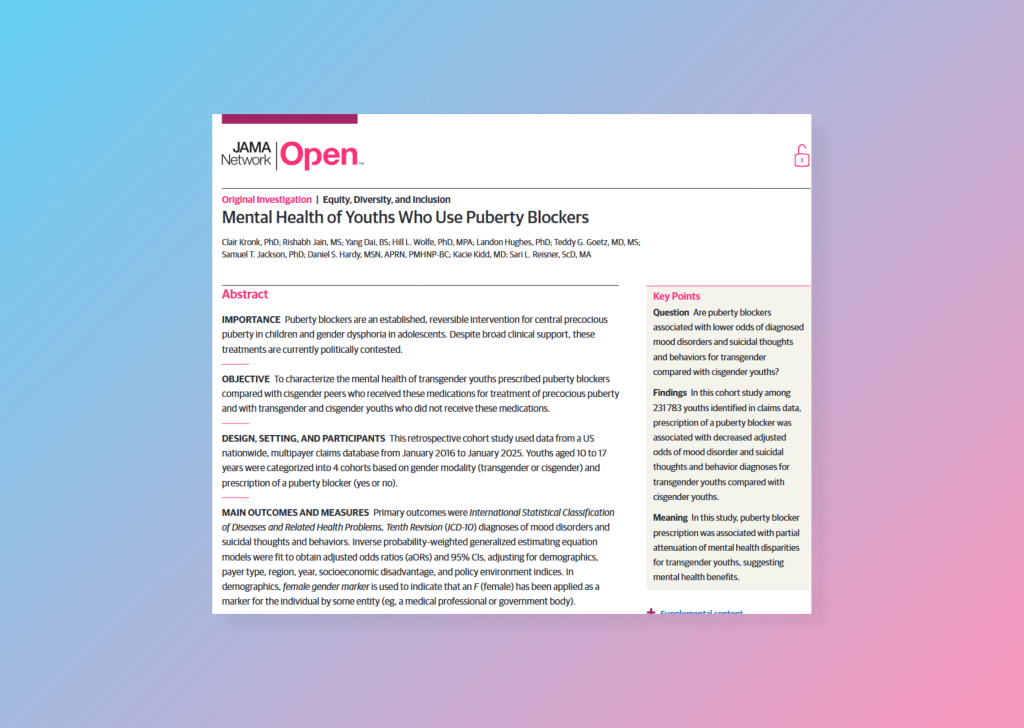
Puberty Blockers and Suicidality: New Study of 230,000 Youths
Lower Suicidality Among Transgender Youths
Read more
Without consent: the scientific misconduct scandal at Norway’s national centre for trans youth
Illegitimate research on trans minors
Read more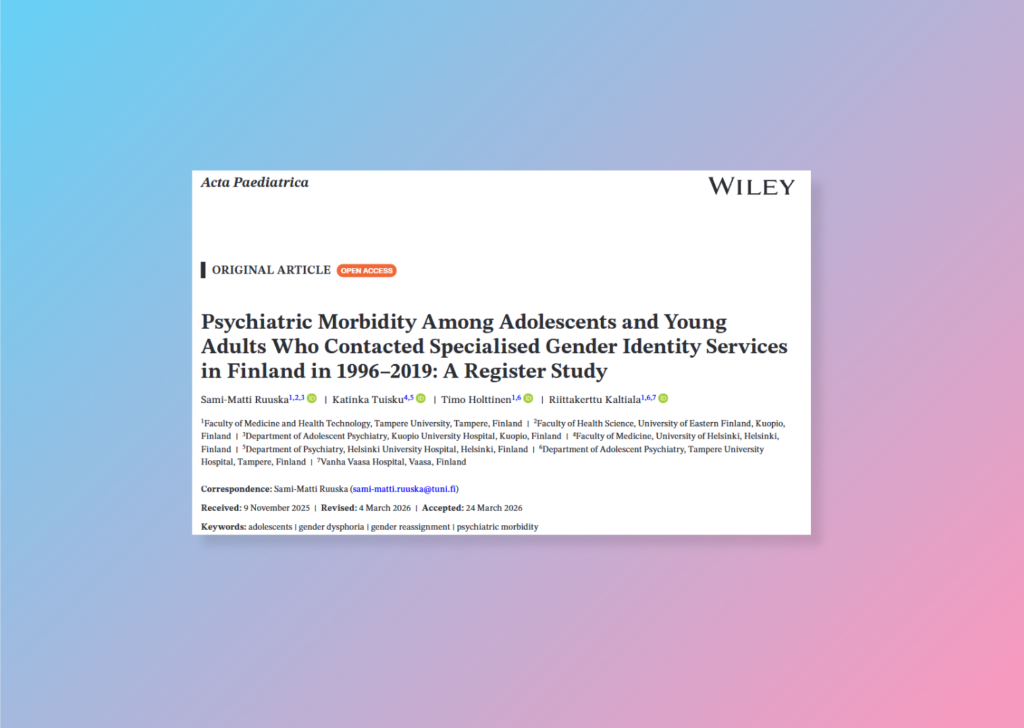
It Is False to Say That Medical Transitions Worsen Young People’s Mental Health
On the pseudoscientific exploitation of a study
Read more
Webinar “A Trans-Skeptical Parenthood” on July 2 at 6:30 p.m.
Trans Youth Trajectories webinar
Read more
2.2% of young people in France are trans or non-binary
Findings from a nationally representative survey
Read more