


Fertility preservation for trans minors or young people questioning their gender is a complex issue involving reproductive rights, medical ethics and psychological support. Chrystelle Lagrange and Fanny Poirier, clinical psychologists, examine in their article the challenges faced by young people and their families when gender-affirming hormone treatment is considered. These interventions, while essential for identity flourishing, can affect future fertility, making prior reflection indispensable.
The authors recall that legislative changes, such as the abandonment of mandatory sterilization for legal gender recognition, marked a turning point in the recognition of transgender people’s rights. However, despite international recommendations in favor of clear and repeated information over time about fertility preservation options, few transgender minors choose to cryopreserve their gametes. This low uptake is explained by practical barriers, reluctance related to medical techniques, or difficulty projecting oneself into future parenthood. A 15-year-old transgender girl, Eva, illustrates this dilemma. Refusing to consider the preservation of her sperm, she prioritized the rapid initiation of hormone treatment, highlighting the sense of urgency felt by some young people.
Decision-making about fertility preservation is particularly complex for minors because it involves considerations of their emotional and cognitive maturity. Puberty blockers and hormone treatments create distinct timeframes: in the short term, they change physical development; in the long term, they potentially alter fertility. The case of 17-year-old Malou shows the importance of gradual support. After two years of individual therapy and in-depth discussions with her parents, she was able to consider and undergo gamete preservation through constructive dialogue.
Family consultation as a whole plays a key role in supporting minors. The authors describe these consultations as safe spaces where each family member can express their concerns and needs. For Charles, a 14-year-old trans boy, the idea of preserving his oocytes generated strong anxiety. After reflection and discussion with his mother, he finally decided not to proceed with preservation, affirming his autonomy and taking into account his psychological and bodily feelings.
The clinical vignettes also reveal the diversity of family reactions. Parents, often grappling with worries, must adjust to their child’s timeline while navigating their own questions. In the case of Maël, a 16-year-old, his parents expressed concerns about hormone treatments and their physical and psychological consequences. The sense of urgency felt by Maël to begin treatment came up against these parental concerns, illustrating the need for mediation between the young person’s needs and those of their family.
Lagrange and Poirier stress that fertility preservation should not be seen as an obligation but as one option among others. They emphasise the importance of free and informed consent, based on information adapted to the young person’s maturity. Medical and psychological consultations should explore the biological and psychic implications of these decisions while respecting minors’ autonomy. The authors also mention the value of continuous follow-up to reevaluate decisions as the young person evolves.
The ethical implications of these decisions are central to the article. Drawing on biomedical ethics principles, the authors highlight the need to find a balance between beneficence, autonomy, justice and non-maleficence. They stress the importance of an attentive and respectful approach to young people, considering family dynamics and each situation’s specifics.
Parenthood, although hypothetical for many young people, can play a role in identity construction. Some, like Malou, view it as a possibility to explore, while others, like Charles or Maël, prefer to postpone the question. The authors also remind readers that current bioethics laws in France limit the use of conserved gametes in the case of legal gender change, adding a legal dimension to young people and families’ reflections.
The article concludes by emphasizing the need to train health care professionals on these specific issues and to develop multidisciplinary, trans-affirmative approaches. These approaches should integrate medical, psychological, ethical, and social dimensions in order to provide appropriate support to young people and their families. As the authors point out, fertility preservation is not only a medical issue, but also an opportunity to strengthen minors’ resilience and autonomy in their gender-affirmation journey.
To access the article, click here.
More news

The Netherlands strengthens its gender-affirming care model for trans minors
The evidence supports gender-affirming care
Read more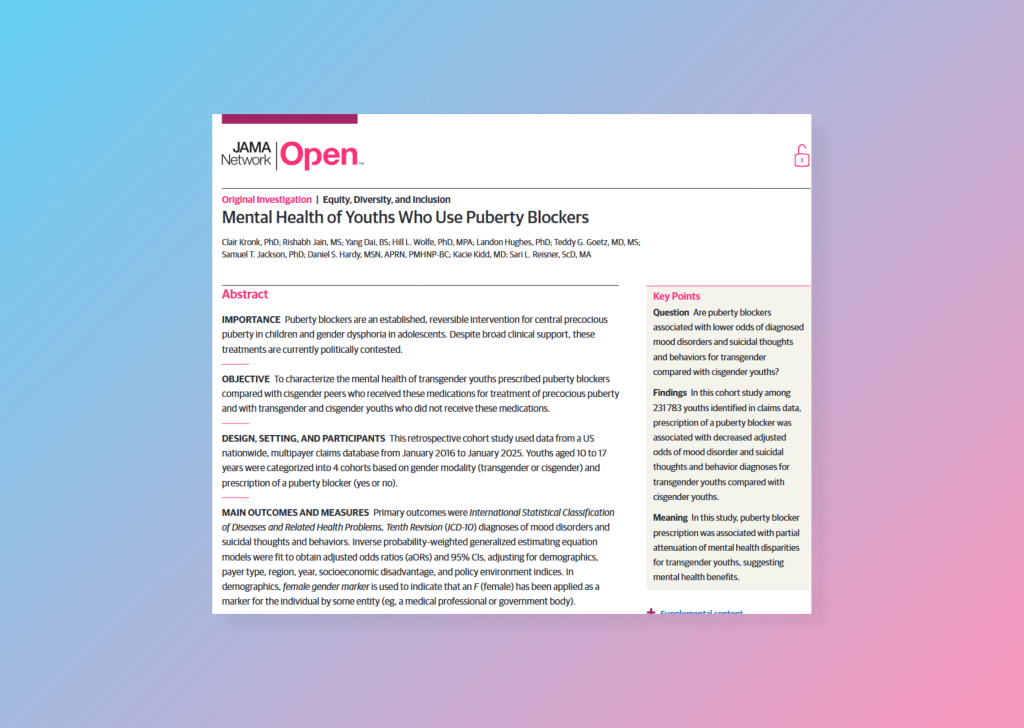
Puberty Blockers and Suicidality: New Study of 230,000 Youths
Lower Suicidality Among Transgender Youths
Read more
Without consent: the scientific misconduct scandal at Norway’s national centre for trans youth
Illegitimate research on trans minors
Read more
It Is False to Say That Medical Transitions Worsen Young People’s Mental Health
On the pseudoscientific exploitation of a study
Read more
Webinar “A Trans-Skeptical Parenthood” on July 2 at 6:30 p.m.
Trans Youth Trajectories webinar
Read more
2.2% of young people in France are trans or non-binary
Findings from a nationally representative survey
Read more