


A study published in Nature Human Behaviour shows that anti-trans laws in the United States increase the number of suicide attempts among trans youth compared with states without such legislation. The research was conducted with more than 61 000 transgender and non-binary people aged 13 to 24, and analysed the impact of state-level anti-trans laws, including restrictions on gender-affirming care or access to gender-affirming bathrooms. The results of this study are particularly significant because they could influence international debates in countries facing pressure to introduce similar restrictions, including France.
The variation in legislation between states allowed researchers to treat this disparity as a quasi-natural experiment to measure the direct impact of anti-trans laws. Nearly half of US states adopted restrictive laws against gender-affirming care over the study period from 2018 to 2022, while the other half did not adopt such laws; some even strengthened protections for trans people. This difference enabled researchers to show more directly that these laws have a harmful effect, based on evidence collected by The Trevor Project, an organisation focused on suicide prevention and support for LGBTQ+ young people under 25.
The results show a significant increase in the number of past-year suicide attempts per person, particularly among trans youth aged 13 to 17, whose rate increased by up to +72 % in states with anti-trans laws compared with the sample average. Researchers accounted for multiple factors to strengthen evidence of causality, such as differences between states, ethnoracial categories, age, and the impact of COVID-19. They also performed robustness checks to validate their results.
According to the authors, the causal mechanism through which these increases occur suggests that the enactment of such laws would strengthen the capacity of already suicidal transgender youth to attempt suicide, rather than leading to the development of strong suicidal ideation among transgender youth who were not previously suicidal. In theory, this increased capacity to carry out suicidal behavior would arise after repeated exposure to painful and fear-inducing events, such as experiences of discrimination.
The publication of this study coincides with the release of another U.S. study by the CDC (Centers for Disease Control and Prevention). This study focuses on transgender high school students and those questioning their gender identity, who face health inequities and academic challenges – notably violence and discrimination – compared with cisgender students. The study draws on the national Youth Risk Behavior Survey, which for the first time collected representative data on these students in 2023. The study shows that 3.3 % of U.S. high school students identify as transgender and 2.2 % as questioning. These students are more frequently exposed to violence, poor mental health, suicidal thoughts, self-harming behaviors, and housing instability, while feeling less connected to their school environment. Approximately 25.3 % of transgender students and 26.4 % of questioning students missed school out of fear for their safety, compared with 8.5 % of cisgender boys. In addition, about 26 % of these students attempted suicide in the past year, compared with 5 % of cisgender boys and 11 % of cisgender girls. The study highlights the importance of interventions to create safer and more inclusive school environments in order to reduce these disparities and better support the health and well-being of these marginalized youth.
More news

The Netherlands strengthens its gender-affirming care model for trans minors
The evidence supports gender-affirming care
Read more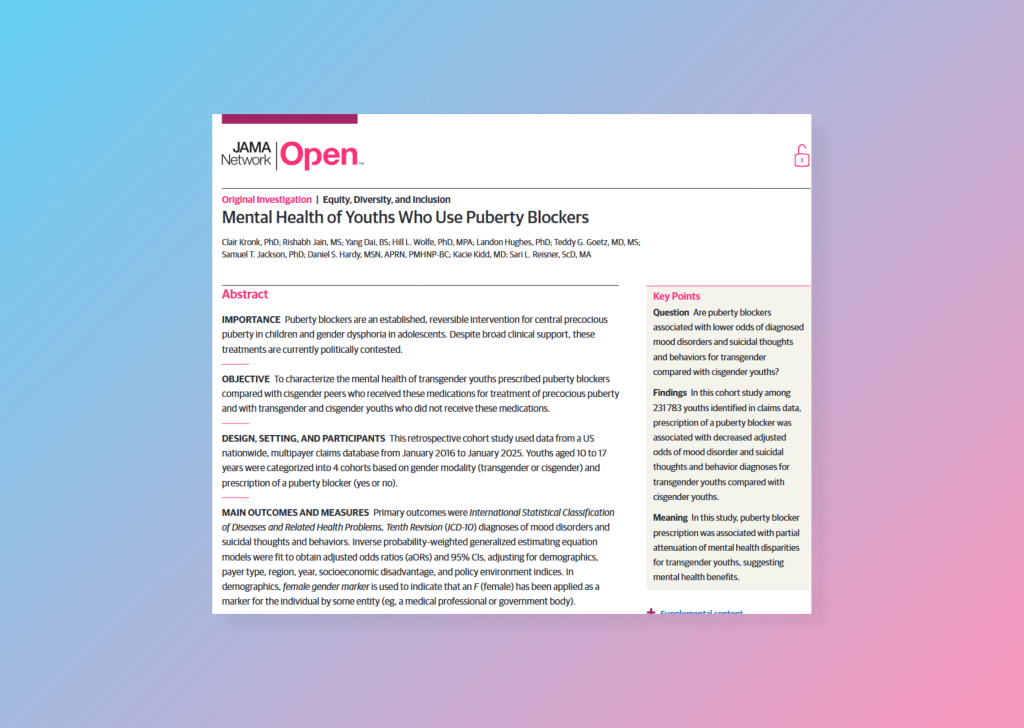
Puberty Blockers and Suicidality: New Study of 230,000 Youths
Lower Suicidality Among Transgender Youths
Read more
Without consent: the scientific misconduct scandal at Norway’s national centre for trans youth
Illegitimate research on trans minors
Read more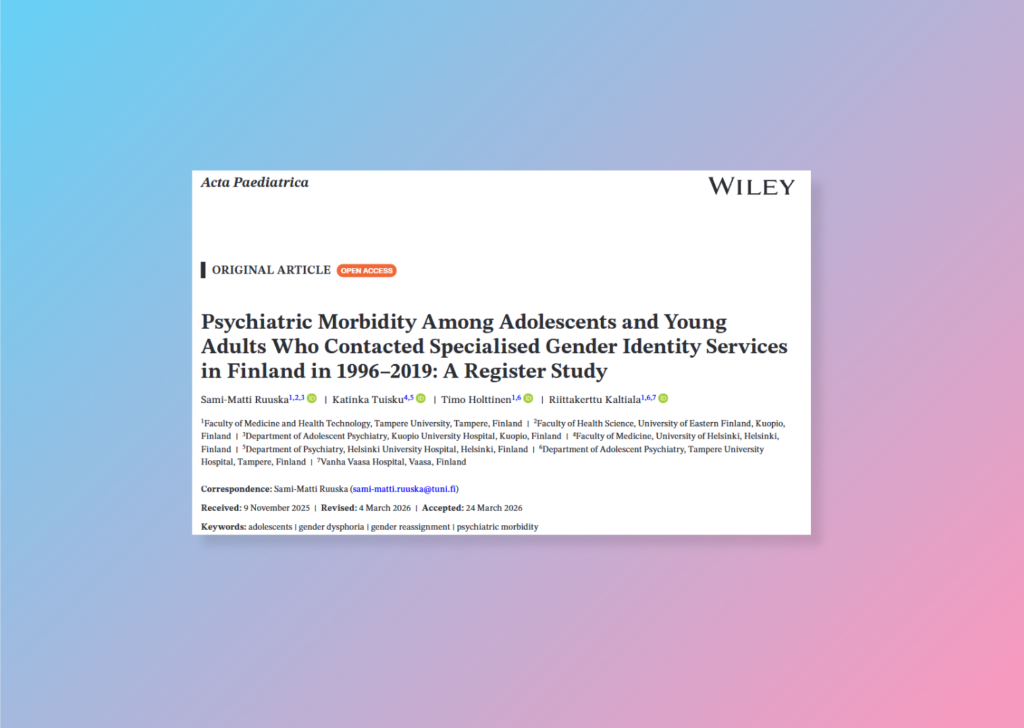
It Is False to Say That Medical Transitions Worsen Young People’s Mental Health
On the pseudoscientific exploitation of a study
Read more
Webinar “A Trans-Skeptical Parenthood” on July 2 at 6:30 p.m.
Trans Youth Trajectories webinar
Read more
2.2% of young people in France are trans or non-binary
Findings from a nationally representative survey
Read more