


In an article published by the prestigious journal The New England Journal of Medicine, Ketil Slagstad explores how the concept of “social contagion” has influenced trans-specific medicine by examining societal responses to increasing visibility and demands for recognition from trans people. In recent years, the rise in prominence of this phenomenon has led some politicians, activists, and health professionals to compare trans identity to an “epidemic”. Slagstad shows that this analogy has been constructed to restrict the rights and access to care of trans youth, particularly in recent laws limiting access to hormone treatments in the United States and the United Kingdom, reflecting an increased politicisation of trans-specific medicine.
The author emphasises that this dynamic is largely based on a rhetoric of protecting the “vulnerable child”, and denounces the tendency to describe young trans people as victims of a fad spread by social media. For example, the controversial theory of Rapid-Onset Gender Dysphoria (ROGD) by Lisa Littman claims that trans identity would be caused by social influences. Although the methods of that study have been criticised, this notion has nevertheless influenced public policy, as in France where the National Academy of Medicine issued warnings about a supposed “social contagion” of trans identity, as noted by Slagstad.
From a historical perspective, the author shows that it is not the first time medicine has associated sexual or gender minorities with social contagion. He recalls that as early as the beginning of the 20th century, psychiatric theorists pathologised minority groups, often in the name of protecting children. The controversy over homosexuality and the so-called “epidemic of inversion” in inter-war Germany illustrates how medical authorities were able to make sexuality a political and social issue, thus influencing public perception and laws.
Slagstad also addresses the question of media visibility of trans people, highlighting its importance in the construction of modern trans identity. Figures like Lili Elbe and Christine Jorgensen, through their stories in the press, not only inspired other trans people but also attracted criticism from authorities who, worried about potential “contagion”, reacted with restrictions. This demonstrates how media and public visibility can both empower minorities and elicit repressive responses.
In France, the physician Jean Vague, author of an article titled “The desire to change sex: the current epidemic form of an ancient evil” (1956), viewed progress towards gender equality and media attention as contributing to the rise of this “epidemic”, perceived as a symptom of modernity. This perspective links medical transitions with a broader social anxiety around the dissolution of traditional gender roles.
The idea of “social contagion” was exploited in the 1950s and 1960s to justify the implementation of strict medical criteria governing access to treatment for trans people. Slagstad points to doctors and psychiatrists who, through rigid eligibility criteria, excluded many hopeful candidates from medical transition, making access to care difficult. This diagnostic framework encouraged patients to conform to a restrictive definition of trans identity, reinforcing a binary view of gender and limiting the expression of non-conforming identities.
A strand of radical feminist critique that emerged in the 1970s and 1980s also played a role in shaping perceptions of trans-specific medicine. Figures like Janice Raymond argued that transition requests were a product of patriarchy and that medical transition reproduced stereotypical gender norms. Although opposed to earlier medical theories, this perspective also devalued trans experience by reducing it to a reaction to rigid social norms.
Slagstad emphasizes that the increased attention paid to transgender adolescents since the 1990s, with the introduction of puberty blockers, has intensified the politicization surrounding trans-specific medicine. However, this practice is now so deeply entangled with political debates over transgender rights that it limits opportunities for discussion about the long-term effects of these treatments and about young people’s capacity to make informed medical decisions. He therefore calls for medical practices that are attentive both to potential benefits and harms, while also respecting the subjectivity of transgender youth.
He calls for medical practices that are attentive both to potential benefits and harms and that respect the subjectivity of trans youth. He also urges recognition of past errors and avoiding restrictions on access to information about trans identities in the name of supposed “social contagion”. According to him, today’s increase in medical transition requests is largely due to better availability of information, not a phenomenon of social imitation. Repressing this information, as was done for other minorities, only increases marginalisation.
Finally, the author concludes that using the epidemic metaphor reflects an attempt by medicine to shift responsibility for transition requests onto politics, framing the issue as a social crisis rather than an individual need for care. For him, this approach avoids crucial discussions about how to support trans people personally and meet their specific medical needs in a respectful way.
To read this article, click here.
More news

The Netherlands strengthens its gender-affirming care model for trans minors
The evidence supports gender-affirming care
Read more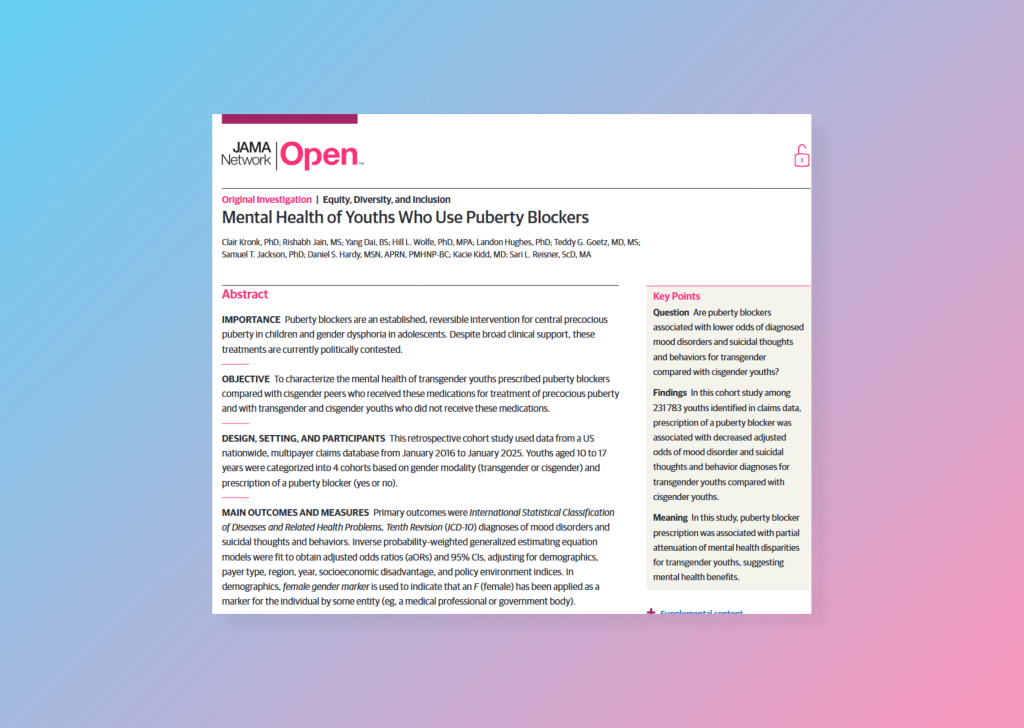
Puberty Blockers and Suicidality: New Study of 230,000 Youths
Lower Suicidality Among Transgender Youths
Read more
Without consent: the scientific misconduct scandal at Norway’s national centre for trans youth
Illegitimate research on trans minors
Read more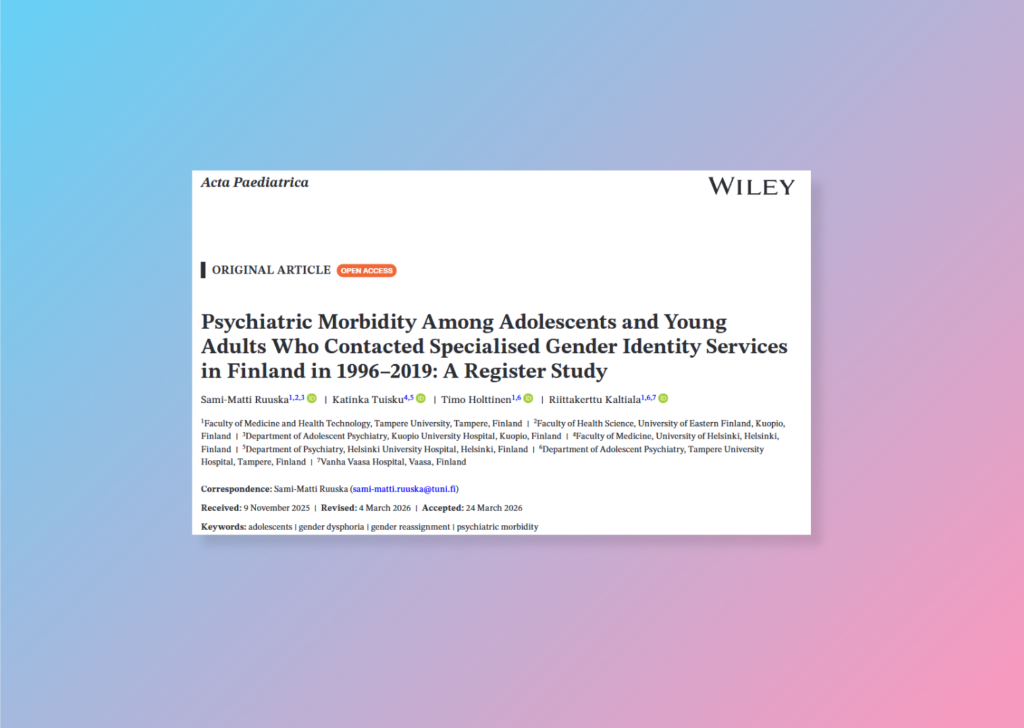
It Is False to Say That Medical Transitions Worsen Young People’s Mental Health
On the pseudoscientific exploitation of a study
Read more
Webinar “A Trans-Skeptical Parenthood” on July 2 at 6:30 p.m.
Trans Youth Trajectories webinar
Read more
2.2% of young people in France are trans or non-binary
Findings from a nationally representative survey
Read more