


A study currently in the process of publication, authored by Chris Noone and colleagues (including Florence Ashley, a member of Trans Youth Trajectories), critically evaluates the report by Hilary Cass, which aims to provide, at the request of English health services, recommendations on care for children and young people exploring their gender identity in England. The authors of the critical study identify significant methodological flaws and unfounded claims in the Cass Report and in the research commissioned to inform that report.
Systematic reviews
Among the research commissioned as part of the Cass Report, seven systematic reviews were produced and published, each based on a published systematic review protocol. The authors of the critical study used the ROBIS tool, recommended by the specialised Cochrane institute, to assess these reviews. The seven systematic reviews were evaluated with this tool by two independent evaluators, with two other evaluators called upon to achieve consensus if there was disagreement. The ROBIS instrument aims to assess risk of bias across four domains.
- The first risk of bias concerns the eligibility criteria of the studies included in the literature reviews. The evaluations reached a consensus that all seven literature reviews were at high risk of bias, due to unacceptable ambiguities in the eligibility criteria of most reviews, significant deviations from the protocol, and the fact that the eligibility criteria excluded studies relevant to the research questions addressed by the systematic reviews. Among other examples, the researchers criticize the exclusion of so-called “grey” literature (theses, government reports, etc.) in violation of the protocol, as well as the exclusion of qualitative research, again in violation of the protocol, even though the Cass Review itself makes use of qualitative data to support its conclusions.
- The second risk of bias concerns the identification and selection of studies. Here again, the evaluations converge on the conclusion that all seven literature reviews were at high risk of bias due to a high likelihood that the search strategy failed to identify all relevant studies. A single search strategy was used for all reviews, without topic-specific adaptations, which calls into question the comprehensiveness of the search. In addition, important studies on social transition were excluded despite their relevance.
- The third risk of bias relates to data collection and appraisal of the studies. Independent evaluations assigned a low risk of bias only to the review on clinical recommendations, while the six other literature reviews were rated as having a high risk of bias. For example, the Newcastle-Ottawa Scale tool was modified for three reviews in violation of the protocol, and these modifications were not transparently reported. This introduces uncertainty about the validity of quality assessment for studies, especially because the Newcastle-Ottawa Scale itself has been heavily criticised historically and the modifications were not appropriate.
- The fourth risk of bias concerns synthesis and results. The evaluations found that all seven literature reviews were at high risk of bias. In two reviews, this was due to inappropriate exclusion of studies considered to be of “low quality” according to the adapted Newcastle-Ottawa Scale: 48 % of puberty blocker studies and 36 % of sexual hormone studies were thus excluded. These exclusions were not pre-specified in the protocol, violating systematic review standards. The deviations from the pre-established protocol are major: while the protocol mandated the use of the MMAT (Mixed Methods Appraisal Tool) to assess each study included in a review, only one of these reviews actually employed it, and did so inappropriately. As explained above, three reviews used a scale other than the MMAT, but adapted it inappropriately. One review used an appropriate scale that was not stipulated in the protocol. The final two reviews did not assess the quality of the studies at all. More seriously, it is on the most controversial subjects – namely puberty blockers, cross-sex hormones, and social transition – where the protocol deviations were most severe. These deviations led to a significant exclusion of studies, justifying suspicions of cherry-picking. The syntheses themselves are sometimes questionable: relying on the quality of remaining evidence judged as “low” or “moderate” via inappropriate and non-pre-established assessment tools, the authors of the literature review on sex hormones concluded, for example, that no conclusion could be drawn regarding a relationship between hormones and mental health. However, more than fifteen of the studies evaluated by the review demonstrated a significant improvement in mental health, body satisfaction, gender dysphoria, or suicidality in connection with hormones; and none demonstrated harm. The general direction of the studies’ findings – which, while limited in quality, favor benefit and show an absence of harm – should not have resulted in syntheses implying that an “insufficiency of evidence” made it impossible to recommend gender-affirming practices.
Beyond shortcomings revealed by the ROBIS evaluation, other deviations from methodological standards were noted in establishing the literature reviews. Except for one author, the review teams were composed exclusively of people without specific subject matter expertise, contrary to established norms, and representatives of impacted communities were not consulted to share their knowledge and experience.
Primary research
In addition to the seven literature reviews, the Cass Review commissioned primary research consisting of several components, including one quantitative and one qualitative component. The quantitative component is a retrospective cohort study using electronic health records. Its authors aimed to estimate trends in the incidence and prevalence of gender dysphoria in the minor population. Although they observe an increase in these measures, they fail to demonstrate why these increases should be considered unexpected or concerning, insofar as they did not attempt to examine changes that are very likely related, such as shifts in social acceptance, diagnostic criteria, or care recommendations. An increase in the co-occurrence of gender dysphoria and autism spectrum conditions was observed, but without statistical testing to verify this observation, even though statistical tests are used elsewhere in the Cass Review, raising concerns about a lack of critical distance. This primary research led, in the Cass Review, to conclusions and recommendations that do not take into account the limitations of this quantitative component, nor those of the qualitative component. At the same time, many other quantitative and qualitative studies of much higher quality were excluded from the literature reviews conducted prior to the Cass Review, suggesting that a double standard may be at work in this report.
How the Cass Report addresses gender-affirming care
According to the authors of the critical study, the Cass Report suffers from two methodological approaches that distance it from evidence-based medical standards.
- The first, paternalistic approach of the Cass Review can be seen in its understanding of gender-affirming care as one treatment option among others, with the therapeutic goal of reducing distress related to gender dysphoria. This perspective dismisses the notion of individual competence, which is nevertheless operative even for those under 16 in England, particularly their capacity to determine which forms of care are most desirable for them. Within this paternalistic approach, the authors of the literature reviews allow themselves to treat care options that are not desired by patients as equivalent – in terms of the quality of evidence supporting them – to gender-affirming care options that are sought by patients. This approach is consistent with a view of transgender people as bearing a mental pathology requiring a cure, rather than as individuals with specific health needs aimed at self-realization. The authors of the critical study instead propose approaching gender-affirming care within the broader framework of sexual and reproductive health, which the World Health Organization defines not only as the absence of disease, but also as a state of complete physical, mental, and social well-being in relation to all aspects of sexuality and reproduction. From this perspective, forcing a transgender adolescent to undergo an unwanted puberty is not a medically neutral act, just as it is not medically neutral to force a cisgender adolescent girl to undergo an unwanted pregnancy.
- The Cass Review considers randomized controlled trials (RCTs) to be the gold standard for evaluating the effectiveness of gender-affirming care, but this approach has significant limitations in transgender medicine. RCTs, while offering strong internal validity, often have limited external validity, and their relevance is contested for specific populations such as transgender youth. Moreover, tying access to puberty blockers to participation in RCTs, as proposed by the Cass Review, is considered ethically coercive. Trials may introduce biases, including demoralization of control groups and differential dropout. The gains in internal validity from randomization diminish with the long timeframes required to assess the effectiveness of sex hormones, reducing the advantage of RCTs to that of well-conducted observational studies. In addition, evaluating gender-affirming care solely on psychosocial well-being is inappropriate, as its primary goal is physical alignment, with mental health benefits arising from living in one’s authentic gender. The Cass Review’s criticism of cohort studies also overlooks the fact that many strong health recommendations are based on low-quality evidence, and that cohort studies could better inform gender-affirming care.
Unfounded assertions
The Cass Review contains numerous unsubstantiated claims, most of which have already been documented by Grijseels (2024). Among these, one can note the assertion that an “exponential” increase in referrals over a five-year period cannot be explained by improved social acceptance – an assertion made without any form of demonstration. Another claim suggests that detransitions are increasing, without providing evidence or even citing the major studies on detransition. The Cass Review also recommends that social transition in prepubertal children should be partial rather than complete, in order to avoid a risk of altering “developmental trajectories,” even though the dedicated literature review did not identify such a risk and the qualitative study reported by Cass, on the contrary, highlighted the benefits of social transition for children who express a desire for it. Finally, the Cass Review completely reversed the meaning of a statement made by one of the participants in the qualitative study, who had argued in favor of greater availability of gender-affirming care options, which may point to a confirmation bias affecting the entire author team.
Socio-political aspects
The study’s authors also criticise the lack of attention given to the socio-political context surrounding the Cass Report’s production, marked by rising anti-trans sentiments in the UK and various countries in Europe. They argue it is necessary to consider how these socio-political trends may influence health interventions aimed at trans people and the evaluation of evidence, expertise, and best practices.
Evidence-based medicine adapted to gender-affirming care
Finally, the authors argue in favor of evidence-based medicine grounded in its three core pillars: the best available evidence, clinical expertise, and the values and preferences of service users. They maintain that the Cass Review did not take all the evidence on gender-affirming care into account and instead chose to rely on generic standards rather than on the best evidence that can be obtained under the methodological, practical, and ethical constraints inherent to gender-affirming care for transgender youth. In their view, the best evidence is produced when participant engagement and trust are maximized through community involvement and clear communication. Participants should form a diverse sample followed longitudinally in rigorous observational studies, with outcome measures that are relevant to transgender youth and their support networks, including the clinical expertise of providers using culturally appropriate and valid measures.
To read the full study, click here.
More news

The Netherlands strengthens its gender-affirming care model for trans minors
The evidence supports gender-affirming care
Read more
Puberty Blockers and Suicidality: New Study of 230,000 Youths
Lower Suicidality Among Transgender Youths
Read more
Without consent: the scientific misconduct scandal at Norway’s national centre for trans youth
Illegitimate research on trans minors
Read more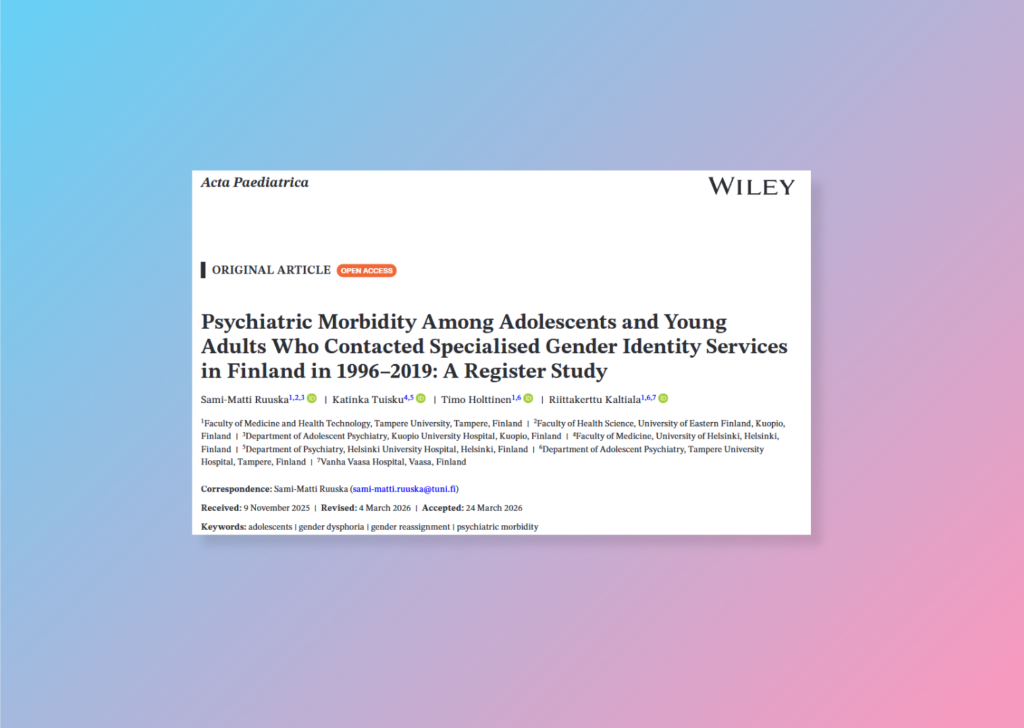
It Is False to Say That Medical Transitions Worsen Young People’s Mental Health
On the pseudoscientific exploitation of a study
Read more
Webinar “A Trans-Skeptical Parenthood” on July 2 at 6:30 p.m.
Trans Youth Trajectories webinar
Read more
2.2% of young people in France are trans or non-binary
Findings from a nationally representative survey
Read more