


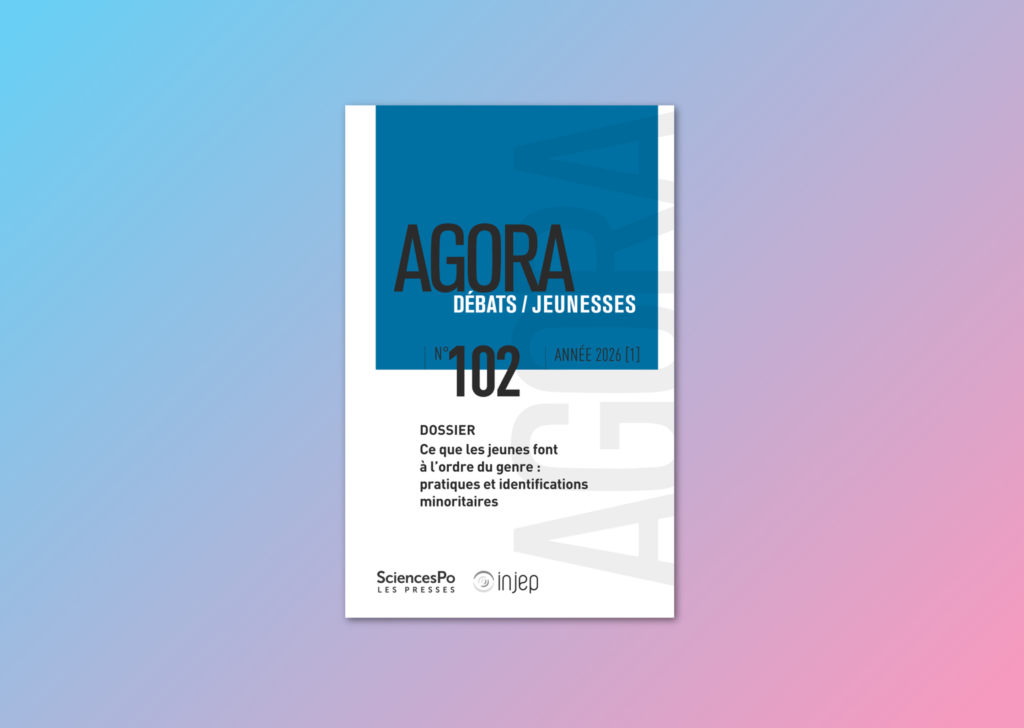
The journal Agora débats/jeunesses devotes its 102nd issue, published in 2026, to sexual and gender minorities among young people. The journal is published by Presses de Sciences Po, at the initiative of INJEP, a national service under the French ministry responsible for youth. Edited by Tania Lejbowicz, Nicolas Sallée and Aurélia Mardon, this thematic issue examines how young people experience, negotiate and transform the gender order through their identifications, sexualities, transition pathways, intimate relationships and social networks. The articles draw on a range of materials – the 2023 ENVIE statistical survey, interviews, ethnography and a case study – to document the experiences of young LGBT+ people. The issue does not describe a simple “liberation” from gender norms, but rather situated transformations shaped by age, social class, race, family, school, medicine and community spaces.
Loïs’s experience, from psychiatric transphobia and transnormativity in 2013 to self-affirmation today
In “A boy (almost) like any other”, Nicolas Sallée and Zéo Richez offer an in-depth study of the trajectory of Loïs, a trans boy described as white, from a privileged social background, who received medical support from the beginning of adolescence, at the age of 10. The article forms part of a broader study on social reactions to gender non-conformity among children in France and Quebec, but focuses here on a singular case, particularly revealing of recent transformations in the care of trans minors. Loïs is presented as the first minor to have received, in 2013, medical support for gender transition in a pioneering French child psychiatry department. At the age of 10, he was prescribed puberty blockers, entered secondary school with a masculine first name and masculine pronouns, changed the sex marker on his civil-status documents at 16, and then began masculinising hormone treatment at 17. His prescription for puberty blockers – following hospitalisation for suicidal tendencies linked to puberty – was deemed “necessary” by the child psychiatrist at the time, Colette Chiland, whose clinical approach has been described in another study by Nicolas Sallée and Leda Raia.
This trajectory illustrates the gradual opening up, since the early 2010s, of possibilities that had previously been highly limited for trans minors. But the article shows that this opening did not mean the disappearance of norms. On the contrary, it took place within a tightly regulated institutional framework, in which families, schools, healthcare professionals and peers all helped define what appeared to be a “legitimate” transition. In Loïs’s case, parental support and access to significant social, educational and medical resources made early recognition of his gender possible. But this recognition was also built around precise expectations: stability of masculine identification, conformity to boys’ codes, distance from any gender ambiguity, and projection towards a trajectory legible to adults.
The authors use the concept of transnormativity to analyse this process. Transnormativity refers to the norms that make some trans lives more acceptable than others when they come closer to dominant cisgender, binary and heterosexual models. Loïs thus learns to become a boy “almost like any other”: he observes masculine behaviours, invests in signs of virility, seeks to avoid anything that might be perceived as feminine, and for a time keeps his distance from LGBT spaces. The article shows that access to medical transition is therefore not only a matter of care or recognition, but also of the ability to produce a coherent, stable account of oneself that conforms to institutional expectations.
However transnormative this clinical approach may have been, it was part of a broader psychiatric context of transphobic pathologisation and sexualisation – forms that still largely persist today – as Loïs had experienced during a previous hospitalisation at the age of 9. He recalls meeting “very problematic psychiatrists”, who spontaneously referred him back to his supposed homosexuality, his mother’s unconscious desires or his father’s absence: “[Psychiatrists] asked me to get completely naked, asked me if I was homosexual… Young psychiatrists too […]. [For them], it was homosexuality, psychological disorders, or some kind of… cheap psychoanalysis.”
The interest of Sallée and Richez’s article also lies in the fact that it does not freeze Loïs in this initial trajectory. As he enters adulthood and becomes less dependent on his parents – whom he perceives as “very homophobic” – and on doctors, Loïs renegotiates his relationship to gender. He allows himself a less rigid, “softer” masculinity, distances himself from certain injunctions around passing, questions some medical or surgical procedures, and is able to make speakable a sexual orientation that is less strictly heterosexual. The article thus shows that transition pathways are not straight lines: they are made up of successive adjustments, institutional constraints, but also renewed forms of self-determination. For the authors, Loïs’s case helps us understand how young trans people come to terms with the gender order – not by escaping it all at once, but by moving through it, sometimes using it, and then renegotiating it.
t4t among young transmasculine people
In “Transmasculine uses of t4t”, Clair Monod examines a term that has so far received little attention in French-language research: t4t, short for trans for trans. The expression emerged in the 2000s in digital spaces in the United States, before spreading through social media, memes, hashtags and dating apps. It refers to romantic or sexual relationships between trans people. Based on interviews conducted as part of Monod’s doctoral research with transmasculine people aged 20 to 30, mostly described as white and endowed with educational, cultural and activist capital, the article analyses t4t as a relational practice, a language of intimacy and a way of locating oneself within the space of gender.
t4t is first described as a form of refuge. For the people interviewed, relationships with other trans people can offer a space of shared understanding, particularly in the face of the violence, awkwardness or normative expectations encountered in relationships with cis partners. t4t can therefore reduce the feeling of having to explain one’s body, one’s trajectory or one’s relationship to gender, and can foster intimacy experienced as more comfortable, safer or more equal. In this sense, it is not merely a romantic or sexual preference: the label may also carry a political dimension, valuing relationships built at a distance from dominant cisgender norms.
But the article also shows that this trans intimacy is not automatically egalitarian. Clair Monod compares discourses that value t4t with the actual relational practices of the people interviewed. She thus highlights that, in her fieldwork, relationships described as t4t often involve transmasculine people described as white and socially privileged. Transfeminine people may be less desired or less recognised as possible partners, while trans men the author analyses as racialised may be assigned specific representations of masculinity. The article therefore shows that t4t is an ambivalent resource: it can offer protection, recognition and the politicisation of intimacy, while also reproducing certain hierarchies of gender, class and “racialisation” within trans social networks themselves.
2.2% of young people in France are trans or non-binary
In “Ways of disinhabiting gender”, Mathieu Trachman draws on the 2023 ENVIE survey to better understand young non-binary people in France. The article makes an important contribution to statistical knowledge of gender minorities, which remain poorly documented in major French surveys. ENVIE was conducted among 10,021 young people aged 18 to 29 living in mainland France, and includes several questions allowing cisgender, trans and non-binary people to be identified. Dans cet échantillon représentatif de la population générale, les minorités de genre représentent 2,2 % des jeunes adultes : 0,5 % de personnes trans et 1,7 % de personnes non binaires. One of the key findings is therefore the significant weight of non-binary identifications among young people belonging to gender minorities.
The article shows, however, that non-binarity cannot be understood as a simple additional category mechanically added to “man” and “woman”. Trachman instead analyses non-binarity as a way of distancing oneself from the social obligation to define oneself within a binary gender. The non-binary people surveyed do not all locate themselves in the same place: some identify as agender, genderfluid, non-binary, queer or androgynous; others combine several ways of naming themselves. Non-binarity thus appears less as a homogeneous identity than as a set of ways of contesting, modulating or displacing expectations associated with masculinity and femininity.
To account for this diversity, the author distinguishes several ways of “disinhabiting gender”. Some non-binary people invest in elements associated with both masculinity and femininity; others seek a form of neutrality; others describe a fluid relationship to gender, liable to vary according to moments, contexts or relationships. This approach avoids two frequent misunderstandings: reducing non-binarity to indecision, or conversely imagining it as a total and definitive exit from gender. The article shows instead that young non-binary people move within a social space still structured by gender, while refusing to inhabit its categories in a stable, exclusive or compulsory way.
Trachman also nuances certain social representations of non-binarity. The survey does not allow it to be reduced to a marginal phenomenon confined to a highly privileged or exclusively activist youth. On the contrary, young non-binary people appear in varied social positions, with educational, professional or social situations that are sometimes more unstable than those of cisgender young people. The article also underlines that non-binary people are mostly people assigned female at birth, which invites us to think about non-binarity in connection with the specific constraints that weigh on feminine socialisation. Ultimately, the article shows that non-binarity is not really just a new generational label: it also reflects the contemporary transformations in the sex and gender system.
Taken together, these three articles show that trans and non-binary pathways cannot be understood either as simple individual expressions of identity or as complete ruptures with the social order. They are built within specific environments, with unequally distributed resources: family support, access to care, activist capital, social position, racial belonging, and exposure to violence. The articles by Fantoni-Decayeux and Ravier extend this observation to sexual minorities: the former shows that the “first times” of sexual minorities are more diverse in their timings and definitions than is assumed by the cisheterosexual model of first penetrative intercourse; the latter analyses the adjustments through which gay men from unfavoured neighbourhoods come to terms with local norms of masculinity and the norms of gay spaces.
This issue of Agora débats/jeunesses therefore offers valuable tools for thinking about trans, non-binary and LGBT+ experiences without homogenising them. It reminds us that minoritised young people do not live “outside” the gender order: they inhabit it, negotiate it, work around it, displace it, sometimes reproduce it and sometimes crack it open. For professionals, families, associations and institutions working with trans and non-binary young people, this reading invites an essential vigilance: recognising identifications is not enough. We must also understand the social, relational and institutional conditions under which they become liveable.
Note: TYT’s scientific news articles are now written and translated with the assistance of AI. Their content nevertheless relies on a systematic and complete human reading of the studies presented, ensuring the accuracy of the information and enabling the TYT team to freely contextualise, editorialise and put current research into perspective.
More news

The Netherlands strengthens its gender-affirming care model for trans minors
The evidence supports gender-affirming care
Read more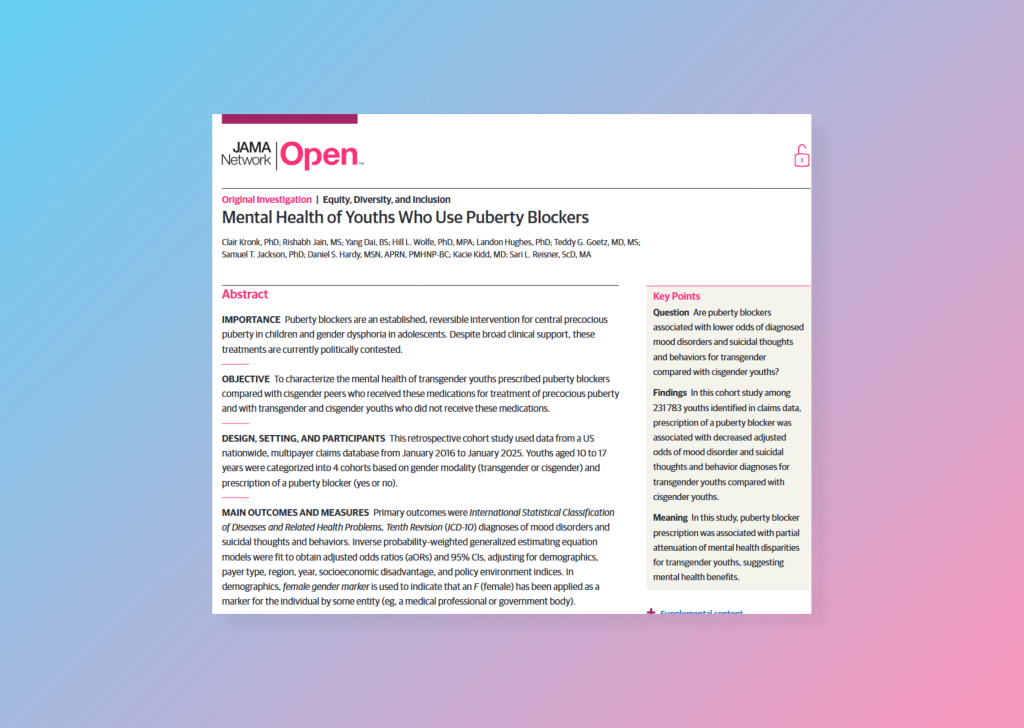
Puberty Blockers and Suicidality: New Study of 230,000 Youths
Lower Suicidality Among Transgender Youths
Read more
Without consent: the scientific misconduct scandal at Norway’s national centre for trans youth
Illegitimate research on trans minors
Read more
It Is False to Say That Medical Transitions Worsen Young People’s Mental Health
On the pseudoscientific exploitation of a study
Read more
Webinar “A Trans-Skeptical Parenthood” on July 2 at 6:30 p.m.
Trans Youth Trajectories webinar
Read more2.2% of young people in France are trans or non-binary
Findings from a nationally representative survey
Read more